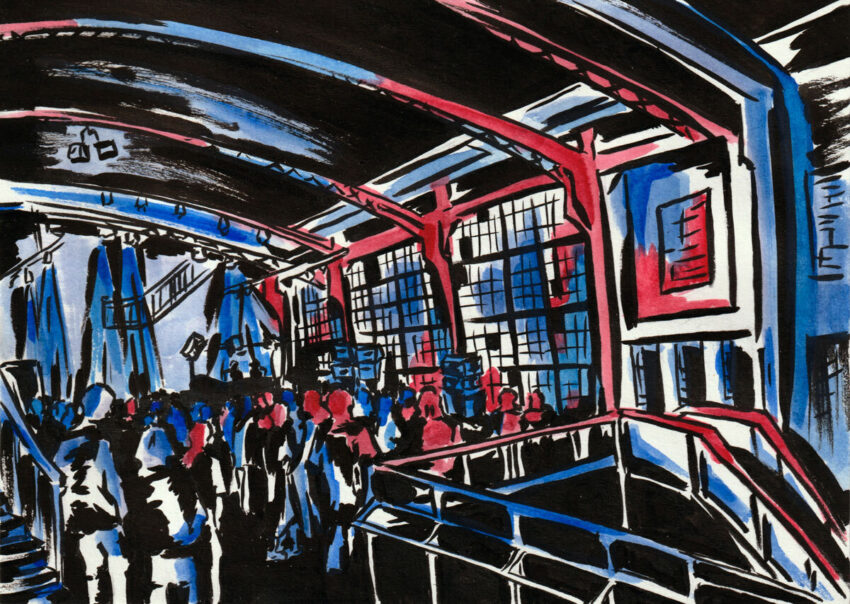
Whitney Wei, Berghain (August 2018). Courtesy the artist
The party is dead, I said to a friend during a midnight walk in Paris last summer. Part of what I meant was obvious: our nights of hard drugs and loud techno and cheap drinks and no smartphones will never return. Walking past the shuttered storefronts and café tables glinting with candles and wineglasses, we reminisced about the underground clubs we’d attended: she in Ramallah, I in Berlin. We spoke about obscure basement rooms, and the wet earth under our feet at summer raves, and the chalky aftertaste of Ecstasy pills. We remembered needles scratching red vinyl records, and the DJs who climbed the apartheid wall, and the friends who died or drowned inside the illusion of the night.
We acted as if we had nothing to do with those peculiar, difficult years anymore. We were writers now, novelists who’d sublimated our nightlives into narrative. But I wondered if people like us, who’d resided in that parallel world for so long, would always be slightly askew, porous to the music of the other realm.
Another friend of mine recently asked me about the difference between “day knowledge” and “night knowledge,” an epistemological binary that captures the stark divide between here and there. At a party, knowledge matters less; it’s a space governed by impulses, not thoughts. And yet the club can also be a site of discovery, where you step onto the electric wires of epiphany. At twenty-two, I was a college dropout in a silver bikini and black mesh overalls, dancing in a starlit meadow on the outskirts of Berlin. Surrounded by thousands of strangers, overwhelmed by the relentless bass of Rødhåd’s DJ set, I could feel my notions coming undone in agitation. I can’t remember what those notions were, or what replaced them. That isn’t the point. The knowledge was the feeling of my mind: altered, wounded, almost unbearably alive.
I haven’t been to a rave, or a real party, in over a decade. But for years after I stopped partying, I constantly daydreamed about these spaces. On the train, in the shower, or during that hot, windless night on the Left Bank. I wanted to restore the world of harsh techno and industrial clubs in Germany. I wanted that strange, ferocious knowledge from the meadow back.
I am hardly the first to map the loss of a party era; a recent smattering of books about nightlife—Liam Cagney’s Berghain Nights, Mark Ronson’s Night People, DJ Disciple’s The Beat, the Scene, the Sound—traces underground rave culture from the 1980s to the early 2010s. I’ve read them voraciously, almost masochistically, in search of a shared past. I’ve always turned to literature in this way: hunting for knowledge, and for the security knowledge brings. Yet even at their most transgressive, books ultimately belong to the realm of day knowledge—bright, abstract, cerebral. Whatever I’ve been looking for in these books cannot really be accessed through ink and paper. It’s the kind of instruction I’ve only ever experienced through physical presence. What is it, really, that the night taught me, and why am I aching for those sultry, unruly, endless hours at the club now?
i say “the club” even though there wasn’t a singular one—there were many, and sometimes it was just a living room with carpeted floors and a Technica on an Ikea shelf, the window open to the rain.
When I first started going to techno parties (I despise the word rave, though I suppose that’s what they were), I was still a high school student in Münster, mostly listening to indie bands such as Beirut and Bright Eyes at home. We lived in an apartment surrounded by new developments and cornfields, in a part of town predominantly designated for low-income families and immigrants. My parents were refugees who’d left Afghanistan around the fall of the USSR. In Kabul, they had been doctors with heroic war stories; in Germany, they needed me to translate basic documents. Our Ukrainian and Syrian neighbors often stopped by to share Tupperware full of oily dishes, or to ask for eggs or childcare. Our door was always open, there was always food in the fridge, and there were many books on our shelves, from Umberto Eco to Hafez, from Lenin to Attar of Nishapur. My parents were Marxists but also traditionalists—atheists who taught me the Quran. They sent me to a Catholic private school an hour-long bus ride away.
Did the sound enact the strangeness of exile?
I loved the rigor of school, and the gaudy rituals of prayer nourished my secret yearning for a higher power. Like many precocious immigrant children, I was a good student. But this was the mid-2000s, not an easy time to be an Afghan or a Muslim anywhere, and the stark socioeconomic disparity dividing me from my rich, blond, and mostly unkind classmates left me feeling freakish and ashamed. The few friends I made at school were also outcasts. On my pink bedroom wall, I’d pinned a picture of Camus, and in my tote bag I carried frosty lip gloss and a grease-stained copy of On the Road. I skipped meals and published angsty poems on Blogspot, dreaming of Edie Sedgwick, leopard coats, and dancing in Andy Warhol’s Factory.
My parents prohibited parties of any kind (only concerts, which counted as cultural edification, were allowed), but by the time I turned seventeen, they were no longer around enough to enforce the rules. My mother, working as a nurse while studying to redo her medical license, spent long hours at the library and came home late at night or early in the morning. My father worked for an NGO that, even if it didn’t pay him well, satisfied his urge to travel. My sister and I lived in our own little world of microwaved dinners, late-night Arte documentaries, and broken curfews.
Boredom and curiosity eventually led me and my friends from concert venues and alternative bars cluttered with vintage decor to the techno and punk scene in the abandoned industrial area by the harbor, where artists’ studios and clubs with names like Favela, Fusion, and Sputnik had been proliferating along the canal since the late 1980s. By the time I arrived there, wild-eyed and baby-faced, my hometown was known as a regional nightlife destination.
At first, techno’s austere monotony and lack of vocals put me off. How unpleasant those strobing lights were, the drum looping ad nauseam. It took a few tries and an Ecstasy pill to comprehend the appeal of a bass-heavy, 126-beats-per-minute sound, to understand it as art. But then it clicked: here was the source material of Aphex Twin and Björk, the origins of Daft Punk. Maybe it was 3:00 a.m. on the sticky Favela dance floor, my friend Isabel grinning at me, her pupils as big as coins. Or maybe it was sunrise at Sputnik, cavernous and dim, surrounded by denim and leather and sweat, a world away from Catholic school. I grew enchanted by the robotic soundscapes, those rainy cymbals and extraterrestrial synths, especially whenever, after a long period of minimal, architectural percussion, the DJ introduced an unexpected ballad or a house sample. Lyrics in a foreign language, string instruments, traces of a human voice—they were shards of light glimmering in the alien dark.
Techno is surprisingly subtle and rewards studious attention; its brilliance lies in the slow, almost imperceptible shifts and sequences during a DJ set that, if done correctly, unfold like a sly narrative. The sound reminded me of the mathematical precision and sweep of Rachmaninoff, and the pulsing drumbeat of the Attan, the tribal dance I saw performed at Afghan weddings. The sonic landscape alchemized an aesthetic absence—empty factories, ruined cities, tonal desolation—into a futuristic vision: recycled machines, new ideas, utopian planets. Did the sound enact the strangeness of exile? It’d be a lie to claim that I was thinking about this question on the dance floor. For the first time in my life, I wasn’t thinking at all; I wasn’t performing the role of the good daughter or good student. It was enough to be a body in a room, hypnotized by the energy of the crowd.
I was drawn to the people as much as the music. Everyone, it seemed, was welcome. The young and old, the straight and queer. DJs, artists, skaters, activists, social workers, and Dauerstudenten (“eternal students” who remain enrolled as undergraduates for countless semesters because university in Germany is basically free). I suppose one could say that all of us were students, seeking something: a third place, an outlet for creativity or hedonism, an ersatz family.
Support Our Commitment to Print
Subscribe to The Yale Review. Receive four print issues a year—essays, fiction, poetry, and criticism.
Seekers can have a dark edge. As Mark Ronson, the renowned producer, puts it in Night People, a memoir about his early years as a DJ in New York, many people come to the club “chasing—or trying to outrun” something. Yet whether they’re looking for it or not, they find “a sense of community,” a maudlin term that nevertheless captures something true about my experience; once you arrive, the impulse toward flight draws people together instead of forcing them apart. Ronson describes “moments of grace that, like the music itself, helped me stay connected to something higher.”
What was the higher thing I yearned for? It was art, yes, but more than that, it was the sense of belonging I’d searched for everywhere and come close to finding only in books. The club was a place to flee the rigidity of school, and it also offered its own countercultural education. The people—with their dedication to hedonism, subversion, and niche art, with their genuine curiosity about the world—taught me for the first time what I would later practice as an artist: a way of thinking with other people, not alone, hunched over a book in my teenage bed, or in the clinical, fluorescent classroom.
One Wednesday night, I ended up at an after-hours session in a high-ceilinged apartment overlooking the train station. Attempting to prolong the party, we hung around a smoke-filled room with a bunk bed, a plate of ketamine, and a small television. I leaned against the wall, talking to a middle-aged divorcée about Allen Ginsberg. She had a bedazzled tooth and quoted a line about Rockland. When I finally left at 8:00 a.m.—school was about to start—I sat at the bus stop, still coming down from MDMA, and stared at the shimmering bicycles of people on their way to work. The whole world, the maple trees and rainy sidewalks and faces of strangers, seemed to be lit from within.
My memories of those years are fragmentary, misted with sleeplessness and drink, but I still remember being in physics class that afternoon, where even the oscilloscope, analog and perplexing and flickering with secret signals, looked like it wanted to teach me about the night.
the term techno became popular in the mid-1980s to define loopy, timbre-rich electronic dance music that adheres to a four-four rhythm and features up to 150 beats per minute. But, especially in its early years, techno wasn’t just a music genre; it was a philosophy. Invented by African American musicians in Detroit who wanted to render themselves inscrutable to Black audiences and white critics alike, techno burns with a resistance to checkpoints, borders, and cultural norms. Amid white flight and the demise of the auto industry in the late 1970s and early 1980s, producers and DJs in the Midwest—specifically Juan Atkins, Derrick May, and Kevin Saunderson, known as the Belleville Three— defamiliarized and deconstructed their musical ancestors in soul and funk. Inspired by the bounciness of disco and house music and the clean, precise, ironic beats of German and Japanese synth-pop bands such as Kraftwerk and Yellow Magic Orchestra, they created a revolutionary sound; like jazz, it incited both aesthetic and ideological innovation. As Liam Cagney traces in his memoir, Berghain Nights, the Detroit school drew on the radical thought of Afrofuturists and artists like Sun Ra. Early practitioners such as Jeff Mills, who started the music collective Underground Resistance in Detroit, sought “to harness techno’s power of anonymity” to shock people out of the “false reality” of the normative mainstream, freeing them to accept their true desires and live authentically.
I want to believe that the peculiar elemental sound it produces is both an elegy for and a continuation of other drumbeats.
Techno spread globally throughout the 1980s and 1990s. After the fall of the Berlin Wall in 1989, producers spliced the playful American sound into something more industrial and minimal; techno became faster and more sterile in Germany and loopier and more psychedelic in the U.K., providing the anarchic pulse of underground rave culture. Countless subgenres of techno have emerged—hardcore, minimal, Gabber, trance, tech house—but they all center the live experience: extended DJ sets meant to be played on the right sound system and in the right setting. There’s an elusive, spiraling quality to techno sets, and the techno dance floor tends to be a less chatty, more introspective space than at other raves.
Both Ronson and Cagney compare techno, with its formal minimalism, to abstract art. But to me, the real revelation was immersion: on the dance floor, the sound became communal. The presence of other breathing bodies evoked a ritual, and the stripped-down melodies reminded me of stone caves and ancient rhythms. After all, humans have been playing percussion for tens of thousands of years: they banged sticks and rocks and mammoth bones; later, they beat hollowed logs covered with alligator skin. Imagine the hands that struck these instruments, and the humans who listened to their rhythms. Volcanoes have erupted and died, ice sheets have melted to reveal swaths of North America, but the fundamental technology of the drum has not changed.
Even now, when I hear a TR-808 drum machine, I want to believe that the peculiar elemental sound it produces is both an elegy for and a continuation of other drumbeats. Our mothers’ primal heartbeats, heard in the womb, and also the drums of our ancestors, who used them to guide war parades and shamanic ceremonies; the talking drums that transmitted revolutionary messages and led to an uprising among slaves in South Carolina in 1739; the drums of New Orleans, where the grief of the oppressed created jazz; and the drum beating defiantly inside someone’s head in Afghanistan, where music is prohibited under Taliban rule.
after high school, my life oscillated between day and night knowledge. I took a gap year to party (miniskirts, older friends, lots of LSD), then went off to study English literature in London for two terms (sober, celibate, reading Virginia Woolf in bed), then moved to Berlin for another year of nightlife. I was running from something—my grandfather had passed away, my father was sick—but the grief, I thought, was folded up neatly inside me. I was probably running toward something too: the Arab Spring and Occupy Wall Street were underway, and there was a strange promise in the air that made me restless, ravenous.
Some of my friends in Berlin worked at Berghain, the legendary nightclub, and it became the nucleus around which I organized my life. We spent almost every weekend there. In one sense, the club furnished us with an alternate reality: it operated on a dream logic that liberated us from the rules of ordinary life. We met Saturday evenings to pregame and often didn’t return home until the following night, or sometimes Monday morning. Berghain was a haven for gay men, with dark rooms for sex with strangers, but the club also attracted gorgeous, sharp-minded women, wizened ravers, and sober music nerds. There was an ice cream bar, an infamous bouncer with face tattoos, and not a single mirror (no photography was allowed; nowadays, phone cameras get taped up at the door). When my friends and I went out, we barely had cell reception, our phones sometimes died, and we didn’t carry chargers. It was entirely normal not to have email on your phone. Work was just a means to an end. The goal was to stay awake, hang out, and listen to music for as long as possible. Time was mossy and thick and green, and I drowned inside of it.
At its best, the rave tells us something about subversion, subculture—the subaltern, even.
But we didn’t have the luxury of true escapism. We weren’t professionals or yuppies or academics; we weren’t characters out of Georges Perec’s Things or Vincenzo Latronico’s Perfection. We were of the “lower classes,” downwardly mobile dreamers who wanted to be musicians or artists one day. Some of us had been hit hard by the Great Recession in other countries; some were fleeing dysfunctional rural homes in Germany. From Tuesdays to Fridays, I sorted neon clothes on an American Apparel shop floor. Dov Charney was still the head of his horny clothing company, and Obama disappointed me.
We were politicized by default—because of family, ethnicity, religion, or class. And though the club didn’t radicalize me, it introduced me to the people who did. A medical student who let refugees sleep on her couch. A forty-five-year-old IT programmer who was also a drug dealer who was also a communist. Some of them I met on the dance floor, then never saw again. Others became embedded in my life. I spent weekday evenings at my friends’ communes and housing projects, where, between drag shows and sour labneh desserts, I learned about Kurdish liberation, the occupation of the West Bank, and prison abolition. These years were built on friendship, a community where the night’s inky essence seeped into the daylight hours and grew more complex; it was learning and unlearning alike.
There was an infantile quality to our idealism, the insistence with which we dreamed of a better world. It didn’t arrive. But there was a sense—a hope—that what we were discovering at the club was a truth we should hold on to. Or maybe it was just the discovering itself that mattered. At its best, the rave tells us something about subversion, subculture—the subaltern, even. The oceanic feeling of the night, which teems with secrets, repressed memories, and illicit desires, can teach us to resist inherited beliefs and norms.
The ritualistic way I dedicated myself to nightlife prepared me for something bigger than myself—my writing and, by extension, my politics. Night knowledge is, after all, also a reminder of the power of crowds. The best parties, with their disorganized, unbridled energy, felt almost Brechtian in their intensity. One morning in late April, I emerged drenched in sweat, ready to riot. Twenty-four hours later, I joined the tumultuous, violent May Day protests in the streets.
the reasons i stopped partying are too various and delicate to go into here. Suffice it to say, my habits had grown compulsive, eccentric. I was living on cigarettes and blueberries, and my mind felt as gridded and translucent as graph paper. But when I try to locate the end, I don’t think of that neural unraveling. I think instead of a summer Sunday afternoon that I spent with Isabel, one of my oldest friends, at Kater Holzig, an outdoor club on the Spree. It felt like the inverse of dark, hermetic Berghain: there was brighter, housier music, a view of the river. In my memory, the air that day was hazy and silver as the sun set over the water. I was high on Ecstasy and a little afraid, and amid the trees on the opposite shore, I could see an art installation by Robert Montgomery—a poem in white-and-pink lights about fire and childhood and safety.
That same afternoon, Isabel decided to read my palm. When she traced the lines on my hand, she pronounced that I wasn’t living my fate. It was a joke, but her words stung. I knew she was right: I needed to go back to college, to complete my degree, to write. I needed to live during the daylight hours again. When that venue closed a year later, I took it as a sign: the party—mine—really was dead.
Watching again now, I am intoxicated by the sheer idea of it: techno in Palestine.
I know that raving is still alive and well in pockets of Berlin, Beirut, and Brooklyn. Books such as Emily Witt’s Health and Safety and McKenzie Wark’s Raving celebrate the liveliness of Bushwick’s postpandemic rave scene, while Charli XCX and FKA twigs dedicate entire albums to the club scene, and Gen Z resuscitates the 2010s aesthetic of the party photographer Mark “the Cobrasnake” Hunter. But the West, as Cagney puts it, has made an “experience economy” out of a countercultural underground movement. Burning Man, Elon Musk on ketamine, and Brat Summer are not techno. These days, even Berghain seems to be dominated by “straight men with white pearl necklaces and straight women in sunglasses staring at their phones,” as Cagney captures it. I’ve seen the same at parties in the Bay or upstate, surrounded by tech guys in glitter who speak about AI and shamanic healing in the same breath. The rave increasingly seems like a space for Aristotelian catharsis, a space to briefly satisfy a desire for community and release before returning to normal life on Monday mornings, cleansed of the revolutionary impulse, utterly unchanged.
Historically, underground party culture has channeled real political rage. Beatnik raving began in the 1950s in response to authoritarian regimes and traditional values, and techno clubs boomed in the aftermath of the Reagan administration. The late 2000s and early 2010s, my party-girl era, responded to the desolation of the financial crisis, the war on terror, and the climate emergency. The facts seem even more unbearable and inescapable now: there is no room on earth, no hour of the day, in which my nervous system is not aware of the pandemic, the fall of Kabul, the second Trump administration, and the genocide in Gaza.
One afternoon last summer, not long before my friend and I walked through Paris, I sat by the AC in a rented room in the South of France and watched, for the hundredth time, the famous Boiler Room set by DJ Sama’ Abdulhadi, filmed in Ramallah in 2018. Over an aerial shot of the city, an off-screen voice introduces her as “one of the pillars of the thriving techno scene of Palestine.” The camera cuts to waifish, dark-haired Sama’ chatting and turning knobs on a mixer, the crowd—exhilaratingly familiar to me—swaying around her. One young man wears nothing but a leather harness, impishly flirting with the camera.
Watching again now, I am intoxicated by the sheer idea of it: techno in Palestine. And then there’s the fact—upsetting, almost perverse—that I am looking at the people on my screen from a point in the future of which they are not yet aware. I know what has happened and is still happening just eighty kilometers or so west of them in Gaza, the catastrophe that changed me and almost everyone I know.
I rewind the video. I don’t want time to move forward. I want it to stand still.
i’m tempted to say it’s naïveté I’m mourning. The naïveté of believing that a transcendental experience on a Saturday night could be revolutionary, that the Afrofuturist dream would come true, that the machines would set us free. But it’s easy to say we’ve lost innocence, that thing we can’t ever recover. It’s harder to see the knowledge that has slipped away and might still be reached for: the embodied awareness of unity, the certainty that the music will rise and fall and come to its proper conclusion, then begin again, elsewhere.
In that starlit field booming with Rødhåd, there was a moment when I stopped feeling the rhythm and fell apart from the group, which throbbed like a large, multitudinous organism. This brief interlude of isolation let me understand that the belonging I’d taken for granted was not guaranteed—that it required both work and surrender, attention and intent. Raves are not protests, but crowds do have the power to transform something, whether for good or ill. These paradoxes remain toiling, productive, not always resolvable.
I carry that ladder with me: it reminds me of the dead, of the world seen from below, of resistance.
In my life right now, day knowledge predominates. I read, I write, I teach. And so perhaps it makes sense that when I try to conjure night knowledge, I think of the murky world of a poem—Adrienne Rich’s “Diving into the Wreck,” in which the speaker examines the sea, the bulb of her diver’s lamp illuminating the ruins beneath the surface. I think of the moment right before her descent, when she is alone on the boat, looking into the depths:
There is a ladder.
The ladder is always there
hanging innocently
close to the side of the schooner.
We know what it is for,
we who have used it.
This little ladder, gleaming against the schooner, is the talisman of my nights. Even if I am not submerged in the underwater feeling of the club anymore, I carry that ladder with me: it reminds me of the dead, of the world seen from below, of resistance.
That meadow where I danced as a twenty-two-year-old is still the site of Fusion, an anarcho-communist festival that started almost two decades ago and remains one of the most famous techno gatherings on earth. The festival functions as a temporary autonomous zone: the idea is to experience the music and community as intertwined with political awakening and learn a type of “holiday communism” that—this part is crucial—you then bring into the real world. After all, there comes a moment at every party when you must leave. The music stops, you pack your bag, you take a bus back home, your eyes adjust to the light. But you have been changed—you have a lesson to learn and one to teach. When you look around you, night knowledge shimmers everywhere, blistering, full of contradictions. You can touch it. It is as ancient as a drum.
Aria Aber is the author of the poetry collection Hard Damage, which won a Whiting Award, and the novel Good Girl, which was shortlisted for the Women’s Prize and is being translated into nine languages. Her work appears in The New Yorker, The New Republic, Granta, and elsewhere.
Support Our Commitment to Print
Subscribe to The Yale Review. Receive four print issues a year—essays, fiction, poetry, and criticism.