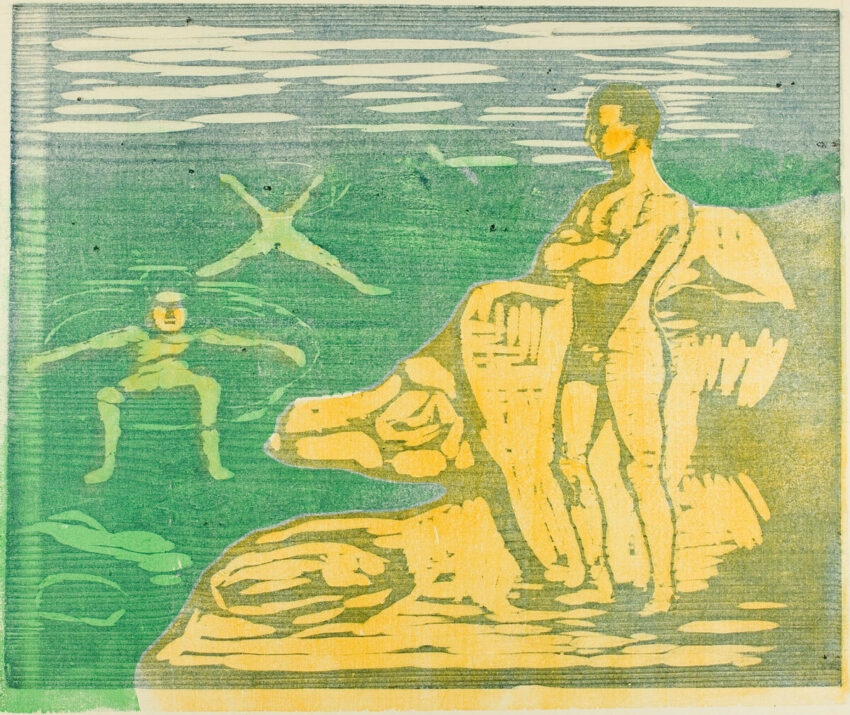
Edvard Munch, Boys Bathing, 1899. Courtesy the Art Institute of Chicago, Clarence Buckingham Collection
A week into my sojourn with Rob, we’d established a routine: black coffee in his swan mug; the slow, puffing two-block walk to the beach; the selection of the day’s spot and the digging of the hole for the umbrella; the rise and fall of a book on each of our bellies; lunch from the cooler and then a nap when the sky turned hazy. By late afternoon, Rob would wobble to the beach snack bar, returning with a sheaf of fries for himself and a Chipwich for me. Though covered in a fine layer of ice crystals, the Chipwich was soon soft. I ate the edges first, the mini chocolate chips crunching between my back molars.
Good? Rob asked as I scraped bits of wet cookie from my fingertips with my teeth.
His gray beard covered the broad space between his nipples and fluttered in the ocean wind. Otherwise, he resembled a Black Mr. Potato Head—all belly, hat, sunglasses, and cheetah-print sneakers, which he wore everywhere, even here in the sand.
Good, I said.
Rob was Robert Bunch, the famous science fiction writer, and I was supposed to be assisting him with his research, though this was as far as the assisting had gone.
I’d met Rob at an event hosted by the City University’s graduate program for creative writing, where he taught and where my friend Cara had just finished her MFA. I’d read all of Rob’s books at the library where I worked and was a fan. What if there were a world without gender and suffering? That sort of thing. After the readings, Cara’s entourage stood at a folding table covered in a bright-red cloth where a cake—purple icing with white flourishes—was being carved up.
What’s the cake for? I asked.
Me, Rob said. He was suddenly beside me, wearing a shirt patterned with human tongues. I’m retiring, he said. Then, quieter: Not of my own accord.
I offered my congratulations, but he waved them off. You’re the only one here who looks like fun, Rob said.
Thank you, I said. What happened to fun?
The answer to this question is elusive to me, he said. I often bring my own.
From a neon-green tote bag splashed with glitter, he produced two feathered face masks and held one out to me. Apparently, he and his deceased wife, a once-famous poet and critic, had worn them to a costume party in the 1970s. Today was their anniversary, he told me, and he was feeling nostalgic. I accepted the mask, placing it over my head, careful not to break the string, which was losing its elasticity. His whole deal charmed me.
At the end of the night, as we stood face-to-face in masks of love, he asked me to spend the month of August with him on the Jersey Shore.
Jules, no! Cara exclaimed once we were on the train going south so that we could eventually switch to a trolley that would go west.
I like him, I replied. Plus, he’d pay me handsomely.
He’s not a good person, Cara said. He barely taught us. Fell asleep in class. He claimed it was jet lag from all the travel, but for two years? Word is he sleeps with all his assistants, and one time I saw him at the Daily Grind with no fewer than six twinks.
Not opposed, I said, though I see myself as more of an otter.
I’d been given this body, not the wrong one, exactly, but not the right one either.
Already I was starting to speak like Rob, as if I were being interviewed on a radio show or expecting to be recorded for posterity. His voice reminded me of someone, and it wasn’t until I was standing in my dark apartment and running the tap that I realized who it was: the voice that had recently started to speak from inside my own skull. If I ran down the stairs in my apartment building too jauntily, the voice said, And where, pray tell, do you think you’re going? When I thought about signing up for a painting class at the art center in my neighborhood, the voice said, I own you, and all you might make out of what you’ve been given.
What had I been given? I had been given good hands, small fingers, and long nail beds that were always remarked on when I got a manicure. A good public education at a central New Jersey high school and a good public education at an affordable state university where there had been a cow you could see inside of—part of its side had been cut away and replaced with clear plexiglass—ambling around the agricultural-school campus. There was the small intestine, and there was the blood and the bile. I’d drawn that cow in my drawing class and been praised for it, a little but not too much, which was good for me. I’d been given this body, not the wrong one, exactly, but not the right one either. I had arrived in my late twenties with a good job as a city branch librarian and good friends and a good apartment, the first-floor rear of a big Victorian where I made extra money working as the property manager. My overhead was low, I regularly sucked the dicks of Penn lacrosse bros when I wanted to, and there was a farmers’ market nearby for flowers and vegetables, which I bought from a hot guy who drove a motorcycle and towed his wares behind him in a little wagon. But then I’d gotten top surgery and the voice had begun.
I own the bulldozer, it said as I stood in my kitchen in the dark, drinking a glass of water. I own the chains.
the family in front of Rob and me packed up their beach gear and was promptly replaced by a late-in-the-day group of friends—four straight white couples who separated quickly into gendered semicircles, the women all in black bikinis of different strap thicknesses and ass exposure, the men taking turns slapping a Bluetooth speaker shaped like a basketball.
From underneath his faded green bucket hat, Rob opened first one eye, then the other. The skin of his pectorals draped like fabric; his nipples kissed the crest of his round stomach.
Alas, he said, inspecting our new neighbors. A terrible turn of events. To the water go I. Care to join me?
This was not really a question, as his comfort and safety were essential elements of my employment. Rob walked very slowly, his legs perhaps no longer able to bend at the knee. He was eighty-four and prone to falling—timber-style—especially when rising from sitting to standing. As we maneuvered down the bank of sand, I offered my arm, and his long fingers curled around my bicep. I could feel the sharp, brittle nails digging into my skin.
Strong boy, he said.
I was a boy, but I sometimes forgot to expect the word. This was only my second summer going shirtless; an image rose up from the previous year, also on the Jersey Shore but under much humbler circumstances—a day trip with Cara and her housemates, Cara feeding me grapes and beef jerky and making a fuss over applying a mineral-based sunscreen to my scars.
Rob and I stood at the water’s edge. His swim trunks were yellow and shiny, like a fisherman’s coat. Two brown teens held hands and ran into the water together, jumping a small wave in unison. A young white guy with a hard, glistening chest and a neck tattoo kicked the water as if testing its hostility against his own.
Rob suddenly lifted his foot and made a small noise. At first I thought he’d been bitten or stung, but then he pointed at something down in the wet sand: bulbous body, creeping slowly on long front legs and short back ones, a flash of red.
A spotted lanternfly—an invasive insect we were all supposed to be killing on sight. I dropped Rob’s arm and snatched up the bug, ready to squish it between my palms.
No! Rob cried. Do not!
He lifted a delicate index finger.
Look, he said, pointing. Look at that color. Incredible.
In my hands, the insect’s little legs thrashed, tickling me.
Give it here, Rob said.
i swam parallel to the shore, raising my head every now and then to check that Rob was still there on the sand, speaking to his fly, but he always was. I did little flips and dips in the water, like an otter. If a man on vacation with his wife and son should happen to look my way, so be it, but I wasn’t chasing looks.
I’d heard that, aside from the emotional ones, the ocean’s restorative properties are mainly mineral—the white popping and fizzing of the surf is minerals breaking apart in the spray. I used my hands to bring cupfuls of water to my face and breathed in. After so many months of working in the library and recovering from surgery, I could use all the minerals I could get.
I couldn’t see my feet through the murky water, but they were there, their little knuckles all going in different directions. Sometimes I felt that if I could get my strange feet straightened out, I could find my life: a man and a thing to do, or possibly a man who would give me a thing to do. I’d tried to have sex with the owner of my building, but I’d misread the cues. One moment he was asking me to mow the lawn and I was doing it, and the next he was sitting on my couch with his legs spread apart. I went and kneeled on the floor between his legs, and he just looked at me. I put my hand on the breast pocket of his shirt like a golden retriever giving paw. We sat there for a long time before he told me to stand up in a low sexy voice that I thought meant yes and then he crossed the room and left and I realized it meant no.
When I looked back at the beach, Rob was waving me out.
that night, rob skipped our nightly cocktail on the porch and even took the salmon and asparagus I’d prepared to his office instead of to the living room, where we’d been watching a new television show about a beautiful male chef who has been wounded by his dead brother and by the world. Chefing was the opposite of being wounded, this show seemed to argue. To chef properly, it was important to wake up at a regular time, to appear clean and follow the rules, and to speak to people with respect, no matter how lowly the food function they performed. As I watched the show, I felt inspired. I, too, could go to sleep at a reasonable hour. I could stack forks devoid of spots. I could listen to bad pop music and, via its energy, be reborn.
I was halfway through an episode alone when I heard the hunt-and-peck of Rob on his sticky keyboard. I’d taken the plastic cover off his ancient square desktop computer when we’d arrived, but he’d assured me he probably wouldn’t use it. Now he was using it—damn was he using it. I finished the show, smoked a preroll on the porch, refilled my water bottle, and took it to bed with me. The sun had drained me like a raisin, but with fluid and rest, I would become a grape again. When I passed the closed door of Rob’s office, the light was still on.
it will be a new trilogy, he said the next morning over breakfast. The first one will be called Lanternfly.
Not Spotted Lanternfly?
Just Lanternfly. The bugs hitch rides from China or Vietnam or are blown inland by winds and appear in brand-new countries, such as the United States. They like a tree called tree of heaven, which is perhaps what I’ll call the second one.
How exciting, I said.
How wretched, he said.
Meaning?
Well, now my vacation is ruined. I’ve got to work. You’ll have to beach without me.
Oh, I said. Won’t you want lunch?
He waved his hand. When I am in the throes, I hardly eat, he said. Coffee and dinner will be sufficient. Protein-heavy, please. Eggs. Canned fish. Seltzer water. Crackers.
I got a pen and made a list on the back of an envelope.
But there is one other thing. He opened his mouth, then closed it again.
Sex, he said finally. I’ll need to have some. A lot, actually. Sometimes several times a day.
I looked at the linen shirt he was wearing, white with orange stripes, and imagined removing it from his back. Unbuttoning the buttons, folding it neatly. He would see my feet. Perhaps he would touch them.
Not with you, obviously, he said. There’s an application, as I understand it. On the phone. But I’ll need your help.
i poured us second cups of coffee, and we relocated to the back garden, where I could vape and he could run his fingers over the thick green skin of the basil plants. The day had started out cloudy but was in a transitional phase now, warm and about to become right. If we had been on the beach, we would have burned.
I knew his age, so I input that first.
Position, I read aloud. Top. Vers Top. Versatile. Vers Bottom. Bottom. Side.
As in?
I chose my words carefully.
Any more options?
Yes, one. Not Specified.
That, he said.
We discussed the pros and cons of face pictures, dick pictures, and the strikes against him in this context: old, fat, Black.
Half Black, he said.
Want me to write that?
No, he said. Put my face. And my books. Put the titles. Write that my fingers are nimble and my soul is wide. Say I will tell them stories.
Tall men have a certain something, like trees. Short men will work harder, like me. I work very, very hard.
I checked some boxes and unchecked others. I felt hopeful for him, and also ashamed. This was a private activity, an activity I’d never shared with anyone. I was used to thinking of sex as a kind of errand, something I did in advance so I wouldn’t be hungry later. But here was Rob, starving.
Here, I said, handing him the phone.
Now what? he said.
Now we wait, I said, and we look.
He gave the phone back to me. You’ll look for me, he said. I’ll tell you what I like. I like all men; it doesn’t matter what size or shape. Tall men have a certain something, like trees. Short men will work harder, like me. I work very, very hard. Fat men have a better touch, a natural instinct for the sensations of flesh. Thin men are more aerodynamic and can see every part of their bodies. They are familiar, perhaps too familiar, with everything, but this self-knowledge can be interesting. The only thing is, I’ll want time. None of this wham-bam-thank-you-ma’am. I can’t do it just like that. I’ll want to give them wine, I’ll want to give them cookies, I’ll want to listen to records.
I think I understand, I said. There’s a word for that now, it’s—
But Rob just waved his hand again. No, he said, there’s no word.
i lay on the beach, having swum a long time and exuberantly, now that I didn’t have to watch Rob. My legs felt gelatinous and my eyelashes dripped water. There was extra breath in my body.
I had used the app so many times, but swiping on Rob’s account made it new again. I was reminded of my very first days on the app, when I would pull a move each time. I would leave something at his place—a sock, a book, a stud earring. Hey you, I’d text. Did I leave my earring? So cute. I was cute for a long time before I became what I am now. No, they’d always text back, though I knew I had. I imagined these men wearing my earrings, reading my books, smelling my socks.
Brian was the first man I messaged as Rob who messaged me back. He had slightly crowded bottom teeth and bleached-blond hair, and lived nearby in Point Pleasant. My place only, I wrote in Rob’s voice, as traveling is no longer easy for me.
Tonight? he replied, with a semicolon-parenthesis winky face. His profile said he was thirty-two, but I knew from this emoticon that he was at least in his forties.
Tonight, I agreed.
When I got back to the house, I knocked on Rob’s door. He was typing away, his eggs from the morning still untouched.
If you were a caterpillar, he asked me, what would your name be?
Fred, I said.
Rob thought about it for a moment, his fingers paused on the keys. Alright, he said. Fred.
You’ve got a guest tonight, I said. Or at least I think you do.
Wonderful, Rob said. When he arrives, send him right in.
brian was half an hour late. Through the bottom half of the screen door, I watched the nose of his Dodge Charger appear by the curb. People were coming back from the beach and dogs were getting their evening jaunts as Brian’s long, tanned legs and feet, somewhat pigeon-toed and bare in cheap plastic flip-flops, came up our stairs.
Well, Brian said, looking me up and down. This is a bit of a bait and switch.
From the living room, with its many woven rugs and chenille pillows and dark wood paneling stained almost black so that the whorls and eddies made concentric ovals like the rings of Saturn, I listened to the sounds emanating from Rob’s bedroom. A heavy item of furniture with trinkets atop it wobbled, then shook. The bed squeaked against its springs, then screeched across the floor. Something heavy—a stack of books, possibly—hit the floor and dispersed into its individual parts. I imagined pushing, I imagined shoving and biting. I imagined Bend over and Hold your ankles and Relax and Let me do it. I imagined a dynamic full of flirting and teasing, despite the sounds that suggested a more straightforward order of things. I could have put my noise-canceling headphones on at any point. I had them right there on the table. On the TV, the chef finally runs into his childhood sweetheart in the frozen aisle of the grocery store. She’s gorgeous, funny, gets him. She opens the frozen-case door, so now a pane of glass is separating them. He can’t speak.
You, it said to me, will never be one of the holy or the beautiful.
Brian came downstairs around midnight. The windows were open and air was coming in, air straight from the ocean. Brian looked the same, if slightly greasier. He had removed the light shirt he’d been wearing when he came in and now wore only a tank top, so I could see his arms, which were lightly muscled. He stood in the dark foyer, where Rob insisted the beach passes be kept in a tiny wooden box. The chairs and umbrella were leaning there too.
Damn, Brian said, and ran a hand through his hair. He glanced upstairs and looked like he was going to say something else.
My voice filled the silence. You, it said to me, will never be one of the holy or the beautiful.
Damn, Brian said again, then pushed through the screen door.
i was back on the app before Brian’s flip-flops hit the pavement.
Since Brian had been so tall and wholesome, now I wanted someone short and swarthy and with more personality. I wanted someone I could share a joint with, someone who would sit with me afterward and offer specific, sensual details.
As Rob listened to Dreamgirls: Original Broadway Cast Album, I found and began messaging with Eli. It was his choice of Not Specified and his predilection for gentlemen over sixty-five that drew him into my net. But I’d be lying if I said that I didn’t take a certain interest in the fact that he, too, was trans. His name made it obvious, also his scars—in one picture of him smiling on the beach, I could see he had the kind of straight-across incisions they were doing in the 2010s, with folds of flesh near the armpits that people called “dog ears,” a thing I had been told used to happen a lot, especially for bigger guys like him. I bet he’d even had to stay overnight in the hospital, a prospect I’d told Cara would have nixed the whole procedure for me.
Hello, I wrote. Is 84 too far over 65?
Yum, he responded.
the next morning, Rob was up before I was, preparing the coffee himself. He was more than a little bit blind, and as he hummed to himself, I repositioned the grounds in the press and recaptured all that had escaped.
Good? I asked him.
Very good, he said. My blood feels thin. As in, flowing.
Rob worked and I beached, showered, and prepared an early dinner, which Rob took upstairs and I ate on the wicker porch couch. The church that played Methodist hymns in bell form was chiming seven o’clock when a silver car slowed in front of the house, even though we’d said half past.
Hey, thanks, Eli yelled as he came around the car’s nose.
The driver raised her hand, then accelerated down the wide street toward the ocean.
Eli was older than me, probably late thirties, short, thick, with a shaved head.
You must be Jules, Eli said. I nodded.
Get a hit? he asked, and I offered the joint.
Eli took it, still standing. His arms in his yellow T-shirt were fatter than mine and limper. So, you and him, like…?
No, I said. I just help out.
That’s nice, Eli said. He took another hit, kept it in his mouth, and passed the joint back to me. I do that for my grandpa, he said. Not in, like, the same way. My grandpa needs to get the baseball score but can’t find the buttons.
Sure, I said.
Eli paused. You trans?
Yeah, I said.
Cool, Eli said.
Well, I said, Rob’s upstairs.
this time, i heardnothing for a long time, and then I heard something, very suddenly. What I heard was Eli crying out and out and out and out. He was yelling Jesus. For some reason, I wondered if Eli, too, had been raised Catholic. A lot of trans guys I knew were raised Catholic, a tradition that prepared you well to transform and then transform again but that never, it seemed, left you.
Don’t you dare wonder, my voice said. Don’t inquire. Don’t long to know.
As I listened and watched my show—now the chef was choosing plates and silverware and glassware for his future restaurant, one that would bear his name and his name only—I had the screen door open. The weather turned, growing cooler, then cooler still. At first I thought, When it starts to rain, I will close the door. But then it began to rain and I did not close the door. Upstairs, Eli was still calling out. But instead of Jesus, now he was saying God. Oh God, he was saying. My God. It was raining harder and the trees began to blow around, a big beach-town storm rolling in. I could see the shine of water coming through the screen, then a small pool accumulating on the hardwood floor. A chill ran through me. My feet, with all the trouble they caused me, were cold. Still, I did not get up to close the door.
i lay there all night, and all night Eli did not come downstairs. I wondered what they were doing for so many hours, though I knew. Sleeping and waking, touching and holding. In my mind, I made a list. I thought, If I can lie here all night without moving from my post, God grant me these ten wishes: 1) To never hear the voice again, or the voice of any god. 2) To find something else to believe in, for example the books in my library, but better. 3) To be able to go swimming at the beach without being ashamed of my feet, or just generally to find myself beautiful. 4) For Rob to touch me just once, to send some of his intergalactic knowledge my way. 5) To make one good work of art in my life, a drawing maybe, or a painting, one that has the effect of making people want to sing along, like an Alanis Morissette song from Jagged Little Pill, which was released the year I was born and which my mother loved and played to me in utero. 6) To love my friends better—Cara, for example, to really truly love her instead of loving her halfway. Love curdles when it is not expressed, goes rancid, and there are many years of such expired love that I still have stored up somewhere. 7) To be able to sleep without the assistance of drugs. 8) To one day own a beach house like this beach house, so I can access the minerals of the ocean even as I, too, approach death. 9) For it to be sunny tomorrow. 10) I could think of nothing else. I was out of wishes.
in the morning it was still raining, and I woke to Eli’s and Rob’s voices in the next room. They were talking quietly and laughing, like they were already boyfriends.
When I walked in, Eli was telling the kitchen that he was an acupuncturist in Asbury Park and had opened his own shop.
Hung out a shingle, Eli said, if you will.
I will, Rob said, wiggling his bushy white eyebrows.
I could give you a treatment if you want, Eli said to me.
For what?
For whatever you need. I promised Rob one for his back.
While I cleaned up the breakfast dishes, I watched Rob remove his shirt and lie face down on the couch where I had been all night. I had touched those white linen cushions and that thin cotton bedspread he was now touching with the aging skin of his stomach and chest and hands. They were his cushions and bedspread after all; my skin and wishes had only been visiting.
This is war medicine, Eli said. Meant to help you feel better quick. It’s not sit-in-your-chair-at-a-spa-and-feel-nice medicine.
Very good, Rob said. Begin.
Instead of inserting many needles and leaving them there, as I was expecting, Eli took one needle and jammed it into Rob’s back many times. Rob winced in pain—Ah, eh, oh, ooh—and Eli gave commentary validating this pain—Ooh yeah, that one’s gotta hurt and Damn that was so sticky, did you feel how sticky that one was?
You feel like a Frankenstein. Then you feel fantastic.
Afterward, Rob lay very still, even long after Eli said, OK! Feel free to get up now! Eli turned to look at me in the kitchen, where I was still putting away the pots and pans. I stopped and looked back. I made a face like, Who knows? But I went over to Rob and crouched down next to him.
I’m alright, Rob said. Very excellent, actually. Now leave me, please.
What about you? Eli whispered to me in the kitchen. I can give you a treatment upstairs.
I’m good, I said.
Come on, Eli said. At the very least, it will give you a great nap. Like, dead out.
Upstairs, I sat at the head of my bed and Eli sat at the foot, arranging his little supplies.
So tell me all your problems, Eli said with a laugh.
Physical or mental?
Aha, Eli said. There’s your first mistake. Chinese medicine doesn’t see them as separate.
Right, I said. Well, I’ve been having trouble sleeping.
Cool, Eli said. I can definitely give you a treatment for that.
I took my shirt off and lay down on my back. Eli walked slowly along the edge of the bed and opened larger and then smaller ziplock bags. Leaning over me, he placed one needle between my eyebrows.
Wow, he said. Your scars look great. You healed, like, perfectly. You’re lucky.
Thanks, I said. I’m still getting used to everything.
Oh I know, Eli said. It took me years. I was twenty-seven when I had my surgery, so about ten years ago. He put a needle behind one of my ears.
I was twenty-seven too, I said. Last year.
Nice, Eli said. Twenty-seven club. He put a needle behind my other ear.
Isn’t it so weird? Eli said. Like, we had tits and now we don’t. That took me forever to work through.
How do you mean? I asked.
Eli took his time answering, inserting needles near the bony part of my wrists.
Hmm, he said, straightening up. I guess I just mean the physical reality of it. I read a ton and watched a ton of videos, and it’s, like, insane. It’s so cool. The chest is full of all these globby white sacks of fat. They cut out a whole glop of breast tissue and then sew you back up. You feel like a Frankenstein. Then you feel fantastic.
I was too scared to watch any videos, I said.
Oh no, you gotta, he said. It’s incredible what they do, the technology, and it’s only gotten better, obviously. But it was weird, like, not knowing where I was while they were doing the surgery. I don’t remember it, but my body was there. And then when I woke up, you want to know what happened?
OK, I said, though I didn’t.
Eli slid a needle into my right ankle. He said, I kept asking the nurses where my chest flesh went.
He laughed and pierced my left ankle. I felt nothing.
I kept asking them, But where does it go? What did you do with it? They kept patting me on the shoulder and saying that it was OK and that the surgery had gone well. Apparently, I was really insistent. Next thing I remember, I was back home with my boyfriend at the time and there was a note from my doctor. It said, Please convey to Eli that removed breast tissue is typically sent to a lab for cancer testing and then incinerated.
Incinerated? I said as Eli put a needle into the crevice between my fucked-up right big toe and second toe.
Yeah, Eli said. They burn it. Isn’t that crazy? Eli stuck a needle between the toes of my other foot.
Crazy, I said.
Eli set a timer on my phone and lowered the shades. He stood in the doorway of my room.
Bye, Jules, Eli said. Drink a lot of water.
i came downstairs a while later, and Rob was still lying on the couch, eyes closed.
When he finally opened them, he wanted to talk. He wanted to tell me about Lanternfly and ask for my help. Finally, I thought, we would begin.
What if, he said, what if it was set in a world where, right before you die, all the people you thought you’d lost were returned to you?
As in?
As in, the dead and the living, the living but distant from you. The people you bullied in school or who bullied you. The friends you fell out with because you didn’t like their partners or because you had a kid and they didn’t or they published a book and you didn’t. The childhood best friend who moved away to Omaha because her dad got a job there. The boy you had a crush on in high school who overdosed on heroin in the bathtub. The gentle boy from your college English class who grew up to be a hard-nosed investment banker. The fellow from grad school who wouldn’t use a condom with your friend.
It knocks something free. Some calmer and stranger energy that is also less strange.
And? I said again. So they come back, and then what?
So each one is a lanternfly. Each one appears to my protagonist before he dies and must be dealt with.
Dealt with how?
Remembered, he said. Spoken to. What I’m seeing is my protagonist on a city street with a whole swarm of spotted lanternflies. A swarm of memories.
I like it, I said.
Also, I said, why do you need sex to write?
The tightness, he said. And the looseness. It knocks something free. Some calmer and stranger energy that is also less strange. After orgasm, the mind is clear. After orgasm, who wants to talk on the telephone?
True enough, I said. But why not just masturbate? Why do you need there to be men?
He smiled. I like to speak and be spoken to, pushed around a little bit. What is sex if not being contacted by a foreign body, perhaps from outer space? It makes one feel a little less alone, no?
Yes, I said, thinking of my voice.
i went to the grocery store and bought all the luxurious stone fruits and all the specialty cheeses with Rob’s credit card. Popcorn coated in pink Himalayan sea salt. Flowers. If Rob would not indulge, I would for the both of us.
Call Eli, Rob said as I was unloading everything.
Within an hour, Eli was back, bearing crabs. The crab clusters were from Alaska, not from New Jersey, but their pink flesh and knobby shells created a feeling of freshness and regional specificity. I looked for newspapers around the house but found none, so Rob sent me upstairs to raid his office.
Take the drafts, he said. Leave the notes.
The room was covered in a fine film of dust. On the desk sat the outdated computer, a box labeled notes, and a series of small treasures, or talismans. A round black stone, so shiny it looked lacquered. A bird’s nest with a paper-thin egg in it. A miniature wooden house covered in cheap pink gemstones. The house had a porch with steps and everything. On the steps were little figurines—one that looked like Rob and three others: a white woman and two little boys.
Eli showed us how to dismember and eat the crabs by gently breaking their shells with our fingers and then feeling for the meat.
You’ve got to tug oh so lightly to get the whole leg out in one piece, he said. Like so.
Rob’s fingers had lost much of their dexterity, so after a few tries I stepped in.
Good boy, Rob said to me as I pulled a tender pink chunk from the biggest leg. Well done, he said as I dunked it in butter and handed it to him.
With every drop of butter that landed on the paper, more of Rob’s novel became visible, each word revealed in reverse.
after dinner, rob opened all the windows and put a record on the ancient turntable. Rob and Eli were on the couch, Eli sitting upright, drinking a cocktail, and Rob lying down with his head in Eli’s lap. He wasn’t wearing any socks, and I watched him move his toes to the beat.
I wish we had a dog, Eli said. A dog would complete this feeling.
What feeling is that? Rob asked.
Boys having fun, Eli said. Boys having entirely too much fun. We could make a dog dance or roll over.
We had a dog for many years, Rob said. Terry and I and the boys. He was a scruffy little terrier by the name of Pluto. But he couldn’t do any tricks or anything. He never listened to us when we called, never took to his name.
I wish he were here now, Eli said. Pluto! Pluto!
And then Rob was sitting up.
The lanternfly was walking carefully along the window ledge.
I’ve got it! Eli said, taking up a hardback book.
No! Rob and I called out together.
Rob swooped for the insect and cupped it between his palms. He sat down on the couch, holding it, and began to cry. First he cried slow tears. Eli sat beside him and rubbed his back while I hovered uselessly. Then Rob straight-up wept, big boo-hoos.
Oh, honey, Eli said. What is it?
I miss my sons, Rob sobbed. My boys!
We could call them, Eli suggested. Here, let me see your phone.
No, no, Rob said, still weeping. I don’t want to bother them. I miss when they were young and snuggled me. I miss my wife. I miss my Terry.
Eli and I looked at each other. Eli rubbed Rob’s back again. I’m old! Rob said. My body is breaking down.
You’re still plenty limber, Eli said, kissing him on the cheek.
They even took my job from me! Rob blubbered. The only job I’ve ever known.
Eli went to get Rob a tissue.
Those people at the university, I said. They’re idiots.
Rob looked up at me then and smiled a little. True, he said.
After nose blowing and a glass of water, Rob stopped crying. He lifted his T-shirt to dry his eyes, exposing his soft belly.
What do you think it means? Eli asked after some time. You’re writing a book about lanternflies, and lo, a lanternfly appears!
He was asking with seriousness, with a serious face and a serious heart, and I saw then that this was the reason Rob was having sex with him and not me. I would never be able to ask such a stupid question.
after we all smoked a good bit, Rob wanted to eat ice cream. I offered to bring the car around, but Rob said no, it was a nice night and he wanted to walk. The town had once been a Methodist camp, and tonight was Illumination Night, so everyone was out and about, paper lanterns lighting up the exteriors of their little pink and green and yellow gingerbread houses. But the line for the ice-cream parlor wrapped around the corner, past the historical society and the mermaid store, and Rob was soon hunching over and holding his back.
You guys sit, Eli offered valiantly. Give me your orders.
Kids wore glow-in-the-dark bracelets and necklaces, and some were even breaking them open and smearing the chemicals on their lips and arms. At the edge of the park, I stood over Rob’s seated form on a bench.
What about punishment? I said. Don’t you think we will be punished if we change too many times?
I was thinking, Rob said, keeping his eyes level and straight ahead, that the narrator of Lanternfly will be not quite dead but almost there, in the place the Buddhists call the Bardo.
That could work, I said. I’d read that.
It’s been done before, he said. As everything worth doing has. But this narrator hasn’t lived a usual life. He’s had relations with people of both genders. He’s lived first as one sex, and then as another. He has had more life than most are ever allowed, so it takes him a long time to leave the Bardo. He’s wrestling in there, thinking and greeting all the people, er, insects, from every phase of his life, and he’s fighting, really and truly fighting, to stay alive. It will take three books for him to die, but he is going to die, eventually.
He’s stuck, I said. That’s interesting. I crouched down so I could be lower than Rob, as I deserved.
Sit, Rob said. Come sit on this bench with me.
I sat.
I see that you are suffering, Rob said.
I swallowed.
I can’t pretend to know the cause, and I can’t solve it. You’re young, not even thirty, and maybe you think the big things have come and gone already, but they haven’t. They’re about to come, they’re coming, the big changes. The thirties, the forties. Even the fifties.
What about punishment? I said. Don’t you think we will be punished if we change too many times?
How many times is too many? Punished by whom? Oh my, you really are a Catholic.
And after the fifties?
The sixties, the seventies. Maybe they’re more like the twenties, Rob said. A certain hunger comes back, an urgency. I’m a horny young boy again.
I think, maybe, I’d like to live a long time, I said. That’s a new development.
Rob tugged on his beard approvingly.
I’m calling the character in my trilogy Jules, he said. And giving him your—how do we say?—unusual feet. Also your beautiful hands.
Wow, I said. I don’t know what to say.
And I’m putting in that strange story about the cow with the hole in its side, was it?
Window, I said. Clear.
Right, he said. Disgusting. I would have stood there for hours, watching the intestines.
I did, I said.
Tall, fluffy dogs darted in and out of the bushes, and in the gazebo a band of three blond teenage girls set up electric guitars and began to play a hymn. I caught the words Messiah and Prince of Peace.
Rob closed his eyes. He covered my hand with his, clumsily, half on my hand and half on the wooden surface of the bench. His skin was warm and dry.
Eli came striding across the grass then, three double-scoop ice-cream cones smushed together in a great tower. I had ordered espresso chip and black raspberry, and whether from the anticipation or the THC or both, my mouth flooded with sour moisture. The teens sang louder and louder in one high, thin voice that I did not believe in, but this nonbelief did not prevent my noticing that the tune was sweet and pleasing to my ears.
I’m a bit scared, Rob said. Of the next phase of matter. Not too much, he said. But a little.
Me too, I said.
The weed had left a rancid taste in my mouth, but it would soon be washed away by cream. Rob lifted his hand away from mine as Eli approached. I didn’t move. I knew that Rob could redeem me in his books, or hurt me, but whatever form I took next in life, he would not be able to imagine it. That work was all mine.
"Lanternfly" is taken from Fat Swim: Fiction by Emma Copley Eisenberg, published by Hogarth Press on April 28, 2026.
Emma Copley Eisenberg is the author of the novel Housemates and the story collection Fat Swim. Her essays, literary criticism, and reporting have appeared in The New Republic, Granta, and Esquire, among others, and she writes the Substack newsletter Frump Feelings. She lives in Philadelphia.
Our Summer Issue
Two pieces by Annie Ernaux, including a print-exclusive essay. Plus a folio titled "What Was AI?" — with contributions from Sheila Heti, Lauren Oyler, Christopher Sorrentino, and others.
Two pieces by Annie Ernaux, including a print-exclusive essay. Plus a folio titled "What Was AI?" — with contributions from Sheila Heti, Lauren Oyler, Christopher Sorrentino, and others.