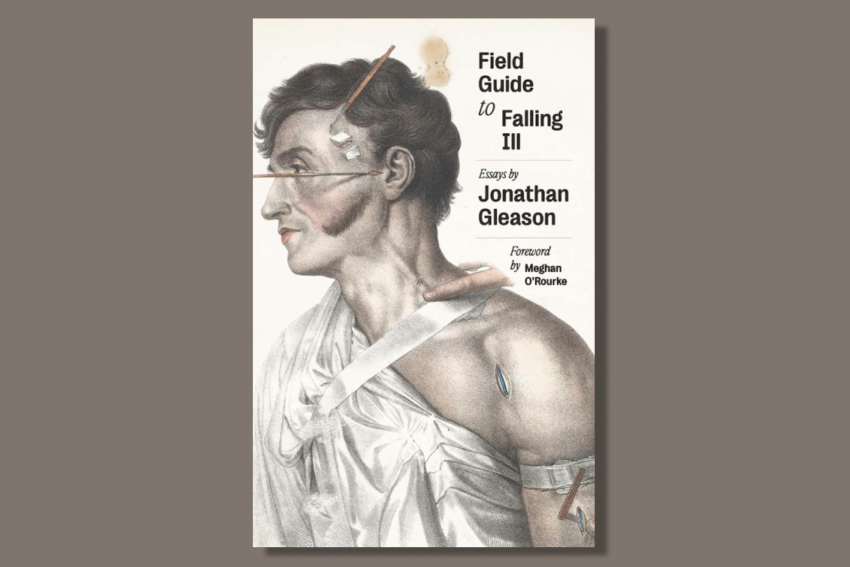
InField Guide to Falling Ill, Jonathan Gleason probes the unstable boundary between harm and help in contemporary medicine. GettyImages
When I became editor of The Yale Review, I wanted to find ways to bring sustained attention to long-form nonfiction that takes real risks—formal, intellectual, and ethical. The Yale Nonfiction Book Prize, launched in 2024 with Yale University Press, grew out of that desire; both the press and TYR wanted to recognize book-length works of nonfiction by first-time writers of the genre that are formally ambitious, intellectually rigorous, and deeply attentive to lived experience—the kind of books we want to read more of, that is. I was honored to judge the inaugural prize, which I have awarded to Jonathan Gleason for Field Guide to Falling Ill, a remarkable book of essays that thinks with unusual clarity about vulnerability as a lived condition, and about how illness alters our senses of agency, care, and responsibility. Moving among reportage, history, and personal reflection, Gleason probes the unstable boundary between harm and help in contemporary medicine.
What follows is a lightly edited excerpt from the book’s final chapter, “No Harm,” which examines the murder trial of William Husel, an Ohio intensive-care physician accused of ordering fatal doses of fentanyl for end-of-life patients (charges of which he was ultimately acquitted), alongside larger questions of medical authority, palliative care, and how we attempt to assign meaning—and blame—in the face of death. Field Guide to Falling Ill will be published by Yale University Press on January 27.
—meghan o'rourke, executive editor
dr. william husel was often one of the only physicians on the floor of the intensive care unit of Mount Carmel West, a hospital on the southwest side of Columbus, Ohio. He worked the night shift, and he specialized in the treatment of end-of-life patients, a difficult and frequently thankless job. One could view his night work as a sign of altruism—a willingness to take on shifts that others did not want. At night, cortisol levels surge and patients are wakeful, putting them at risk of secondary complications. There is a “60 percent rise in death rate beginning at 2 a.m. and reaching a peak at 8 a.m.,” as a 1987 article in The American Journal of Medicine put it. In other words, many patients die at night. In the sharp, unnatural light of the ER at 3:00 a.m., families are weary, and the idea of a good death holds least sway. But volunteering for the night shift could also be a sign of something else. There is less oversight in hospitals at night, as fewer doctors and pharmacists are working, and most administrative staff is away. In the hushed corridors and darkened rooms, what might it be possible to do?
In 2019, Husel was accused of prescribing fatal doses of fentanyl to critically ill patients in one of the largest homicide cases in Ohio history. He pleaded not guilty to twenty-five counts of murder. His trial began in February 2022, and I watched video footage live from my apartment in Iowa City, five hundred miles away. I had noticed the case because I’d grown up in Grandview, a suburb a few miles from Mount Carmel West, and I was drawn in by the important questions it raised about how we now die in America. Was it possible to have a good death in our current medical system? Murder trials are often complicated, but of the many aspects that were raised in the trial of Husel—the fact that he did not administer any of the painkillers himself, the fact that the majority of his patients were in the process of being removed from life support when they died, the fact that there is no set federal limit for a legal dose of fentanyl—his guilt or innocence turned on the question of how a jury would read his choice to work at night, what that said about the impenetrable inner world of the doctor and his motives. After seven days of deliberation, Husel was found not guilty on April 20, 2022.
Where were the drugs going, what were they being used for, and why?
Between 2014 and 2018, while Husel was employed at Mount Carmel, more than two dozen patients died at night under his care. On its face, this was not such an alarming fact. Husel was an ICU doctor, working in an area of Columbus with high rates of poverty, alcoholism, and drug addiction. In Franklinton, the neighborhood that Mount Carmel West served, the median household income is $33,000 and the average life expectancy sixty years. So the deaths, while high, did not stand out enough to a staff who were inured to a particular flavor of suffering in a part of the hospital that has a high rate of patient death to begin with. As staff testified during the trial, the first suspicion was a common one: that drugs were being diverted—a technical term for the theft of controlled substances in a medical setting. The idea that a staff member might be stealing fentanyl from the hospital for sale or for personal use was straightforward. The motives and rationale of addicts were predictable, almost dull, in a state experiencing a stupendous rise in opioid use. But the truth was not so straightforward. The drugs were all accounted for. They had either been administered to patients or properly disposed of. The doses, though astonishingly high, were not being stolen. Which left more unsettling questions: Where were the drugs going, what were they being used for, and why?
For months pharmacists had exchanged concerns over the quantity of paralytics and painkillers that Husel prescribed. For the most part, friends and family members of patients who had died under Husel’s care went home distraught, but not suspicious, over the deaths of their loved ones. Only in courtroom testimony, years later, did some family and friends of the dead report leaving the hospital with a sense of unease.
On October 25, 2018, a pharmacist issued a formal report about Husel to his supervisors. The pharmacist’s concern was triggered by the death of James Timmons, whose palliative extubation (removal of life support) had been supervised by Husel. Timmons had died about ten minutes after receiving a one-thousand-microgram dose of fentanyl ordered by Husel—an enormous dose for a man who was already catatonic. After reviewing the report, the pharmacist’s supervisors further elevated the concerns, and an internal review was triggered. (The review would eventually identify thirty-five suspicious deaths.) On December 5, 2018, Husel was fired from Mount Carmel West, and the hospital notified the State Medical Board of Ohio, as well as the police, of its decision. On June 5, 2019, the police charged Husel with twenty-five counts of murder. He turned himself over to police that day.
to understand mount carmel west, you must first understand its neighborhood. Part of the horror and intrigue of the Husel case was that, in theory, it could happen anywhere. This is the salacious threat and tantalizing promise of true crime: It could happen to you too. But for the most part, it doesn’t, and the Husel case was always much more likely to occur in a place like Franklinton.
Franklinton is a neighborhood of persistently rotten porches, split cinder blocks, and trampled zinc fencing. Locals call it “the Bottoms” because the flood line of the surrounding rivers lies above the basements of most houses in the neighborhood. For years, insurance companies refused to secure homes in Franklinton because they were considered too high-risk. It is the oldest neighborhood in an already old city. Before Columbus was incorporated, before Ohio was even a state, when the country was barely a country, Franklinton was already a settlement. The flatness of the Midwest begins here, after the Appalachian foothills ripple out and then still, giving way to the flat glacial till that continues mostly unbroken until the Rockies. It is a neighborhood in near-biblical thrall to water and its temperament. Surveyors first settled this low-lying region in 1795, but their villages were swept away in 1798. Undeterred, they moved uphill and began again. Throughout the nineteenth century, Franklinton experienced periodic floods that pushed homes off their foundations and scraped up brick-laid roads like crumpling wallpaper. For decades, the neighborhood was decimated and rebuilt again and again. Then, in 1913, a worse flood came. The levees protecting the neighborhood failed. Nearly a hundred people died. Streets became clogged with loose lumber. Houses tipped over, into the rushing water, until they came to rest oddly on one of the tilted planes of their roofs. Families retreated to Mount Carmel for shelter. The hospital was the tallest structure in the region, and it was built on slightly elevated land. In more ways than one, Mount Carmel was an institution and a sanctuary.
in 2014, david was a student at Mount Carmel’s school of nursing. Later, he worked as a nurse’s aide in the emergency room, though never with Husel. We spoke over the phone in the spring of 2022, just after the trial concluded. While studying and working, David lived in Franklinton, within walking distance of the hospital and campus, in a house his family had purchased in 2004. A generation of siblings had cycled through that house. David’s older brother lived there before him, and his younger sister lived there when we spoke. He described the neighborhood as a place where no one cared, a place with lots of crime and little money, where overflowing garbage cans were constantly toppled and the front doors were often boarded up and graffitied. Yet David knew the place not as an outsider but as someone who had lived there. Really, he told me, these were just signs of neglect. Trash service was irregular; taxis, police, and even ambulances were hesitant to go there; attempts to develop the neighborhood had, until recently, been failures.
David was a character—brash, talkative, lightly profane—and he had an eccentric’s memory for striking details. He talked about random gunshots startling him awake at night, the ache of gunpowder in the air. He described AC units lifted from windowsills like pies set out to cool in a children’s story and stereo systems pried like gemstones from parked cars. He remembered a pallet of shrubs being snatched from his front yard, and wondered out loud what the thief could have possibly wanted with them. He told me about the people who would occasionally come to his door asking for money and, more strangely, how he once opened it to a man who told a long story about falling asleep on his mattress with a lit cigarette, nearly burning his house down. It took a while for him to realize what the man wanted. When David told the man that he didn’t have a mattress to spare, the man simply shrugged, unfazed, and moved down the block to knock on the next door.
That it seemed natural to assume the high doses of fentanyl were being abused or stolen and sold was an old prejudice, a pairing of Franklinton’s high Appalachian population with opioid addiction and drug dependency, an assumption that the people there were more likely than others to be looking for escape. He used the phrase “urban white trash,” which is still the dominant stereotype of the neighborhood, even though it remains one of the few racially diverse neighborhoods in Columbus, but he didn’t agree that Franklinton was any worse than other parts of the city. He called it a down-to-earth neighborhood. A strange place, one that was rough around the edges but essentially good.
Our Summer Issue
Two pieces by Annie Ernaux, including a print-exclusive essay. Plus a folio titled "What Was AI?" — with contributions from Sheila Heti, Lauren Oyler, Christopher Sorrentino, and others.
February 22, 2022, was a day of record-breaking rain, with some outlying counties under flood watch. Inside, the courtroom seemed to have the dull, warm ambiance of a midwinter school day. Proceedings had been stalled by the pandemic, and as the trial began, the courtroom was clad in plexiglass. Cameramen recording the proceedings had to be careful not to catch the reflection of an anonymous juror against the barriers; witnesses had to shout to be heard by the court stenographer.
The first day of the trial was filled with the predictable turns of an opening argument: a family photo of Husel dressed in white next to his wife and two daughters; an emphasis on his Ohio childhood, with a father in mass transit and a stay-at-home mother; and the absolute assertion that, despite some room for error, no criminal acts had been committed. But in other ways, the case was marked from the beginning as exceptional. Jose Baez, a lawyer who once defended Casey Anthony, Aaron Hernandez, and Harvey Weinstein, acted as lead for the defense. He had the face and confidence of a TV lawyer, which in some ways he was, having transcended his profession with so many high-profile cases. He opened with a stark question: “Have you ever thought of your death?” It was a daring move and an acknowledgment of the defense’s steepest challenge: the fact that each patient in question had died under Husel’s care—there would be no evading this fact—and that the jury would be reminded of these deaths, and perhaps their own, with each new witness. The defense’s task, then, was to show that these deaths were inevitable and that they had not been hastened by Husel. To do this, the defense would have to approach death nakedly.
Baez laid out the complicating features of the case. He highlighted the fact that some of these patients, though certainly not all, may have already been habituated to opioids and therefore less responsive to their palliative effects. He noted that many of these patients were sick—by the time Husel ordered nurses to administer the allegedly fatal doses, at least one of them had experienced multiple organ failures, and at least four had been brought back after multiple cardiac arrests. He told the jury that there was no institutionally set maximum dosage for opioids until after the hospital’s investigation into Husel. Finally, he laid out his central theory of the case: that the hospital had for years maintained poor practices around drug administration, and when its administrators got scared—when they saw the number of deaths—they went looking for a scapegoat in Husel. It was a compelling argument but one troubled by the uniquely large doses that Husel ordered.
on day twoof the trial, the prosecution called Talon Schroyer, one of the pharmacists who first raised concerns about the quantity of fentanyl that Husel prescribed. Schroyer was a young, wide-eyed man with a goatee. He described his reaction to the doses as simply “shocked.” As he spoke, he looked as if he were reliving that shock. He explained that the medications’ “effects can be synergistic,” which is to say that there is a mutual amplification of effects when vasodilators (used to aid circulation) and opioids (used as painkillers) are combined. If both vasodilators and opioids suppress breathing, when they are used together, it is not a matter of simple addition; they multiply each other, become greater than the sum of their parts. One might assume that Shroyer’s testimony would be clarifying, but on this second day of the trial, the challenge for the prosecution crystallized.
Death is profoundly technical.
I had expected, when the case began, to be conflicted by it, to feel myself torn in two directions, between the desire of this doctor to relieve suffering and the essential preciousness of human life, even in its final moments. I had expected to flip sides with each changing of the guard between examination and cross-examination. I had, in short, been prepared for a television trial, one punctuated by bold claims and clear, if conflicting, narratives. Instead, what I experienced from the moment the prosecution called its first witness was confusion, interrupted by brief moments of clarity. The orderly theorizing of the opening statements was immediately washed away by the impenetrable bureaucracy and the specialized operations of the hospital system: the nuances of various pain and coma scales (Glasgow versus RASS versus Moscow); the type of vials used to administer fentanyl and their specific forms of delivery (in bolus or infusion); whether or not a patient had benzodiazepines in their system when a particularly high dose of fentanyl was given, and if they did indeed have benzodiazepines in their system, who administered them, and if they were administered, how they were approved, and if they were approved, when and where and why. Even simple procedural elements of the case, like where the pharmacists sat (in the basement, receiving medication orders from the hospital above, orders that could be overridden and then retroactively approved), had to be clarified again and again.
Language is often accused of being inadequate to encompass the size of an issue, but here, in the courtroom, another curious breakdown occurred: the inability of language to order and clarify the technicalities of the hospital’s procedures and the minuteness of medical details. Death is profoundly technical. We tend to talk about it as a singular event, a swift moment-by-moment passage from one state to another, but in both the hospital and the courtroom that passage becomes hazy, the overlapping complexities of the body enter the legal field uneasily. Patients’ hearts stop. Their kidneys fail. Their respiration drops below sustainable levels. They are administered CPR under code and intubated. They are given pain medication and paralytics whose side effects are weighed against the probability of their suffering. They die and recover, Lazarus-like, and their exact times of death are recorded in minutes and seconds, though these records are a lie of medical and legal utility. Language has trouble accounting for an overlapping Venn diagram of collapse, except in the general, and the general does not count as evidence here. Read the rest of this essay inJonathan Gleason’sField Guide to Falling Ill,published by Yale University Press.
Editor’s Note:For the sake of privacy, some names and identifying details have been changed.