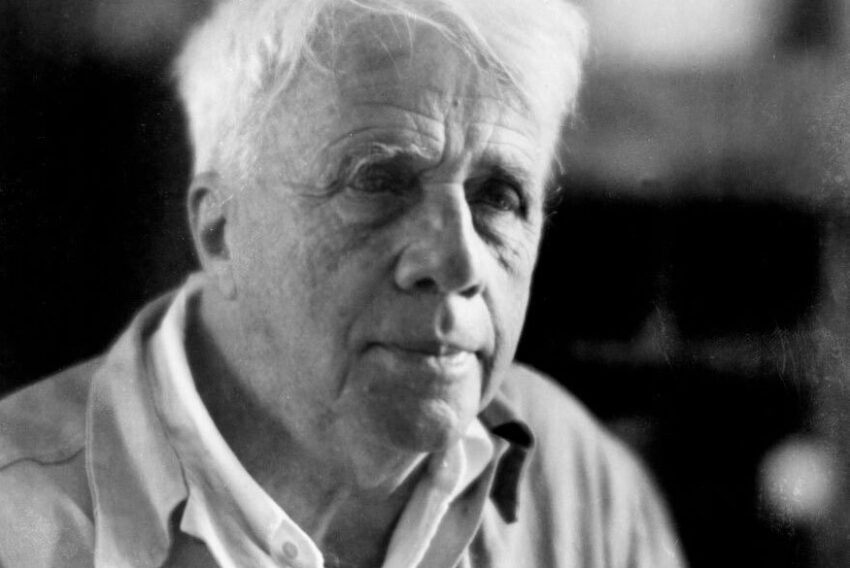
i hadn’t thought of Robert Frost as a poet of midlife. When I pictured Frost, I realized, what I saw was a double exposure: the old man who knew too much for his own good, the boy who little understood all he already knew. But I have come to see that the poet who, in April 1923, submitted three poems to Wilbur L. Cross, then the editor of The Yale Review, was undergoing something like a midlife crisis. He was forty-nine. The poetry world had changed, and Frost was feeling defensive:
Robert Frost at Midlife
In his poems for The Yale Review, the poet reckoned with mortality, imperfection, and the limits of form
Be good to the poems. At least they are two things: they are regular verse and they are by a hand practiced in regular verse. Some of the stuff you have had was in free verse, which is bad, and some of it was in regular verse by a hand practiced in free verse which is worse.
“Nothing Gold Can Stay,” “To Earthward,” and “I Will Sing You One-O” would appear six months later, in the October 1923 issue of The Yale Review—three of the twenty-eight poems that Frost first published, from 1916 to 1949, in the pages of this magazine.
Taken together, the three poems offer a snapshot of Frost at midlife: anxious about his career, eager to reassert his own aesthetic values. A poem like “Nothing Gold Can Stay” has, in the century since its publication, so permeated our culture—quoted in everything from S. E. Hinton’s novel The Outsiders to the lyrics of Lana Del Rey—that it can feel like it has always existed, like Stonehenge or the rings of Saturn. But to rediscover Frost’s poems in the pages of their first publication is to see them not only as timeless but as records of time’s passage, meditations on their own belatedness. We see a poet thinking through what it means to be bad and good, what it’s like to exist in a fallen world, and why poems might matter to people who are, after all, finite.
By the time Frost submitted this trio of poems to The Yale Review, he had already, more often than most, come up hard against life’s limits. When he was eleven, his father died of tuberculosis. When he was twenty-six, his first son, Elliott, died of cholera at the age of three. Later that same year, Frost’s mother died of cancer. When he was thirty-three, his daughter Elinor Bettina died days after she was born. When Frost was forty-three, a friend of his, the British poet Edward Thomas, was killed by an artillery shell in the Battle of Arras. When he was forty-six, he had to commit his sister, Jeanie, to a state mental hospital in Maine. The list is partial, and life would not get easier.
Frost was a playful poet, but in order to play, we needed to agree on the shape of the field, the rules of the game.
Unlikely as it may seem, Frost’s views about “regular” and “free” verse were not incidental to such privations. Rather, the impersonal regularity of meter suggested to Frost an allegory for the boundedness of mortality. Meter isn’t what we hear—not quite—in the “regular verse” that Frost wrote. Meter is a scheme, the ghostly da-dum, da-dum (if, as it was near exclusively for Frost, iambic) behind the sounds of the poem we read. What we hear instead is the poem’s own peculiar rhythm, which bends and strays and sometimes snaps back into place against the measure (meter’s etymological root) established by the poem’s scheme. This is how meter is like mortality. Our lives are bounded by birth and death and punctuated along the way by the kinds of markers that biology and custom have established as roughly universal. We live in relation to that fixed scheme, our lives gaining meaning in the play between the wild rhythms we make as we go and the unforgiving meters to which we must, at the end of the day, conform.
Free verse is bad, according to Frost, because it has no sense of those limits. He liked to say that he “had as soon write free verse as play tennis with the net down.” Frost was a playful poet, but in order to play, we needed to agree on the shape of the field, the rules of the game. Free verse would be like living as though you’d never die. But Frost reserved his real venom for poems in “regular” verse by poets who generally wrote without fixed meters because, in his view, their unpracticed hands could do no more than follow the rules, which made for a very boring game.
Frost always wanted to do two things, simultaneously, in verse. He was committed to meter and, often, to rhyme—he was, in this sense, a deeply formal poet. But he was equally committed to something he variously described throughout his life as the “sentence sound” or the “sound of sense.” In his 1942 sonnet about Eden, “Never Again Would Birds’ Song Be the Same,” he imagines the sound of sense in Eve’s voice as “her tone of meaning but without the words,” something we might redescribe as knowing the gist of what someone is trying to express even if we can’t quite make out what they’re actually saying. In a letter to his former student John T. Bartlett, Frost wrote, “The best place to get the abstract sound of sense is from voices behind a door that cuts off the words.”
Through a closed door, in Frost’s lovely image, we might hear the idiomatic rhythms of human language in the wild. Through a closed door, we might recognize our parents arguing, or a professor lecturing, or children playing, even if we can’t make out a word anyone is saying. What Frost wanted to do in his poetry was to have both kinds of order at once: the scheme of meter and the idiomatic rough-and-tumble of talk. Moreover, he didn’t want to reconcile the two. Rather, he wanted to expose the tension between them. In a letter to the writer John Cournos, Frost tried to explain this principle of versification:
There are the very regular preestablished accent and measure of blank verse; and there are the very irregular accent and measure of speaking intonation. I am never more pleased than when I can get these into strained relation. I like to drag and break the intonation across the metre as waves first comb and then break stumbling on the shingle.
The waves that roll in and then crash on a rocky shore—they are an image of how the rhythms of idiomatic language might seem at first to gain sway in a poem and then yield, ultimately, to the cold demands of meter, but they are also an image of how our lives, however free, are led in the foreknowledge of our certain deaths.
What would a poem that showed this strain—and that bore this knowledge—sound like? We might look to “I Will Sing You One-O,” the most imperfect of Frost’s three poems in the October 1923 issue of The Yale Review. Frost has adapted his title from the first line of the English folk song “Green Grow the Rushes, O,” which is a kind of counting song, something like “The Twelve Days of Christmas.” Frost, though, is interested in counting just to one. The poem’s solitary speaker lies awake in his bed and hopes to hear, from the clock tower, that his long night has nearly passed. The bell, alas, tolls only once, and its bad news for the insomniac listener is echoed by another single note, coming from a nearby steeple.
One and one don’t add up to two in this poem. The world implied by these two sounds—Frost calls the first a “knock,” as though it, too, were made on a closed door—is populated only by the lonely. What the clocks seem to say is that we’re all, each one of us, alone. And behind that message lies its cosmological confirmation:
Their solemn peals
Were not their own:
They spoke for the clock
With whose vast wheels
Theirs interlock.
It’s a beautiful and harrowing image: the turning gears of our clocks measure time by interlocking their gears, as it were, with the turning wheels of the cosmos. So it is with poetry. This poem, like virtually every poem Frost wrote, is roughly iambic, but its lines are shorter than most—this is iambic dimeter, two da-dums. The line “They spoke for the clock,” however, adds an extra, unstressed syllable to the expected second iamb—which creates the impression that the earthly clocks are hurrying to synchronize with their celestial counterpart. The following line, “With whose vast wheels,” all monosyllables, perfectly iambic, slows us back down into the regularity of cosmic time. “Theirs,” the first word of the line after that, refers to the gears of earthly time, while the verb, “interlock,” gathers the line’s two stresses into its single action, just as its rhyme (“clock” with “interlock”) cinches time into place. Soon enough, the poem seems to say, each of us will know what time it is.
love might be a remedy to this grim solitude. It would be nice to think so. According to Frost, his own views on love changed dramatically at midlife and were recorded in his poem “To Earthward.” In 1938, fifteen years after the poem’s first publication in The Yale Review, Frost wrote to the historian and critic Bernard DeVoto: “One of the greatest changes my nature has undergone is of record in To Earthward and indeed elsewhere for the discerning.” According to Adam Plunkett, Frost’s latest biographer, it was not a poem that he would read in public. What great change had the poem recorded? Frost elaborated in his letter to DeVoto:
In my school days I simply could not go on and do the best I could with a copy book I had once blotted. I began life wanting perfection and determined to have it. I got so I ceased to expect it and could do without it. Now I find I actually crave the flaws of human handwork. I gloat over imperfection. Look out for me. You as critic and psychoanalyst will know how to do that. Nevertheless Im telling you something in a self conscious moment that may throw light on every page of my writing for what it is worth. I mean I am a bad bad man But yours R. F.
That last sentence may sound more like boast than confession. But it also may have been Frost’s way of making clear that he hadn’t forgotten something DeVoto had told him that summer, when the two had been together at the Bread Loaf Writers’ Conference in Vermont: “You’re a good poet, Robert, but you’re a bad man.”
It’s not certain whether DeVoto said those precise words to Frost, much less what Frost had done to deserve them. (Frost related the comment to his first biographer, Lawrance Thompson, who transcribed it in his notes.) But it’s not hard to guess. Frost was sixty-four years old in the summer of 1938. Elinor, his wife of more than four decades, had died in March. At Bread Loaf, Frost became infatuated with Kathleen Morrison, the wife of the conference’s director, and would disappear with her on long walks into the woods. At some point, Frost urged her, unsuccessfully, to divorce her husband and marry him instead.
Let other poets fall upon the thorns of life; this one lived as though even the petals could make him bleed.
“To Earthward” narrates this fall from grace as the exchange of one kind of love for another. Its eight stanzas split neatly in half: the first four describe an eroticism so chaste it hardly deserves the name, the latter four a desire for contact so excessive it sounds sadomasochistic. The poem begins by remembering a time when no more than a kiss could be tolerated: “Love at the lips was touch / As sweet as I could bear.” That opening echoes the tremulous, halting desire of Whitman’s “Song of Myself”: “To touch my person to some one else’s is about as much as I can stand.” For this younger Frost, as for Whitman, any direct contact might have been “too much”—and so Frost subsisted on scent: “I lived on air // That crossed me from sweet things.” The middle-aged poet of “To Earthward” ruefully looks back on his youth and finds an idealist who barely lived in the world:
I craved strong sweets, but those
Seemed strong when I was young;
The petal of the rose
It was that stung.
Let other poets fall upon the thorns of life; this one lived as though even the petals could make him bleed.
No longer, though. At the poem’s midpoint, at midlife, Frost has given up his sweet tooth: “Now no joy but lacks salt / That is not dashed with pain / And weariness and fault.” The involuted syntax tracks the complexity of this newly discovered, discriminating palate. Pain is now the salt that lends love its savor. A craving for ambrosia had led the young man toward ever more ethereal objects of desire, but the mature poet knows, as the Frost of 1915’s “Birches” had already known, that striving for perfection was a fool’s game: “Earth’s the right place for love.” And yet though the boy who climbed birch trees “toward heaven,” until they bent and lowered him back to earth, had had to reconcile himself to terrestrial life, the desire given voice in “To Earthward” is no compromise:
I crave the stain
Of tears, the aftermark
Of almost too much love,
The sweet of bitter bark
And burning clove.
The only sweetness here lies in bitterness, love’s only record is injury.
Fallenness is audible in the poem’s meter too. The stanzas of “To Earthward” are unusual: quatrains whose first three lines are iambic trimeter and whose final line is even shorter dimeter, rhyming abab. In 1915, the scholar and author George Herbert Palmer published a three-volume edition of the works of George Herbert, the seventeenth-century English poet for whom he was named, and presented Frost with a copy. In the third of those volumes, Frost might have encountered “Vertue,” a poem whose quatrains (three lines of iambic tetrameter followed by one of dimeter, rhyming abab) and lexicon (“sweet,” “earth,” “rose”) significantly overlapped with those of “To Earthward.” The poem’s argument, as Palmer wrote in his edition, concerns “the perpetuity of goodness; which is bright as the day, sweet as the rose, lovely as the spring, but excels them all in never fading.”
Was Herbert’s “Vertue” a model for Frost’s “To Earthward”? If so, Frost turns Herbert’s argument on its head. “Vertue” anticipates Frost’s sensitive young man who would be wounded by even the soft petal of a rose:
Sweet rose, whose hue angrie and brave
Bids the rash gazer wipe his eye;
Thy root is ever in its grave,
And thou must die.
“Onely a sweet and vertuous soul,” according to Herbert, can escape the gravitational pull of mortality. Frost’s poem precisely doubles Herbert’s in length. Its first half describes an innocence in line with Herbert’s piety. And then Frost turns, not to an artful (much less pious) evasion of the grave but instead to its lusty embrace. This is how “To Earthward” ends:
When stiff and sore and scarred,
I take away my hand
From leaning on it hard
In grass and sand,
The hurt is not enough:
I long for weight and strength
To feel the earth as rough
To all my length.
Frost wants neither sweetness nor virtue. I mean I am a bad bad man. The familiar alternatives of the carpe diem poem (“The grave’s a fine and private place,” Marvell conceded, “But none, I think, do there embrace”) collapse, in Frost’s hands, into a single outcome. Desire’s endgame, in this light, looks a lot like death.
the poems wilbur l. cross had been printing in The Yale Review
weren’t the only ones that had been getting under Frost’s skin in early 1923. That January, he had described another poem in a letter to John Erskine, an English professor at Columbia:
Such news reaches me from the great world as that common sense is now considered plebean and any sense at all only less so: the aristocrat will spurn both this season; an American poet living in England has made an Anthology of the Best Lines in Poetry. He has run the lines loosely together in a sort of narrative and copyrighted them.
The “American poet living in England” was T. S. Eliot. His “Anthology of the Best Lines in Poetry” was The Waste Land, which had appeared first in England in Eliot’s own little magazine, The Criterion, in October 1922, then in the United States in The Dial in November, and finally in book form in December. To pad out that volume, Eliot famously included a section of quasi-scholarly notes on his own poem.
Frost was annoyed by the pretensions of Eliot, the self-annotating expat. Safe to say he was also rattled by Eliot’s success. Frost, after all, had gotten his own big break while living in England in 1913. Among the initial favorable reviewers of his first collection, A Boy’s Will, was Ezra Pound, who within the decade would become the ad hoc editor and dedicatee of The Waste Land. During Frost’s two and a half years in England, Pound introduced him to the leading lights of Anglophone modernism, but, even at the time, Frost was ambivalent about Pound’s cultural milieu. From England, he wrote back home to Bartlett:
There is a kind of success called “of esteem” and it butters no parsnips. It means a success with the critical few who are supposed to know. But really to arrive where I can stand on my legs as a poet and nothing else I must get outside that circle to the general reader who buys books in their thousands. . . . I want to be a poet for all sorts and kinds. I could never make a merit of being caviare to the crowd the way my quasi-friend Pound does.
Pound’s poetry, to borrow Frost’s self-consciously homely phrase, may well have buttered no parsnips, and The Waste Land likewise may have resembled poetic caviar, yet it also, almost immediately, sold by the thousands.
Frost was being clever and bitchy when he called Eliot’s modernist epic “an Anthology of the Best Lines in Poetry,” but he was also onto something. “These fragments I have shored against my ruins.” That’s Eliot at the end of The Waste Land. In an earlier draft, Eliot had it: “These fragments I have spelt into my ruins.” Both versions of the line suggest that Eliot understood his method more as curation and less as composition—as anthological, in other words. In his 1919 essay “Tradition and the Individual Talent,” Eliot had argued that one shouldn’t expect to find the personality of the poet in the poem: “The progress of an artist is a continual self-sacrifice, a continual extinction of personality.” What fills the gap left by personality, according to this paradoxical-sounding theory, is what Eliot calls “tradition” (“the mind of Europe,” he puts it elsewhere), as it has been metabolized and reformulated by the self-sacrificial poet. Whether such a process is better understood as dissolving the poet (“spelt into my ruins”) or standing against such dissolution (“shored against my ruins”) is, it turns out, very hard to say.
But maybe metaphor is something like a gold nothing.
As it happens, William Rose Benét reviewed Eliot’s epic poem in the same issue of The Yale Review that contained Frost’s trio of poems. About The Waste Land, Benét was approving, if uncertain: “I found it deeply emotional underneath all attitudinizing, . . . it moved me (for all its eccentricity), and . . . its oddity fascinated.” Then he added: “These feelings of mine about ‘The Waste Land’ overcame my irritation at the pedantic ‘Notes’ and at certain other posturings.” Throughout 1923, Frost was preparing his fifth book for publication. Its full title, in a silent jab at the self-annotating “American poet living in London,” would be New Hampshire: A Poem with Notes and Grace Notes.
One of those “Grace Notes” was “Nothing Gold Can Stay.” The poem seems unlike The Waste Land in almost every way: short, in rhyming couplets of iambic trimeter, it’s the kind of poem a child might learn by heart. And yet it shares with Eliot’s poem a preoccupation with life after the fall, and an initial setting in the early days of spring:
Nature’s first green is gold,
Her hardest hue to hold.
Her early leaf’s a flower;
But only so an hour.
Then leaf subsides to leaf.
So Eden sank to grief,
So dawn goes down to day,
Nothing gold can stay.
A first line so simple that one almost doesn’t notice it not making sense. “Green” can be “gold” only if one of them is metaphorical. Perhaps the plain sense of the line is something like “The first appearance of new green growth in spring is precious.” Or perhaps Frost is thinking of forsythia, and what is metaphor and what is literal is the other way around: “The first sign of new life in spring is the shock of these golden-yellow flowers.” This latter reading seems supported by the poem’s next three lines, but here again we’d have to take “leaf” as indicating something like “growth” if we wanted the forsythia reading to make sense. (Or if we’re thinking of, say, lilacs, whose leaves precede their blooms, then Frost’s “flower” might be metaphorical and the “leaf” literal.)
The point of all this is not, I think, to resolve the paradoxes between green and gold, leaf and flower. Rather, the poem wants to teach us about the incommensurability of the literal and the metaphorical. We can think of one thing in terms of another, but we cannot have both at once. At least not in a postlapsarian world. After the fall, in every sense, the flowers are gone, and all that’s left is “leaf” subsiding to “leaf.” Frost may well have been thinking of Milton’s account of the immediate aftermath of Eve’s sin: “Earth felt the wound, and Nature from her seat / Sighing through all her Works gave signs of woe, / That all was lost.”
Once Eden sinks to grief, once all is lost, what can stay? In a notebook that he kept between 1918 and 1921—which is to say, just as “Nothing Gold Can Stay” was taking shape in his mind—Frost wrote the following:
The mind is given its speed of more miles an hour than even the stream of time so that it can go choose. absolutely how fast it will go with the stream or whether it will stand still on it or go against it. The great thing is that it can stay in one place for a while and it is probably the only thing that can.
It’s a curious idea. Can the mind, housed in the mortal body, “stay in one place for a while”? Perhaps, on finding the right words. Like a love note slipped between the pages of a book; like, printed in the pages of a magazine, a poem whose lines give their reader something to say aloud, both in and out of time.
A gold thing cannot stay—there’s the plain sense of the poem’s first line. If something is fine, it is, as though by definition, evanescent. But maybe metaphor is something like a gold nothing. “Like gold to airy thinness beat,” as Donne once described another shimmering absence. If so, the final line, “Nothing gold can stay,” becomes not a negation but an assertion: a gold nothing can stay.
At least for a little while. A decade and a half after this trio of poems was published in The Yale Review, Frost wrote an essay, “The Figure a Poem Makes,” that eventually became a preface to his Complete Poems. Think of the “figure” he has in mind as something like the one made by an ice-skater performing a routine. The poem, for Frost, should emerge as the record, etched into the ice but also held in the memory of the awestruck spectator, of the poet’s embodied movement through time. What would such a figure be like? Here’s Frost:
The figure a poem makes. It begins in delight and ends in wisdom. The figure is the same as for love. No one can really hold that the ecstasy should be static and stand still in one place. It begins in delight, it inclines to the impulse, it assumes direction with the first line laid down, it runs a course of lucky events, and ends in a clarification of life—not necessarily a great clarification, such as sects and cults are founded on, but in a momentary stay against confusion.
Frost’s “momentary stay against confusion” might remind us of Eliot’s “fragments . . . shored against my ruins”; the claim is for poetry’s potential as a bulwark against dissolution. But it strikes me as something like the inverse of Eliot’s line. Eliot, the impersonal embodiment of literary tradition, nevertheless cobbles together fragments against his own personal ruin. Frost begins by telling a love story—and ends in a defense of poetry that doesn’t necessarily have any poet, much less Frost himself, in the picture. A poem doesn’t just stay in the sense of simply enduring. Rather, the poem is an act (like a judicial stay) that, for its moment, suspends the progress of time, that draws us out of one kind of life—bounded, mortal, falling apart—and into another.
Kamran Javadizadeh is a literary critic and associate professor of English at Villanova University. His writing appears in The New Yorker, The New York Review of Books, PMLA, and elsewhere. He also hosts Close Readings, a podcast about poems.
Originally published:
April 6, 2026
Featured
What Happened When I Began to Speak Welsh
By learning my family's language, I hoped to join their conversation.
You Might Also Like
The Poet as a Young Critic
In Thom Gunn’s early work for The Yale Review, he valued style above all else
The Role of the Modern Writer
In his work for The Yale Review, Thomas Mann grappled with an artist’s relationship to society
Support Our Commitment to Print
Subscribe to The Yale Review. Receive four print issues a year—essays, fiction, poetry, and criticism.
Subscribe