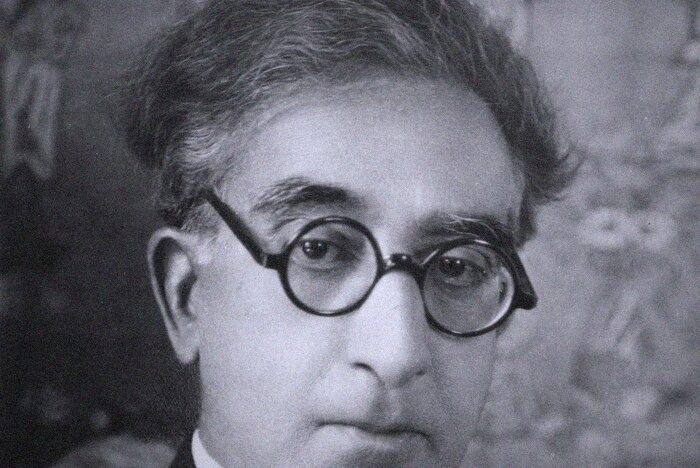
Constantine Cavafy in Alexandria, where he lived for decades in a candlelit flat, sitting in shadow while his guests sat in the light. Photograph via Wikimedia Commons
Before he became a world poet, Constantine Cavafy made himself a local legend. From 1907 until his death in 1933, he lived above a brothel in a working-class neighborhood of Alexandria, Egypt. (“Up here is the spirit; down there is the flesh,” he quipped.) Writers and intellectuals gathered in his rooms for impromptu seminars. Tall bookcases displayed ancient texts, historical treatises, dictionaries. The rugs and tapestries were frayed, the chairs fragile. Here Cavafy discoursed on prosody and the rise and fall of empires. Surrounded by family heirlooms, he presented himself, in his words, as “an ultra-modern poet, a poet of the future generations.” By the time they left, lightheaded from the ouzo and mastika he served, clutching a specially chosen selection of his poems, new visitors had become disciples.
The “old Greek poet” is venerated by the melancholy characters in Lawrence Durrell’s suite of novels, The Alexandria Quartet (1957–60). They know their Cavafy by heart and recite “The City” and other favorites the way the religious quote scripture. Today, rue Lepsius, where he lived, has been renamed Cavafy Street, and his second-floor apartment is a museum (or perhaps a shrine). He must be the most translated modern Greek author. His books and papers are housed in the Cavafy Archive, in the center of Athens, and they are available free of charge to readers everywhere, thanks to a vast digital site hosted by the Onassis Foundation.
But familiarity is not intimacy, and the ease with which we can call up Cavafy’s elegant handwriting on our laptops is deceptive. Even as he pursued literary fame with single-minded intensity, half of his charisma was his mystery. He never installed electricity in his flat, preferring the flickering yellow light and dripping wax of tapers. Not only at night but in the day, when his windows were shuttered against the desert sun, he seated his guests with candles beside them so that he could study their faces, while he sat in shadow, present as little more than a voice.
“outside his poems Cavafy does not exist.” Robert Liddell, a British novelist and philhellene, quoted this remark by George Seferis on the first page of his 1974 biography of Cavafy, the first and until now only such biography in English. It was effectively an apology for his book’s existence. Seferis, who became Greece’s first Nobel laureate in literature in 1963, wanted to scare off prospective Cavafy biographers. He felt that the only way to approach his great predecessor was to ignore the personal anecdotes of Alexandria’s literati and hearsay about his sex life. (As word had it, he visited hammams and had affairs with men.) The point was to focus on the poems. Only the poems matter.
Seferis was certainly right insofar as Cavafy’s daily life in maturity was so routine as to seem virtually without incident. In 1892, at the age of twenty-nine, Cavafy took a position as a civil servant in the state bureaucracy, and he remained in that post for a full thirty years, walking the short distance between his flat and the office, there and back, every day. That he enjoyed greeting shopkeepers and casual acquaintances and was habitually late to work, for which he made charmingly implausible excuses, is almost the extent of the excitement. The clerk Cavafy is like the insurance man Wallace Stevens, although in contrast to Stevens, who was a company vice president, Cavafy worked at the Department of Irrigation, and his tasks, as dry and low-level as the name of the bureau implies, consisted mostly of copying correspondence.
Cavafy, especially the young Cavafy, remains an inferred presence, a silhouette.
The real story happened when the clerk went home and, day by day, decade by decade, made himself into a poet of global reputation while writing in Greek, a language spoken by less than 1 percent of the world’s population. Cavafy was the master of, as he classified them, three categories of poems. In his “historical” poems, he took up the theme of decadence in French and British literature and explored it via vignettes and character studies set in the eastern Mediterranean world of late antiquity, which in his hands became a mirror of modernity. In his “philosophical” poems, he created existential fables comparable in some ways to Kafka’s parables. In his “hedonistic” poems, he evoked male same-sex love with a degree of frankness and a depth of feeling that have few precedents in any language. Into this profoundly original body of writing, Cavafy poured his whole life “drop by drop,” as Seferis put it. How do you write about a man who is most alive when he turns away from the world and sits down at his desk? Most literary biographers face some version of this challenge, but the problem is acute in Cavafy’s case. A Cavafy biographer has too much of some materials to work with and not enough of others. As an older man, obsessed with his literary legacy, Cavafy preserved a great deal of paper: not only the usual centerpieces of a writer’s archive—journals, correspondence, drafts—but also train tickets, menus, and all sorts of lists, including lists of lists. He seems to have saved every letter he received. Yet the majority of the letters he himself wrote are lost. Certain facts from his early life are obscure. We know next to nothing about the particulars of his sexual and romantic experience. While some of the missing pieces are due to the Cavafy family’s frequent relocations, stemming from financial misfortune and political upheaval, the lack of information about his sexuality implies censorship by the poet, his executors, or both. In this crucial respect, there is very little Cavafy outside his poems.
In their new biography of the poet, Gregory Jusdanis and Peter Jeffreys begin by professing skepticism about “the artificiality of biography,” inasmuch as the genre requires the construction of that dusty old thing—a single, coherent story. Being unable to produce a satisfying version of the birth-to-death narrative of the writer’s life, because there are too many lacunae in Cavafy’s archive and because too much of his story is a matter of dull routine, the coauthors make a virtue of necessity and proceed thematically. This means approaching Cavafy via his family, city, friendships, reading, and eccentric publication practice. Consequently, the narrative moves “forward, backward, and sideways,” returning to topics from multiple points of view. (When this becomes too confusing, the reader can turn to a chronology at the front of the book.)
For much of the biography, then, Cavafy is seen as a product of the people around him, the places he lived, and the books he read. Constantine Cavafy is a masterpiece of contextual research, evoking everything “outside” the poems in suggestive detail. (By comparison, Liddell’s slim first attempt was amiable and informed but lacked the historical distance and archival resources that the new biographers use to advantage.) The result, however, is curious. When we read letter after letter from Cavafy’s brothers without hearing his voice in response, or when we explore the streets of Alexandria without more assurance that the poet passed this way than a conditional verb provides, Cavafy, especially the young Cavafy, remains an inferred presence, a silhouette.
This shadowiness is consistent with his poetry, where we repeatedly encounter a recessed, elusive subjectivity. In “Walls,” a despairing speaker complains of the barriers that have sprung up around him:
Ah why didn’t I observe them when they were building the walls?
But I never heard the noise or the sound of the builders.
Imperceptibly they shut me out of the world.
(Translation by Rae Dalven)
In “Hidden Things,” a speaker warns us not to “try to find out who I was.” An “obstacle” always interfered with his self-expression. He can be understood only by studying “my most unnoticed actions, / my most veiled writing.” And even then, there may be no point in trying:
Later, in a more perfect society,
someone else made just like me
is certain to appear and act freely.
(Translation by Edmund Keeley and Philip Sherrard)
Cavafy, who saw himself as a poet of “the new phase of eros,” was fully modern in that he understood homosexuality as an identity rather than a behavior. So it is easy to read “Hidden Things” as the lament of a closeted writer who suffered from the threat of stigmatization and yet, like a prophet, foresaw a time in which people “made just like me” would be able to express themselves without censure.
But this reading of the poem is too easy. Scholar of history that he was, it is unlikely Cavafy believed a “more perfect” society was waiting up ahead. Refined verbal stylist that he was, it is unlikely he looked forward to his “most veiled” writing no longer being of value or interest. We have to ask ourselves: Does this “I” belong to Cavafy or to a dramatic fiction of some sort? To a character who is bravely, or perhaps foolishly, clinging to his faith in civilizational progress? What is Cavafy really saying? Reading his poetry, we continually discover potential ironies and ambiguities of this kind, “hidden things,” even when it seemed we might someday be free of them.
cavafy’s feeling for decline and decay had a basis in his family history. He was born into luxury, in 1863, as the youngest of the seven sons of Peter John Cavafy, a Greek cotton trader in Alexandria. The Greek merchant class in Egypt became wealthy when the American Civil War disrupted the British textile industry, resulting in greatly increased production and inflated prices for Egyptian crops. The cotton boom was over by the time the poet’s father died in 1870, and his lavish lifestyle had left his family in debt. Nine-year-old Constantine and his mother, Haricleia, moved to England, where the family had been living prior to his birth, and the Cavafy brothers tried to shore up their business interests in Liverpool and London. But in 1877, the family returned to Alexandria no better off. They would never recover their wealth or the social status that came with it.
The Cavafys were part of a Greek diaspora that saw art as a reward for, and complement to, commercial success. Money made it possible to appreciate art and to create it, and art was an alternative source of distinction once the money was gone. The Cavafy brothers fostered the talent of young “Kosti,” believing in his poetic genius and taking pride in it for themselves. Constantine was closest to Paul and John. Paul, with whom he briefly shared the flat on rue Lepsius, was a queer dandy in the fin de siècle mode. His later years were hard, and he died penniless and alone in France, perhaps making him one of the models for the young men who come to no good in Constantine’s poems. John, a published poet with skill but limited inspiration, made the first English translations of his brother’s poetry. The family honor and intimacy-in-adversity that bound all seven brothers together eventually gave way to alienation under the pressure of failed ambitions and ever-present money worries. Yet as Cavafy’s brothers followed one another into the grave, the coldness and selfishness for which he later became known can be read as symptoms of his grief. His obsession with fame is not an attractive trait. But it reveals the burden of the last man standing, who struggles to preserve his family name when everything else has been lost.
Support Our Commitment to Print
Subscribe to The Yale Review. Receive four print issues a year—essays, fiction, poetry, and criticism.
His family’s fortunes also influenced Cavafy’s sense of what it meant to be a modern Greek. “Never forget about the Greeks that we are bankrupt,” he told E. M. Forster, who fell under the poet’s spell while he was in Egypt as a Red Cross volunteer during World War I. “That is the difference,” Cavafy continued, “between us and the ancient Greeks and, my dear Forster, between us and yourselves,” meaning the English. “Pray, my dear Forster, that you—you English with your capacity for adventure—never lose your capital, otherwise you will resemble us, restless, shifty liars.”
British manners were second nature to Cavafy long after his early years in England. He and his brothers spoke English fluently and moved in and out of it in their letters. He himself spoke Greek with an English accent and liked to make a show of it. The two languages and cultures had long been linked for him. The first Byzantine church that impressed him, with its candles, icons, incense, and chanting, was in Liverpool. His fascination with classical antiquity may have begun with a visit to the Elgin Marbles at the British Museum. The roots of the funerary aesthetic in his mature poems were nourished by family trips to the Greek cemetery in London. As a young man of letters, he wrote an essay about the influence of Greek thought on Shakespeare. “Ithaka,” perhaps his most famous poem, approaches the Odyssey by rewriting Tennyson’s “Ulysses” (a poem that he discusses in another early essay).
From Alfred Tennyson and Robert Browning, Cavafy borrowed the dramatic monologue and made it a vehicle for his historical poems. From a poem like Browning’s “My Last Duchess,” he learned the value of including a character who remains disconcertingly silent while another holds forth. In “Homecoming from Greece,” one of the many Cavafy poems set in the Hellenistic period, a philosopher on board a ship urges his companion to confess that it is a relief to leave Greece and return to the eastern Mediterranean:
Let’s admit the truth from here on in:
we too are Greek—what else could we be?—
but with loves and with emotions that are Asia’s,
but with loves and with emotions
that now and then are alien to Greek culture.
The philosopher’s speech rises to a stirring conclusion in praise of the hybrid and impure:
Of the blood of Syria and of Egypt
that flows in our veins, let’s not be ashamed;
let us revere it, and let us boast of it.
(Translation by Daniel Mendelsohn)
This is eloquent, and just the sort of thing we might expect Cavafy himself to say. But when we take the companion’s silence into account, the rhetoric feels strident, perhaps even bullying. Hermippus, as the companion is called, may not be ready to embrace shameful loves and emotions out there on the edge of empire.
unlike in athens, where the classical past is a physical presence, there were few ruins in Cavafy’s Alexandria. Antony and Cleopatra had made love there, but the only evidence of that lay in books. This absence encouraged the poet to “develop his own peculiar and spectral understanding of the classical heritage,” as Jusdanis and Jeffreys point out. “Rather than pining for magnificent temples and masterpieces of sculpture, he welcomed the ghosts of Hellenistic Alexandria at home.” That image comes from “Caesarion,” a poem in which Cavafy’s speaker recalls picking up “a collection / of Ptolemaic inscriptions” to pass the time. A brief mention of Caesarion, the son of Cleopatra and Julius Caesar, caught his eye, and the very obscurity of this figure, forgotten by history, stimulated his imagination, enabling him to form an image of the youthful king “more freely in my mind.” Suddenly, the seventeen-year-old of mixed blood, put to death by Octavian, entered the room:
you seemed to stand before me as you must have been
in vanquished Alexandria,
wan and weary, idealistic in your sorrow,
still hoping that they would pity you
the wicked—who murmured “Too many Caesars.”
(Translation by Rae Dalven)
“Too many Caesars” is a remark by one of Octavian’s advisers, playing on a line from Homer. The fragmentary phrase was enough to summon, for Cavafy, the ghost of “vanquished Alexandria.”
Since the city’s founding by Alexander the Great, the cultures of Greece and Egypt had been intertwined in Alexandria, and Cavafy saw himself as an Egyptian Greek (“Egyptiotis”). What did that mean, exactly? He had no interest in the Pyramids of Giza and the Sphinx—“I don’t understand those big immobile things,” he said—and there is scant record of his attitude toward the Arab majority in Egypt. Jusdanis and Jeffreys note that Cavafy knew “very little Arabic” and that he had an Arab servant but few Arab friends. In these ways, he was typical of middle- and upper-class Europeans in Alexandria who were proud of their British and French cultural heritage and stood apart from the city’s Muslims.
Yet Cavafy’s Anglophilia and his love of Baudelaire did not mean that he supported European domination of Egypt. In 1882, disaffected Egyptian military officers led a nationalist challenge to Egypt’s Anglo-French-aligned government; riots broke out in Alexandria; and Muslim Egyptians began attacking Europeans in the streets, crying “Death to Christians!” The Cavafys fled to Istanbul, where Constantine lived with his mother and her extended family for three years. (“I am from Constantinople by descent,” he remarked proudly, using the Byzantine name of Istanbul, with the implication that his birth in Alexandria made him an exile in relation to the city that had been the center of Greek culture and learning for a millennium.) Upon the family’s return to Alexandria, they found their property destroyed (including some of Cavafy’s papers). British warships had put down the revolt by turning their cannons on the city.
Cavafy did not socialize with the British in Egypt, the exception being Forster, who was the eager one driving their friendship. Cavafy’s habitual lateness to work perhaps hints at some insolence toward his British superiors. But Jusdanis and Jeffreys go much further, maintaining that Cavafy was an outraged critic of British rule. They base that claim on his sustained interest in the Denshawai affair, an incident involving British military officers and Egyptian villagers that led to the hanging of four Egyptian men and the flogging of many more at the orders of a British special court. In “June 27 1906, 2:00 P.M.,” Cavafy focuses on the suffering of “the innocent / seventeen-year-old youth,” whom the British “strangled,” and on his mother, whom he depicts rolling “on the ground” with inconsolable grief. (This translation is by Rae Dalven.) The title’s specification of the date and the precise time of the verdict gives it a brutal actuality.
The trouble is, as the coauthors acknowledge, the poem is “a unique document in the Cavafian corpus”—unique because it deals with a hotly contested contemporary event, and because the people in the poem are Muslim. (Some of the young men in other poems may be Muslim, but none is clearly marked as such.) Along with many other completed poems, Cavafy put this one in a drawer. There is no silent character to comment by inference on what is said in “June 27 1906, 2:00 P.M.” But when it comes to Cavafy’s feeling for his Arab neighbors, the poem is an isolated piece of evidence with silence all around it.
cavafy’s approach to publication was highly unusual. Although his poems appeared in periodicals, he never published a conventional commercial book. Instead, he had his poems printed individually and gave them to friends as loose broadsheets. In 1904, he selected fourteen poems to be printed in a run of one hundred copies. In 1910, he produced another bound edition of twenty-one poems with a run of two hundred copies. After this, he reverted to distributing his broadsheets by hand in ad hoc collections. The broadsheets were stacked in an “improvised ‘bindery’” or “scriptorium” in his apartment, where he would prepare selections particular to the recipient. Through this oddly private mode of publication, he ultimately distributed at least twenty-two hundred handbound collections of his poetry.
Cavafy did everything he could to control his poetic reception. He dictated a chapter in an associate’s book explaining and (of course) praising his own work. When his innovative poetry became the subject of sharp attacks, he created a “pro-Cavafy” magazine. His bespoke gifts of poetry turned readers into initiates. Not trusting the mail, Cavafy depended on intermediaries to convey his poems to far-flung admirers. This method meant that the reading of his poems retained an aspect of personal encounter: it kept the work between friends. It also guaranteed that no one, not even the most devoted disciple, had access to his work as a whole.
Given his ambition, we might expect Cavafy to have welcomed translation of his poetry. But this was not the case. Forster badly wanted to see a book of his friend’s poems published in Britain. Their correspondence about this matter was comically protracted, as Forster pursued Cavafy and was met with dithering or silence. Even a letter from Leonard Woolf inviting Cavafy to publish with the Hogarth Press failed to win him over. He may have been anxious about seeing his erotic poems in print. He would have been reluctant to give up his usual level of control, and as Jusdanis and Jeffreys note, his “supreme self-confidence” was always shadowed by “crippling self-doubt.” But it is also possible that, knowing the target language as well as he did, he felt his style could not be translated into English without losing what was essential to it.
That figure floats somewhere between a photograph and a fantasy, a dream image generated by the poems.
By Jusdanis and Jeffreys’s count, there are now more than thirty selected or complete translations of Cavafy’s poetry in English “by major literary figures.” The number of translations implies the insistent lure of the task—and the difficulty of succeeding sufficiently to delay the next attempt. Truly, it doesn’t look that hard. Like so much English verse, Cavafy’s poetry often has an iambic basis, and it depends on statement and implication rather than metaphor, wordplay, or description. His poetry is often described as “dry,” even “desert-dry.” Cavafy went so far as to call the use of adjectives “a form of weakness” that “debilitates speech.” Although his early poems were composed in the purist register, the artificially constructed language known as Katharevousa, for which there is simply no English equivalent, he later repudiated his early work and became a poet of the demotic.
So it is not surprising that English translators often treat him as a plain-style free-verse poet. The results, in some cases, have been so plain as to seem banal, leaving the Anglophone reader to wonder what all the fuss is about. But the texture of his poems is a good deal more complicated than English translations usually suggest, let alone capture. To begin with, Cavafy did not give up on the purist register and what he called its “moribund splendors.” He marbled his demotic diction with it, creating layers of historical reference. (“It is one of the talents of great stylists,” Cavafy declared, “to make obsolete words cease from appearing obsolete through the way in which they introduce them in their writing.”) Many Cavafy poems do not rhyme, but more than half do, while internal rhyme and complex expressive rhythms are everywhere. In short, what might seem to be a lack of verbal ornament and formal intricacy turns out to be an abundance. Once, when a protégé grew impatient with his discussion of the fine points of metrical analysis and said, “Certainly, maître, all of these are details,” Cavafy snapped: “What else is art but details?”
For all of us reading his work in English, then, the difficulty of finding Cavafy outside his poems is compounded by the difficulty of finding him inside them. W. H. Auden claimed that what survives of this poet in every translation he knew is “a tone of voice, a personal speech.” But how could “a tone of voice” come across without the “details” Cavafy felt were everything in art, and which in this case are specific to his Greek? Reading a Cavafy poem in English is like observing a visitor in his salon: the face of the translator illuminated by candles, the poet sitting in the dark. Still, Auden may have had a point. Tone is a function not only of voice but of manners, a way of treating the reader, and Cavafy’s manners, with his British-accented tact and indirection, his trick of saying more by saying less, translate rather well.
Those manners are essential to the power of the erotic poems. In “The Afternoon Sun,” Cavafy’s speaker finds himself in a room he knows intimately, because he used to meet a lover there before their lives diverged and the building was “taken / over by agents, businessmen, concerns.” (The translation here is by James Merrill.) He recalls the arrangement of objects in the room and mentions making love there “so many times.” But rather than say more about that or describe his lover, he points to where the bed had stood, noting that “the afternoon sun used to reach halfway” across it. For a moment, we are in the presence of those lovers, not because we see them but because we are seeing what they saw.
Poets create poems, but the converse is also true, and despite Seferis’s qualms, we need literary biography, in Cavafy’s case as much as any poet’s, to track that back-and-forth. Over the course of his career, Cavafy’s supersubtle poems created the figure that Forster first introduced to English readers as “a Greek gentleman in a straw hat, standing absolutely motionless at a slight angle to the universe.” That figure floats somewhere between a photograph and a fantasy, a dream image generated by the poems. For who else could have written them? The portrait of that Greek gentleman in Jusdanis and Jeffreys’s marvelous book is a great deal longer and more detailed than Forster’s telling sketch, without, it might be objected, making him any less of a mystery. But that is as Cavafy wished it, and as his poems will go on insisting.
Langdon Hammer is the Niel Gray, Jr. Professor of English at Yale University. He is the author of James Merrill: Life and Art and, with Stephen Yenser, coeditor of A Whole World: Letters from James Merrill. He is at work on a critical biography of Elizabeth Bishop.
Support Our Commitment to Print
Subscribe to The Yale Review. Receive four print issues a year—essays, fiction, poetry, and criticism.