When v was born in late 2015, shoved violently from my body on choppy Pitocin surf and handed to me by my husband, I knew from her face that it had been rough for her too. She eyed me warily.
Respect, I thought.
The adrenaline of labor didn’t subside but became the baseline of an anxiety so profound I was unable to sleep for days, then weeks, after her birth. When I closed my eyes, blue shapes slid across the screens of my lids; when I opened them, it felt as if something were obscuring the center of my vision, and only at the periphery, it seemed, could I occasionally catch glimpses of what was left of the world.
The thing obscuring everything else was my daughter’s body.
It was a frigid New England Christmastime, and people kept stopping by, wanting to meet V in her purest form. They brought wet boots, sneezing children, sickly sweet paperwhites, burnt cookies, scratchy woolen knits smelling of attic, and books on sleep training with complicated charts. But V knew perfectly well how to sleep. She went about it as intensely and purposefully as she went about everything else, grousing a little and retreating deeply into herself. I was the one who apparently needed someone to swaddle and soothe me, to relieve me from the weight of what we had done.
My mother, nostalgic about her days in La Leche League, the breastfeeding advocacy group that has at times looked askance at women who rely on bottle-feeding and formula—that is, most mothers who work outside the home—sent messages from the other side of the country: “Got milk?” No one had warned me that breast milk took a few days to come in; certainly no one had informed V.
The first postnatal doula we hired was very young. She declared V “high-needs,” constructed elaborate tents out of muslin blankets above her crib, and played white noise from an app on her phone. The second postnatal doula we hired was very old, with the sulfurous air of unspoken grievances. She informed me that I had failed to bond with my baby. After we fired her, I discovered that my copy of Vivian Gornick’s Fierce Attachments was missing from a stack of books on the coffee table I’d read in the months before my daughter’s birth.
I had wanted to be prepared. I’d bought What to Expect When You’re Expecting, downloaded the pregnancy apps, and so on. Looking at them was another matter; was there really no quick-start guide? I had ended up preparing in a different way: with the author Rachel Cusk fleeing a coffee shop as she held out her roaring, colicky baby in front of her “like something on fire” in A Life’s Work: On Becoming a Mother; with the sculptor Anne Truitt eking out time in the studio amid housekeeping duties and bills in Daybook: The Journal of an Artist; with the poet Audre Lorde’s realization that she holds both her mother’s “secret poetry” and “hidden angers” in Zami: A New Spelling of My Name. I had smiled in recognition, while reading Maggie Nelson’s The Argonauts, when Nelson asks: “Is there something inherently queer about pregnancy itself, insofar as it profoundly alters one’s ‘normal’ state, and occasions a radical intimacy with—and radical alienation from—one’s body? How can an experience so profoundly strange and wild and transformative also symbolize or enact the ultimate conformity?”
I had not really understood, before giving birth, that parenthood was where society met my body.
These ideas were sustaining during the months when V and I were getting to know each other and I would startle at a tiny sneeze from the next room or bolt from bed in panic at a hungry cry. They clued me in to how scary it could feel to be permeated by love that sets its own paradigm. They assured me that the difficulty of this transition wasn’t due to any deficit of affection. Love wasn’t always perfectly executed, but it was undeniable, and its exigencies would become perceptual filters. I relished the moment in Daybook when Truitt’s daughter Mary, playing in the bath, asked her whether artists were “just born that way.” Truitt replied that she thought they might be. “I had been absorbing her brown body against the white tub, the yellow top of the nail brush, the dark green shampoo bottle…her orange towel, and could make a sculpture called Mary in the Tub if I ever chose to.”
Still, I had failed to grasp an obvious fact of parenthood: that I had bound myself irrevocably to the world and made myself freshly vulnerable to it. Nothing had prepared me for the cruelty of a culture that aggressively advocates breastfeeding and attachment parenting but has no federally mandated paid family leave. (Working wasn’t optional for me, as it had been for my mother; as a writer under contract, I was back at my desk within ten days.) I had not really understood, before giving birth, that parenthood was where society met my body, and that caregivers were continually making up for civilization’s many lacks, expected to embody all things lovingly boundless, unconditional, and selfless in a bottom-line world. I felt reduced to a symbolic ideal that didn’t align with the values of the society in which I existed as an actual woman, under real circumstances.
“I told my daughters, ‘You can have it all! You just don’t have to do it all at once,’” a well-meaning matron of taste and style had declared at a book festival fundraiser I’d committed to while I was still pregnant. She was talking about a scene in Elena Ferrante’s Neapolitan Quartet in which Lenù, in the trenches of new motherhood, struggles to write, but she might as well have been speaking directly to me. There was nothing unusual about my situation—most mothers do, in fact, “do it all at once,” not because they want to “have it all” but because they must. I had a baby, I had a job—one that allowed me to work mostly from home, with a wonderfully understanding editor and a very involved husband. He was stressed himself, being new to not only parenthood but my country, tasked with working out his professional future in a foreign context and language. In addition to his support, I had a mother-in-law who stayed for months at a time to help us. How lucky was I?
But three weeks in, I was nearly catatonic with insomnia. My anxiety was so vast and all-consuming that it seemed absurd even to me, not to mention counterproductive, as our pediatrician informed me at our first well-baby visit. In retrospect, this monolithic anxiety seems rational, given that so much of my nonliterary preparation had taken the form of risk management: bulleted lists of things to avoid, like phthalates, sulfates, bisphenol A, pesticides, lead paint, high-food-chain fish, turkey sandwiches, unpasteurized cheese, even my own bad mood—any of these things could have harmed my daughter’s developing nervous or endocrine system irreparably.
Even worse was sudden infant death syndrome. We could not leave V in her crib on her stomach, we were warned in the hospital, as it increased the risk of sudden death. Nor could we place her on her side, as that, too, correlated with sudden death. The only safe position for sleeping babies was on their backs, a position inhospitable to rest, and so they had to be swaddled, straitjacketed in a blanket using a complicated folding technique. Just as I finally mastered this, a push notification from one of my pregnancy apps arrived: swaddling linked to sudden death.
But there was nothing, my obstetrician said, to be worried about.
Meanwhile, I could no longer read the newspapers or watch the films or stream the limited TV series that everyone said were so great, in case the plots involved the harm of young girls, their bodies so often offerings on the altar of narrative stakes. Violence against children could be literary: Ferrante’s Lila is hurled out of the window by her father, thrown “like a thing” for the crime of wanting to attend middle school. But it was also real: the summer before my daughter was born, a toddler in polka-dot leggings washed up on a Boston Harbor beach, wrapped in a plastic bag. By the time V was one, family separations—children too young to know their parents’ names taken away from them at the southern border—dominated the news. Violence was real, epistemic, and viral.
Inviolable was the word that came to mind when I beheld V, when I bathed her in the kitchen sink—her un-sat-upon behind, her dangling truffle feet dripping water. The inward focus, the hum of her becoming, was often so intense I could have drowned in the surge of oxytocin that her body elicited in mine.
But what kept me up at night was her violability.
“Think of something else,” my husband said. But my daughter’s body, the thought of it tucked safely in her pastel owl-print sleep sack, was also my solace.
Life, as the old joke goes, is the leading cause of death. In creating great love, we create the potential for great loss. I understood then that all of it—the paperwhites and the pastel owls, the apps and the sleep-training manuals—was just a distraction from the unbearable weight of love that had kept me up for three and a half weeks straight, deranged with insomnia, listening for the next breath.
i was giving v another bath in the kitchen sink when a memory came to me. I was probably four myself, and I was in the tub with my own mother, both of us naked, laughing, enjoying the warm water on our skin. My father entered the bathroom, looking for something in the medicine cabinet. He made a comment to my mother about her body. “When you grow up, will you have that too?” I remember him asking me. I feel his intrusion, hard and masculine. I see us both from his perspective. “No!” I said. Forty years later, my face still burns at this exchange.
My mother had once written up a childhood memory of her own and shared it with me. It vividly recalled an Easter parade at her childhood church in Chicago, where a nun had shamed her for wearing a dress that exposed her arms. The account then jumped abruptly to a scene of my mother holding her newborn daughter—me. It will be different for you, she promised me.
She had written an essay, or the hint of a beginning of one, about the inculcation of body shame, but I also felt it was an essay about passing the buck. How, exactly, would it be different for me, when she couldn’t name the problem? I had loved her body. It had created miracles; it had been my comfort and my shelter. But the shame I felt she’d internalized was my mother’s milk.
shame corrodes those parts of us that are generative and expressive, shutting us down, filling us with self-doubt. It uses the opposite impulse that art-making does. But as some artists have taught us, if you can see it for what it is, if you can bear to call it out, shame can be both medium and message.
“I started writing and realized I was ashamed to be a woman,” the critic Lucy Lippard has said, recalling how she became a feminist. It was the early 1970s, after her divorce; she had just begun working on her experimental novel I See / You Mean, which traced her consciousness-raising. It’s a quote that still stops me in my thoughts. What did she mean by “ashamed to be a woman”?
I don’t know what the tipping point was for Lippard, who later wrote that the novel “had brought home to me the fact that I was not one of the boys.” Perhaps it was an accumulation of things, personal and professional. (In 1969, Clement Greenberg had singled her out for derision among other “lady art critics.”) Perhaps she meant that she was ashamed to be associated with the qualities traditionally identified with femininity. Ineffectuality, irrationality, and emotionality. Moral and physical weakness. All those coded words—small, shrill—for the feminine.
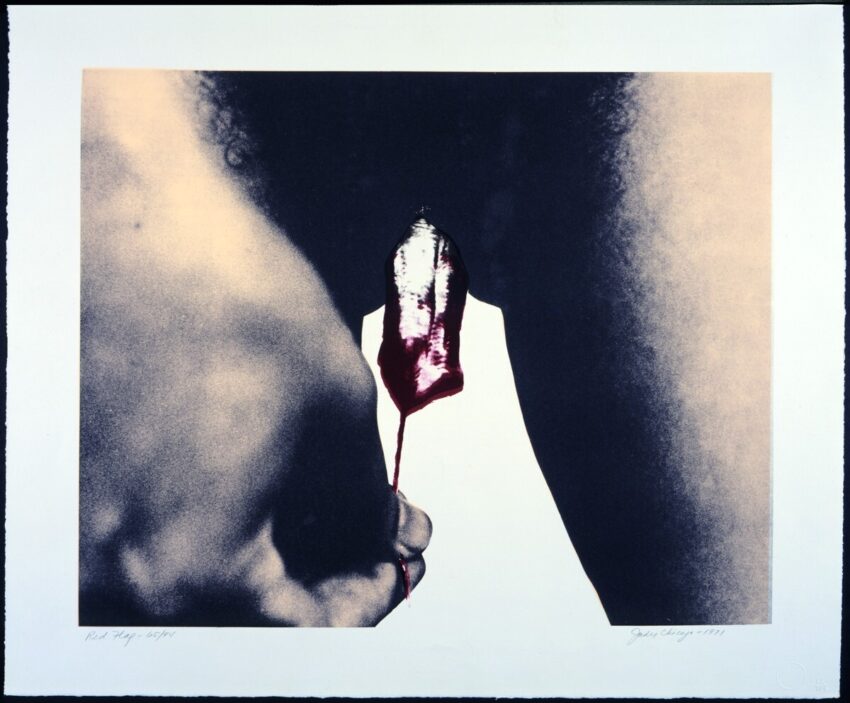
Was I, too, on some level, ashamed to be a woman? It seemed so unlikely; it had often been the men in my life who struggled to regulate their emotions; many of the editors and friends I trusted most were women. But it was true enough that, while coming of age in the 1990s, I had more or less taken feminist art—the strands of it Lippard had written about and showcased in the 1970s and 1980s—for granted. I had never given much thought to women who put bodies, often their own, in their work—like the multimedia artist Judy Chicago with her 1971 photolithograph of a tampon emerging from a vagina, Red Flag, or the filmmaker Carolee Schneemann, who pulled a written manifesto out of her vagina in her 1975 performance piece, Interior Scroll. They didn’t embarrass me, but I’d never found this kind of work especially interesting; by the 1990s, it seemed no longer radical but slightly kitschy.
The second version of Schneemann’s vaginal manifesto channeled the voice of a male filmmaker deriding her experimental art:
The dense gestalt was, of course, exactly the point of work like Schneemann’s, which reclaimed women’s bodies from the realm of the classical, abstract, and decorative: a counter-representation of everything that had been denied and suppressed in femininity. It was also a reaction to the notion that art is a strictly intellectual pursuit, detached from the realities of our embodied presence in the world. “My whole problem with theoretical structures has to do with their displacement of physicality,” Schneemann explained in a 1994 interview, “as if there is a seepage or a toxicity from the experience of the body that is going to invade language and invalidate theory.” The usual criticism—that such work was essentializing—felt wide of the mark, given that these artists were reacting precisely to having been essentialized. They had taken their shame at being women and made blunt instruments out of it.
So, what had been my problem?
Maybe, from my late 1990s vantage point, I had thought that I didn’t need vagina art in a postfeminist era (an impossibly quaint notion thirty years later). My inability to empower myself by donning a pussyhat in 2017 perhaps emerged from a related arrogance.
But at some point after my daughter’s birth, I had begun to think of vagina art differently, as a more explicit variation of “ucky” art, to borrow a term Eva Hesse once used to describe her work to Sol LeWitt. Hesse, a postminimalist artist who gained attention in the 1960s, made soft sculptures out of latex, suggestive of skin and bodies and entrails. She wasn’t a feminist in the sense that Schneemann and Chicago were; she wasn’t explicitly taking on the patriarchy. But the objects made by Hesse, who was a toddler when she and her Jewish family fled Nazi Germany (her mother died by suicide when Hesse was ten), were nothing if not of the body. They were the opposite of the hard-edged, industrial, ultrasmooth, geometrically pleasing “specific objects” that the sculptor Donald Judd was making; they were droopy, porous, and vulnerable, intentionally prone to decay. In her 1976 monograph on Hesse, who died of a brain tumor at thirty-four, Lippard wrote:
An integral part of Hesse’s work is that certain pleasure in proving oneself against perfection, or subverting the order that runs the outside world by action in one’s inside world, in despoiling neat edges and angles with “home-made” or natural procedures that relate back to one’s own body, one’s own personal experience.
By the early 1990s, Schneemann sounded a little defensive about Interior Scroll, writing in Art Journal: “I didn’t want to pull a scroll out of my vagina and read it in public, but the culture’s terror of my making overt what it wished to suppress fueled the image; it was essential to demonstrate this lived action about ‘vulvic space’ against the abstraction of the female body and its loss of meanings.”
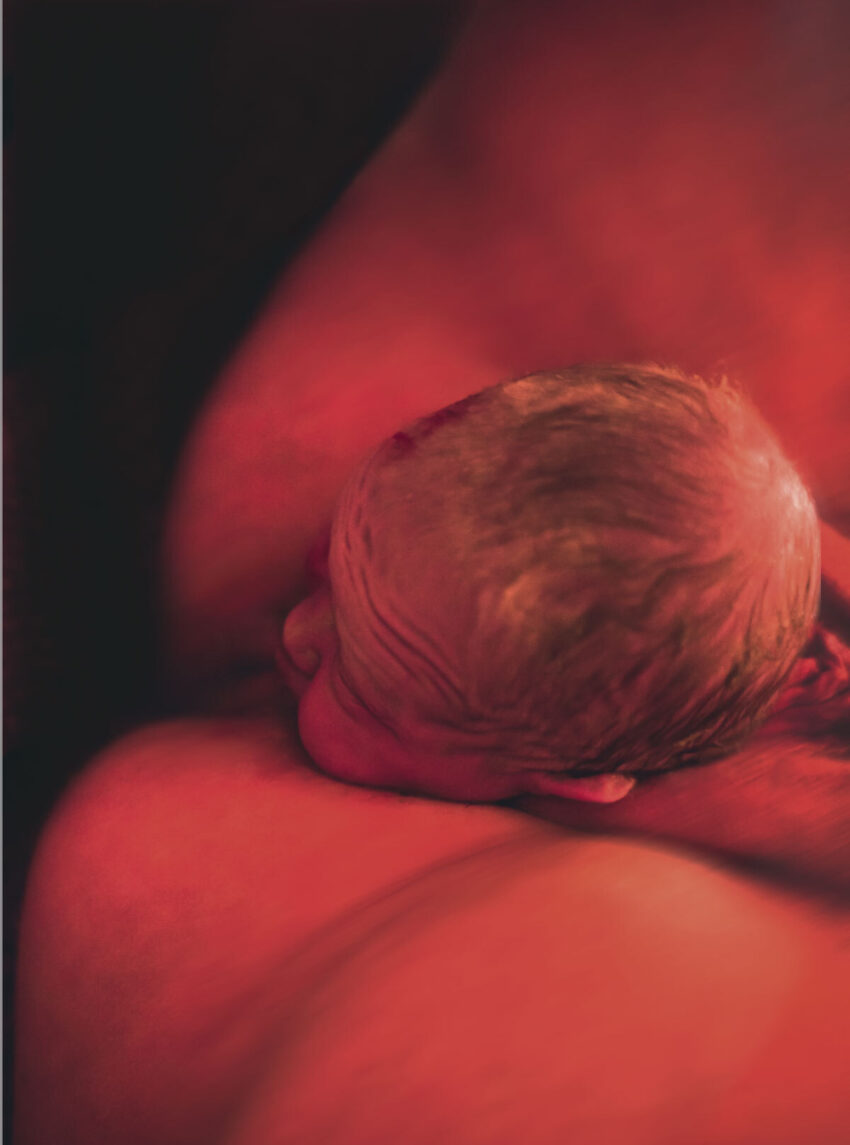
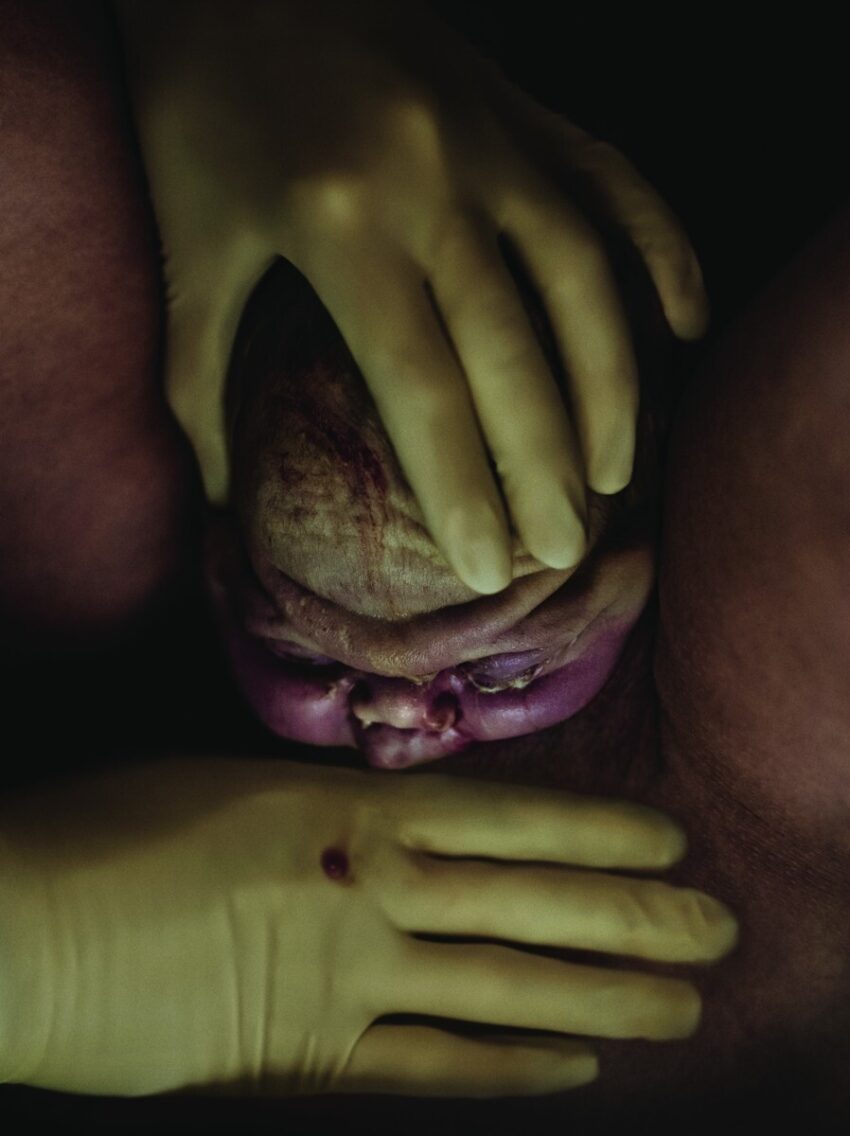
when i first saw Heji Shin’s Baby photos—closely cropped large-format portraits of crowning infants—at the 2019 Whitney Biennial in New York City, I felt a shock of recognition. Here, writ enormous, was Schneemann’s “vulvic space.” Gory, rumple-faced, with blood pooling in their eyes, the babies abstracted nothing.
Heji Shin, Baby (20), 2017. Courtesy the artist
They seemed to Shin like something from The Exorcist, she told me when I reached out and asked about her initial reaction to the results of the shoot. (She had worked with a midwife to obtain permission from the mothers, who received a set of conventional photographs of the delivery in exchange for allowing Shin in the room.) Her retoucher had started to cry on first sight of the images. But as the horror-movie thrill of them wore off, the Baby photos took on other meanings. Men often reacted more positively to the images, Shin said, finding in them an analogy for art-making. Once babies entered the realm of metaphor, they were deemed acceptable as art.
Talking to Shin—who is not a parent—I realized that looking at the Baby series was probably the first time I had seen new motherhood depicted unsentimentally. To have a child is to take a risk, to make art is to risk, and here, embodied in Shin’s bloody babies, was all the fragility of the human animal and its ferocity of will. The photographer seemed relieved when I told her they were the closest thing I’d ever seen to my own experience. I didn’t find the Baby series transgressive, nor did I see the images in metaphorical terms. They were true, and they were a relief.
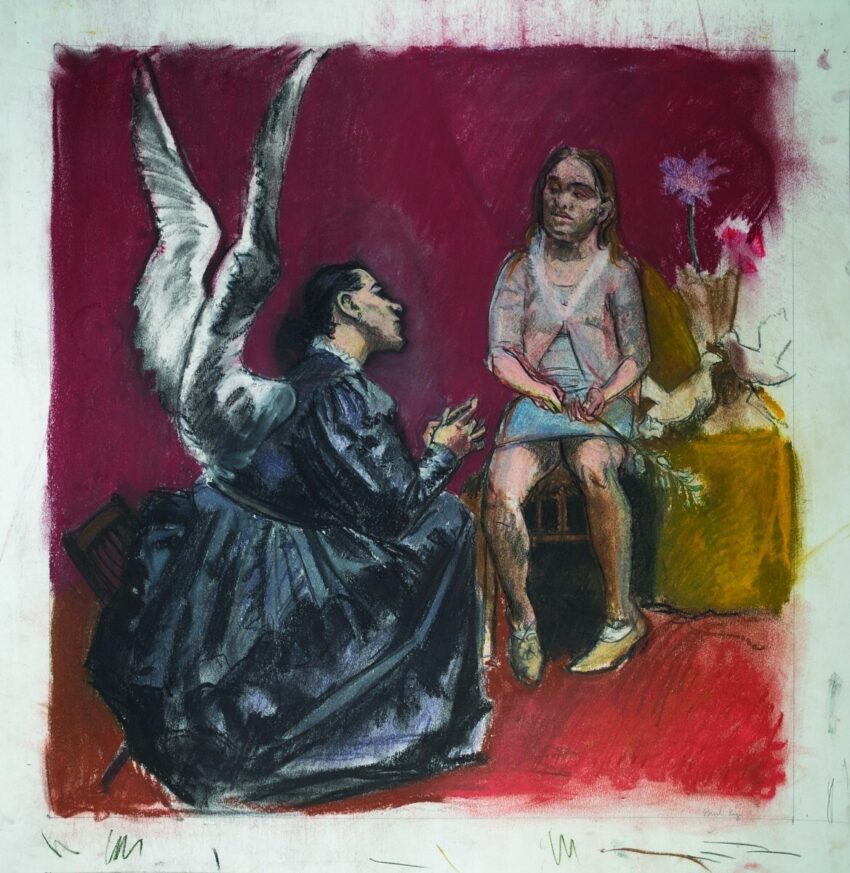
It surprised me that Shin, who was born in Seoul, had grown up in a Catholic residence for children run by nuns in Hamburg—her mother, a nurse, had immigrated to Germany when Shin was four—and that religious iconography had been formative. The lush aesthetics of Catholicism came back to me as we spoke: Christ’s suffering, Mary’s haloed beauty, the familiar motifs rendered in stained glass or mosaic. Jesus’s story has always been the embodied one, his journey from radiant swaddled infant to human sacrifice, dripping blood from his crown of thorns. Though her body is central to Christian narratives as a divine vessel, Mary is traditionally depicted more symbolically, dressed in blue, the emphasis on her purity and receptivity. In 2002, the Portuguese British artist Paula Rego humanized her in a series of drawings and paintings. Using her own granddaughter as a model, Rego depicted the mother of God as a contemporary adolescent, stricken and vulnerable.
Esther Strauss, crowning, 2024. Courtesy the artist
Being an artist, Shin had remarked, was all about deciding what was sacred and what was profane. I thought of this when crowning, Esther Strauss’s sculpture of the Virgin Mary giving birth, was beheaded by unknown vandals on July 1, 2024, while it was being exhibited in an Austrian cathedral. A week later, on the University of Houston’s campus, Shahzia Sikander’s Witness—an eighteen-foot-tall female figure, a salute to feminine resilience, deemed “satanic” by a Texas antiabortion group—was also beheaded. Sikander declined to create a new head, and the university complied with her request to leave on view her decapitated tribute to the power of women.
was i really naked when I was first sent to you? V asked me one night, after the bath and story. Yes, I explained, we all arrive naked, but there are people waiting for us with blankets.
She had begun wanting to reenact her birth. Lying in bed together, we’d play a game of pretend: she’d be a new puppy or a cub or a kitten, hiding under her bedcovers, and I’d play the appropriate mother animal, all eager anticipation. After a brief wait, she’d emerge wearily but triumphantly, and I’d hold her in my arms as though for the first time, one body becoming two.
When she’s upset, it’s my body she most often (re)turns to. At three, V had a bad fall at the pool outside our apartment: lurching forward suddenly, she went flat on the pavement, face-first, stunned. Only when I gathered her in my arms did the sobs come. The scrapes minor, the betrayal by a world that allowed such things to happen colossal. In moments like that, her body is given back to mine, her breath syncing up with my own as she calms. Technically, she is still part of my body and always will be. When she was in utero, cells migrated between us that live on in our body tissues through a process known as microchimerism. The effects of these cells aren’t fully understood, but it’s not a neutral process; the cells active in both of us can be beneficial—or not.
And then I would think about how tawdry this kind of fantasy was, the drive-by glance into the abyss.
Tending to my daughter’s body was a big part of the job when she was four and five: detangling, clipping, folding clothes, locating the dachshund-shaped hair clip—mother as valet. I was often a little impatient in the early mornings before school, V stubbornly with her nose in a graphic novel while I pulled clothes over the top of her and under the bottom of her; inevitably, the book would end up stuck in one sleeve, and only one leg would make it into the jeans. Hopping around the room on one foot, she’d gun for laughs.
Sometimes while dressing her, I imagined getting the call—from the police? Who makes such calls?—and having to tell someone what she had been wearing that morning. And then I would think about how tawdry this kind of fantasy was, the drive-by glance into the abyss.
I had heard that children discover their bodies from the head down—that is, arms before legs. I remember watching my baby daughter, propped up on a nursing pillow, as she gazed at her right hand, then her left, captivated by the insight that these appendages were part of her body. A couple of years later, I walked into her room and found her standing in a straddle, upside down. “I believe she has discovered her vagina,” I texted my friend Nell. “That’s huge!” Nell texted back. “And very small 😀.” Vagina, vagina, vagina, my husband and I name it and normalize it. There will be no cute euphemisms for body parts.
One day, apropos of nothing, V asked the question: How does the baby get in there, anyway? I explained it to her, but it seemed impossible; this couldn’t be accurate information. A year or so later, she asked again, and with follow-up questions. This time it stuck. My husband and I ordered books. She was untroubled to learn about menstrual periods and body hair. It was just more information.
In October 2020, I was driving V to kindergarten—she was in a green trapper hat in the back, strapped into her booster seat—when NPR announced Amy Coney Barrett’s confirmation to the Supreme Court. Barrett’s voice, her pious tone, was too much for me; I turned off the radio.
“Mama, what’s wrong?” she asked as I pulled myself together.
“I’m OK. Just a little sad today.”
Someday I would attempt to explain the battleground, but my focus then was on body acceptance and body safety. On teaching her that all bodies are different and deserving of love and respect. That she got only one body and it was important to take care of it. That her body was hers alone.
When I said things like this, she wanted to know why anyone would want to hurt her—a question that flummoxed me. I had grown up at a time—an arguably more innocent one, before revenge porn—when the disappearances or murders of young girls were nightly news entertainment. That the world wasn’t safe for girls was a given, and the onus was on them to do the right thing in any situation. The poor choices that got women and girls into danger were the object of discussion, not the culture that made violence sexy. If I got hurt, it was my own fault.
But why would anyone want to hurt me?
I had no idea where to begin.
I told V it was my job to keep her safe, but I wouldn’t always be there, and the best thing she could do was also sometimes the hardest, which was to listen to herself, to what her own body and no other was telling her.
it had begun to feel like a tell that much of the art I had written about and taught, art dealing with the politics of the body, didn’t depict bodies at all, like Glenn Ligon’s paintings of appropriated texts quoting James Baldwin, Zora Neale Hurston, and Richard Pryor, the black-on-white letters blurring into a syntax of illegibility; or the statistics wielded by the Guerrilla Girls on their 1989 poster, Do women have to be naked to get into the Met. Museum? “Less than 5% of the artists in the Modern Art Sections are women, but 85% of the nudes are female,” it explains. (The poster does, sort of, depict a woman’s body—the text is printed alongside a reproduction of an Ingres odalisque, viewed from behind, wearing one of the Guerrilla Girls’ trademark gorilla masks.)
We all have our preferences, and I had always been drawn to abstract or conceptual art without digging much into why that might be. In the age of identity, there was undeniable power to be gained by refusal: rejecting the expectation to be easily read, ignoring suggestions to put your own face or body into your work. An extraordinary lineage of Black American abstract painting—Sam Gilliam’s euphoric rainbow splatters, Rashid Johnson’s imposing black-soap-and-wax-coated works, Jennie C. Jones’s synesthesia-driven minimalism, Howardena Pindell’s formal explorations with circles—had proved just how effective they could be, those experiments with not only form but also radical color, absence, and gesture. I was attracted to codedness. I admired the implicit critique in it. Pindell has traced her fascination with the circle to a root-beer stand in the Jim Crow era, in particular to the red circles that appeared on the bottoms of the glassware, designating them for use by African Americans.
Over the next few weeks, more and more human bodies appeared in class: sick bodies, addicted bodies, aging bodies, scarred bodies.
My problem with figuration, I was beginning to understand, ran far deeper than aesthetic inclination. It had something to do with how thoroughly I had been trained to see bodies, and particularly feminine bodies, as emblematic—of beauty, desire, grace, and so on, but also the opposite of those things. How easily the female body becomes a site of projection; how tough it is to unlearn, even when we recognize the function of these depictions of the body, this impulse to symbol.
How often had I dreamed of leaving my body, with its complications and needs, behind? But something changed with the 2016 election, with #MeToo, and with parenthood. Thrown back on my body, I had no choice but to embrace embodiment. I began, in fact, to crave it.
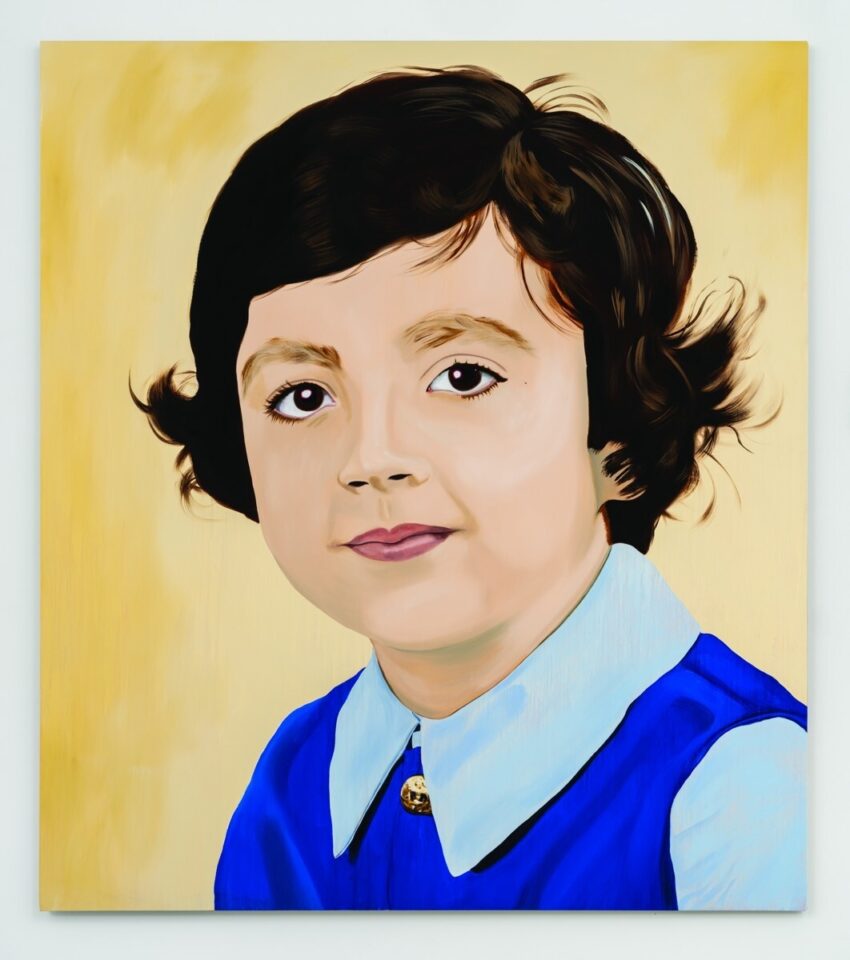
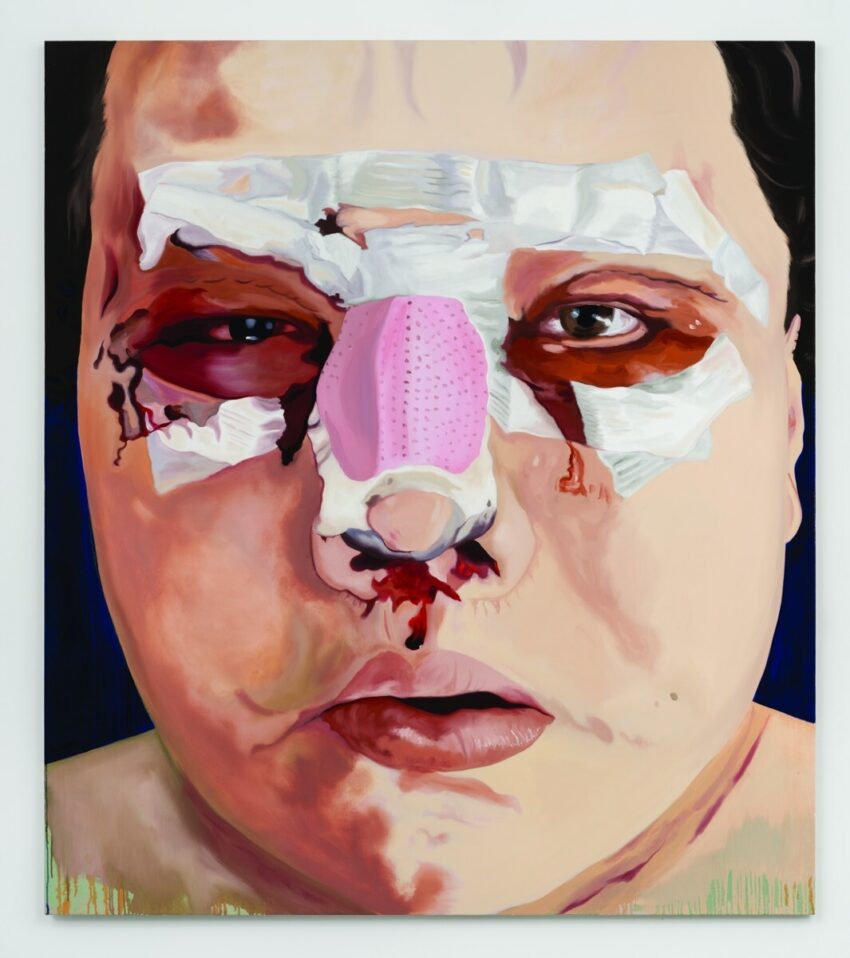
Victoria Cantons, A transgender girl, 2023. Photo: Damian for Hauser and Wirth. Courtesy the Victoria Cantons Studio, London
In my graduate-level classes in arts practices, we often look to examples of more established artists and the conceptual strategies behind their works as they are realized through text and image. The interests and touchstones of the students generally drive our discussions, but one day I gave them a specific assignment: to bring in works of art depicting the human body that they found interesting or challenging. Together, we looked at the Baby series and Interior Scroll; Emily Eveleth’s paintings of doughnuts, all flabby rolls and oozing orifices; Senga Nengudi’s second-skin installations, made of pantyhose; Rebecca Horn’s prostheses; David Hammons’s ghostly grease-and-graphite body prints; Simone Leigh’s chandelier of breast-like abstract forms and magnificent grass-skirted bodies; Ana Mendieta’s figures burned into the earth or buried in grass and flowers. We spent forty minutes discussing a duo of portraits by the British painter Victoria Cantons: one depicts her as a child in what seems to be a school uniform, in a pose reminiscent of a formal portrait, the other as an adult, bruised and bandaged, just after facial feminization surgery. I brought in Ligon’s Hands, a silk-screened close-up taken from a newspaper image of Louis Farrakhan’s Million Man March in 1995, the upraised hands demanding to be recognized, and I placed it alongside an image of the extraordinary hand stencils from Argentina’s Cueva de las Manos, cave prints that date back to the early Holocene. Over the next few weeks, more and more human bodies appeared in class: sick bodies, addicted bodies, aging bodies, scarred bodies.
Victoria Cantons, Untitled (Woman), 2022. Photo: Damian for Hauser and Wirth. Courtesy the Victoria Cantons Studio, London
The discussions these works inspired moved from the material to the conceptual to the deeply personal. The day we looked at Cantons’s work, one student raised his hand to tell us that the only pictures his parents displayed of him in their home were taken when he was a child, back when he was known by a girl’s name and wore feminine clothes. “Fucking hell, man,” another student said.
The conversations were sometimes difficult, but for many in the room, they provoked the kind of relief I’d found in Shin’s newborns: an affirmation we hadn’t known we were waiting for, the kind found in seeing something of one’s own experience expressed publicly. There we were, a set of awkward bodies seated around a table, exchanging images and stories, inviting in an acceptance that had eluded many of us, even in our imaginations.
at the end of the semester, one of the students in my class, Katheryn Horne, a Ho-Chunk printmaker, presented each of us with a gift: a linocut of a vulva. I was pleased; I brought it home and placed it on a shelf in my living room.
People who notice the lithograph see different things in it: a mandala, a solar flare, a seashell, a nebula. One night, my husband and I invited colleagues over for dinner, and an older gentleman, a historian, complimented “the lovely botanical print” on the shelf.