In A Closer Look, a writer annotates a piece of art or an archival object.
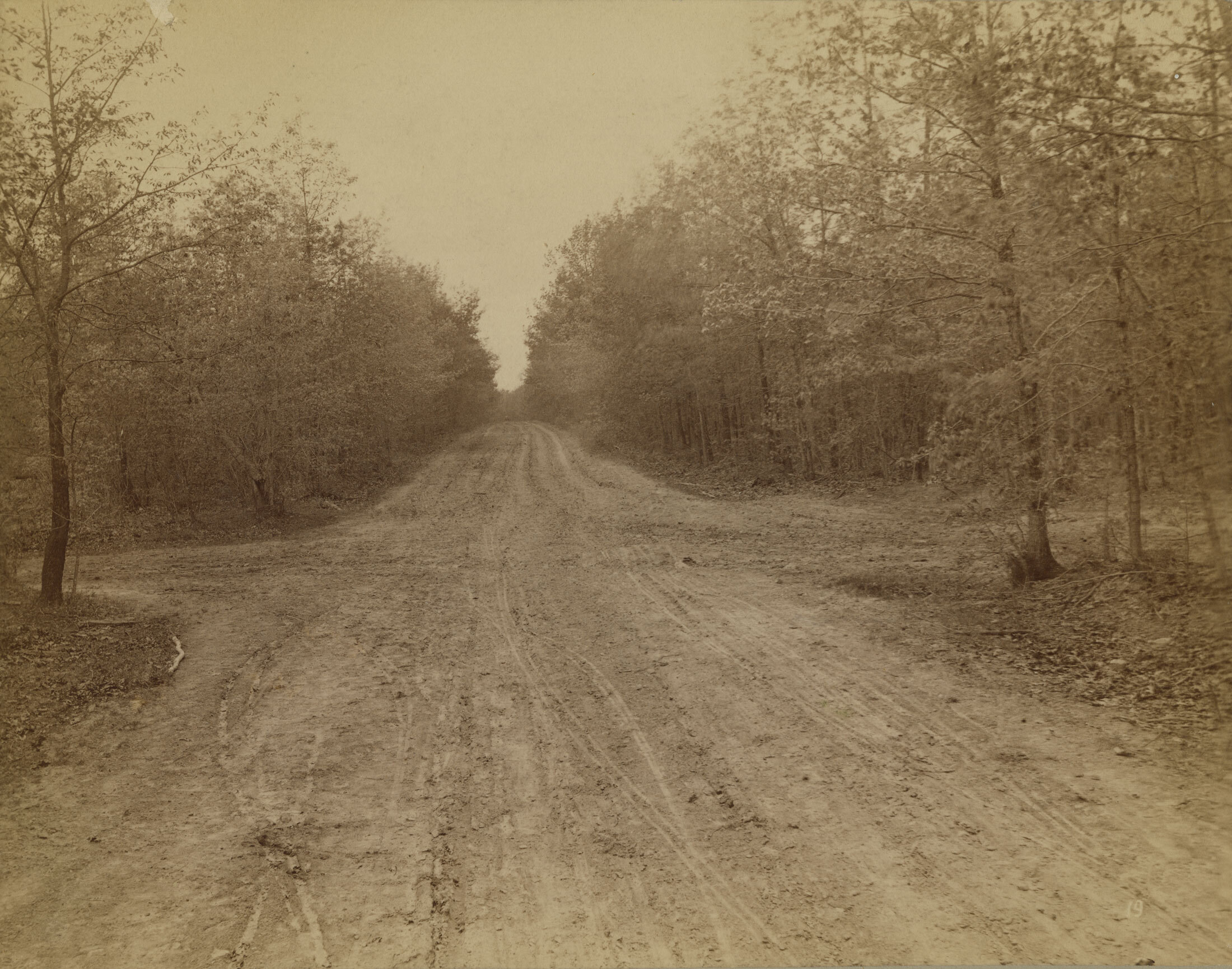
Image Content Callouts
William H. Tipton, The Wilderness, the Orange Plank Road Looking southwest across the Brock Road, 1887. Courtesy the Virginia Museum of History and Culture
This 1887 photograph shows the intersection of the Orange Plank and Brock Roads in northern central Virginia. It was on and around these roads that, twenty-three years before, Union and Confederate forces fought for two brutal days, May 5–6, 1864.
Seen from the road, the forest rises like a dark wall. This wilderness was known as the Wilderness, which is a name that, like the ghost in Hamlet, simply called the Ghost, is so unclever as to make it oddly elusive—nearly allegorical. A few miles south of Virginia’s Rapidan River, the woods are about halfway between what were then the warring capitals of the North and the South: Washington, D.C., and Richmond. It was a second- and third-growth forest, cleared initially in the early seventeenth century to cultivate tobacco, later to fuel the local ironworks. The thick underbrush was a tangle, covered with shrubs and briars, wild and overgrown, “gnarled, vine-throttled,” in the words of one historian. The war correspondent Charles A. Page, of the New York Daily Tribune, called it a “jungle”; General Ulysses S. Grant, in a dispatch sent during the battle, called it a “dense thicket.” Soldiers who went into this forest, which seemed to hold them as though in a trap or net, had trouble describing it. Some pictures made at the time or in the aftermath lack composition; a sketch by Alfred R. Waud, an illustrator working for Harper’s Weekly, looks like a scribble. Was it the twisted, confused quality of the undergrowth or the horrors of what occurred there that made this forest so hard to represent from inside? It was as if this terrifying place could not be clearly depicted or even seen.
Standing outside it, in the small clearings around Lacy’s Farm or Todd’s Tavern, generals on both sides tried to gain cognizance of what was going on inside, debating with one another the often conflicting reports that emerged. Gordon C. Rhea, who wrote the definitive modern account of this battle, describes how more and more men were “poured” into the forest. It was like a black hole; what went in tended not to come out again. Survivors described how, after entering, they could not follow orders or even proceed in a straight line. They had to duck and curve, clamber and bushwhack. It could take hours to traverse a mile. They quickly lost sight of one another and turned without knowing they had turned; when fired upon, they sometimes did not know whether they were facing their own men or the enemy. Soon after rushing up Orange Plank Road toward the intersection depicted in the accompanying photograph, a leading Confederate general, James Longstreet, was shot by other Confederates; the bullet entered his neck and lodged in his right shoulder.
Perhaps he was watching his memories take shape and dissolve in the clouds or, as some men do when dying, calling for his mother.
By the end of the two-day Battle of the Wilderness, almost thirty thousand soldiers were killed, wounded, captured, or missing. Neither side achieved an obvious advantage or gained any ground. This was the first major battle of the Overland Campaign, whereby the Union forces slowly pushed the Confederates south to defend their capital. It was the first time that Generals Grant and Robert E. Lee directly encountered each other in battle, and there had been much speculation about who would outmaneuver whom. Judged in retrospect, the major feat of stratagem surely belonged to Lee or his generals, who may have tricked Grant’s Army of the Potomac into fighting on this terrain, which was vastly disadvantageous to its superior numbers and artillery, and doing so again. Just the year before, the North had been defeated a few miles from this same place, in the Battle of Chancellorsville, and Union soldiers, uneasily venturing through these woods for a second time, encountered, amid the understory, bones of their fallen fellows, now clean of flesh. Some claimed to recognize the skull of a dead friend or horse; noticing that the undergrowth was thicker in some areas, one soldier enclosed in a letter to his wife a violet plucked from soil that had been nourished, he said, by the blood of the last year’s fallen. Picking their way through the dark forest, the soldiers might have felt that they were seeing the aftermath of the battle they were about to fight.
Soldiers on both sides fought bravely as officers pored over maps, looking for opportunities in the terrain. Near the key juncture of the Orange Plank and Brock Roads, soldiers dug trenches and tried to fortify them with fallen trees, the branches of which the men sharpened to points. (James McPherson points out that the Civil War, like World War I, was a war of trenches, although here trees and brush functioned as barbed wire.) Both sides tried to achieve the element of surprise, sometimes marching for hours in order to attack from an unexpected position, especially from the flank. When commanded to do so, the soldiers climbed over the tops of their trenches and rushed into the tangled no-man’s-land of the dark woods, cheering or maybe screaming while, from the other side, tiny iron nuggets came whizzing through the air until they intersected with a tree trunk or bone. Often, the soldier couldn’t see and had to fire by what was called “earsight.” At least one lost officer was separated from his own regiment. So thick was the firing that saplings stood lopped off at chest height or bent down with the weight of embedded bullets, while all around, soldiers clutched at themselves, gasped, stared, fell. Their bodies entangled with the thick brush on the forest floor, which, as it grew darker, seemed to writhe.
The density of the sylvan undergrowth meant that the woods repeatedly caught fire from the exploding shells; in the June 4 issue of Harper’s Weekly, Waud described what he saw: “Some were carried off by the ambulance corps, others in blankets suspended to four muskets, and more by the aid of sticks, muskets, or even by crawling. The fire advanced on all sides through the tall grass, and, taking the dry pines, raged up to their tops.” During the night, the wounded who were unable to extricate themselves burned alive. Their screams could be heard by those outside the forest, who did their best to tend to men who crawled out. One Union general, James S. Wadsworth, was shot in the head after attempting to turn his horse; the bullet entered the back of his skull, spraying his aide with brain. It was not an instant death. Wadsworth died in a Confederate field hospital two days later. While lying on the forest floor, his body was looted of valuables as he stared at the treetops—or so it was said. Really, who knows? Perhaps he was watching his memories take shape and dissolve in the clouds or, as some men do when dying, calling for his mother—if only within his thoughts.
Grant sat on a stump or on the dirt, leaning against a tree at the edge of the forest, whittling sticks.
By the end of this battle, despite outnumbering and outpowering the South, the North had suffered the majority of casualties. And yet, if the Confederates won this battle according to one logic, they lost it according to another, more powerful logic. Three years into the war, what became evident was that no one’s heroism or feats of martial brilliance would, in the end, matter. A perhaps obvious truth had become strikingly evident: in a war, just as in the normal course of a human life, major material processes unfold that lie outside any individuals’ realm of control or even awareness but that nonetheless determine their fate. To the North belonged the irresistible strength of factories, superior rifles, and a larger population. Even after stretching the eligible military age to seventeen on one end and fifty on the other, the South had, at this point, no one left it was willing to draft (having refused, most importantly, to arm the nearly four million people enslaved in the South), so it could no longer replace fallen men. Arguably, all the North had to do was just keep going, banging away, relentlessly, as though unmindful of the human cost. The objective reality of material power suddenly became subjective, felt. It was with the quality of realization that one Confederate reflected on this battle: “The struggle ahead of us was of a different character from any we had experienced in the past—a sort of premonition of the definite mathematical calculation, in whose hard, unyielding grip it was intended our future should be held and crushed.” This was the beginning of the end for the Confederacy because no longer would the Union heed its own accumulating losses. After the battle, Grant quietly retreated to his tent, where, according to his chief of staff, he wept face down on his cot but then soon reemerged to announce that “there will be no turning back.” The next morning, he ordered his army to march on for another battle, as though they were the victors pursuing a routed force.
Eyewitnesses reported that, throughout this battle, Grant sat on a stump or on the dirt, leaning against a tree at the edge of the forest, whittling sticks. He was not making anything; he was just sitting there, paring down one stick after another, flicking woodchips with his penknife until the stick was sharpened to a point, and then he would break it in half and take up another stick and begin whittling that one down in turn. He also smoked and did so in a similar way, one cigar after the next, about twenty cigars. His appearance, as usual, was disheveled. Unlike Lincoln, who remained sleepless during the Battle of the Wilderness (after receiving the tally of the Union dead, he reportedly said, “I cannot bear it”), Grant maintained his characteristic ability to sleep even during periods of intense crisis. As was his habit, he said little—and observers continued to debate whether he was wise or just simple. Critics had long accused him, erroneously in this case, of drunkenness. He may have seemed, in his mute or senseless way, like a fate of old: inexorable and unanalytic.
Within a couple of days, Grant’s Army of the Potomac and Lee’s Army of Northern Virginia, with all their rattling cannons and wagons of supplies, had moved on, and the woods were quiet again. Shhhhhhh, said the leaves.
many have said that silence is the only appropriate form of commemorating the fallen. The poet Louis Simpson wrote this about the tendency toward silence among soldiers of World War II: “To a foot-soldier, war is almost entirely physical. That is why some men, when they think about war, fall silent. Language seems to falsify physical life and to betray those who have experienced it absolutely—the dead.”
Returning to look at the 1887 photograph of the Wilderness, I appreciate its effect of silence. The composition is as straightforward as possible: The camera has been positioned in the middle of Orange Plank Road, which extends into the distance, parting the image down the middle. About halfway up the picture plane, Brock Road divides those halves into quadrants. X marks the spot. And all around grow the trees, dark and unreadable.
Visiting a battlefield, whether in person or only through photographs, we are surely mistaken in thinking that old trees are wise, projecting onto them the qualities we might wish to find in our own aged selves, but at least trees have the virtue of not talking. Rather, they just stand there, holding space for what lies outside our comprehension. And we can imagine ourselves just standing there with them—as though peaceful physical proximity could be, as it sometimes is between people, a form of understanding.
Rachel Eisendrath teaches Renaissance poetry and critical theory at Barnard College, Columbia University. She is the author of Gallery of Clouds.
Featured
What Happened When I Began to Speak Welsh
By learning my family's language, I hoped to join their conversation.
You Might Also Like
Terry Allen’s "Cross the Razor"
How one artist started a conversation across the US-Mexico border
What Irony Makes Visible
Fifty years later, Stephen Shore's photographs reveal an impending crisis