The writer on what poetry can witness that no other form can
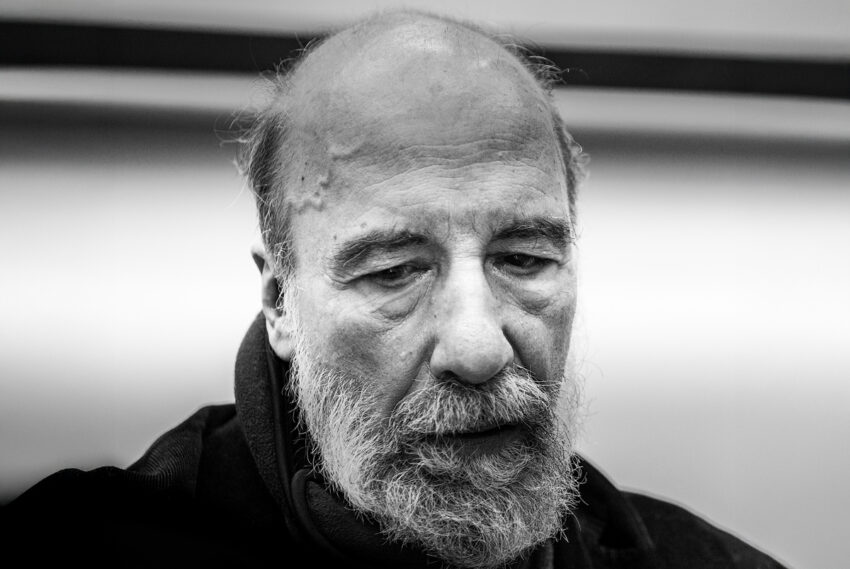
Photo: José Torres
The Chilean poet Raúl Zurita, recipient of the 2026 Griffin Poetry Prize Lifetime Recognition Award, is an artist of the grand gesture. He has written more than a dozen books of poetry, and his poems have also made provocative appearances in public spaces: scrawled in skywriting above New York City and bulldozed into the Atacama Desert, where they can be read only from the air. After being incarcerated and tortured by the military junta under Pinochet in 1973, Zurita cofounded the revolutionary art group CADA (Colectivo Acciones de Arte, or Art Actions Collective) and began writing poems as acts of political resistance and testimony. His radical, incantatory writing explores the atrocities of war, the corruption of language by the state, and the simultaneously lonely and communal experience of life under authoritarianism.
Many of Zurita’s books have been translated into English, and he has received numerous literary awards, including the Chilean National Prize for Literature. The Griffin Poetry Prize Lifetime Recognition Award is a testament to his remarkable and idiosyncratic poems, which are composed, in the words of Griffin Prize Trustee Aleš Šteger, of “the language of all the tortured, all the lost, all the disappeared, old, ancient words, reset, risen from the dead, revived into a new community.”
This conversation, which was translated into English by Anna Deeny Morales, has been condensed and lightly edited for clarity.
—the editors
The Yale ReviewWhat first drew you to poetry? What writers have most influenced your work?
Raúl ZuritaI admire all those who have refused to recognize the limits of what’s human, but this is entirely admiration, and I couldn’t say I’m influenced by them, because this would be an arrogance without limits. Dante, for example, and Shakespeare and Homer and Rimbaud are figures of such magnitude that one comes to believe they wouldn’t have wanted to be born into this world. Poetry is the Cassandra of our time; she knows everything, but her condemnation is that no one listens to her. And so I can’t speak of influences, but I can speak of an indebtedness to all the poetry I’ve read and seen, and for all of it, I feel an absolute admiration.
TYRChile is often called the Land of Poets. What about this place—culturally, topographically, politically—fosters such remarkable poetry?
RZ
Chile is a long and extremely narrow tract of land, and because of this, its rivers arrive fast to the sea. We weren’t granted the magnificence of the Amazon, or the Nile, or the Mississippi. The rivers of Chile have been her poetry, and that poetry—from the sixteenth-century epic poem La Araucana
by the Spanish soldier and poet Alonso de Ercilla, who participated in the War of the Conquest, to Nicanor Parra and Enrique Lihn—has shaped an image of a language and a face. This has been a particularity of Chilean poetry but perhaps also of all Latin American poets.
And if, as Marx says, religion is the heart of a world without a heart, poetry is the heart of the heart of the heart of that world without a heart.
TYR In your experience, what can a poem capture about political violence and repression that other forms of writing (journalism, fiction, memoir, etc.) cannot?
RZI don’t know if this is true—who can say?—but if it is, it’s because poetry’s role is as the human activity closest to death. In the horrific world in which we live, overfull with rubble, with blood and death below the rubble, poetry is the first to lift itself up to tell us, the survivors, that still another day waits for us. And if, as Marx says, religion is the heart of a world without a heart, poetry is the heart of the heart of the heart of that world without a heart—it’s the hope of a world without hope, the possibility of that which has no possibility. Maybe it’s something like that.
TYRYou have spent much of your career bringing poetry off the page and into public spaces; in 1982, you had five airplanes skywrite your poem “La vida nueva” above New York City, for example. What motivated these public displays, and what do they offer that private acts of reading and writing do not?
RZThese interventions in the landscape have been my most intimate acts, because from the idea of creating them to the act of making them concrete, so much time passed, and because of this, they’re stuck to my skin. They’re a fundamental part of me, and I’ve never wanted to expand or criticize poetry of the page or book, because who has expanded the poetic page more than Dante or Shakespeare or Sappho? Those poets transformed the world too. So the reason I’ve done the things I’ve done is simply because I found them beautiful. It’s beautiful to see a poem of madness, love, and death traced on the sky.
TYRYou have worked with your translator Anna Deeny Morales for more than a decade. How has the act of being translated informed your own artistic process, and what might be lost in the leap from Spanish to English?
Today, to speak of this world filled with dead and rubble and boots that step on that rubble is a crucial, absolutely necessary act.
RZ My relationship with Anna Deeny Morales has been magnificent, and it’s an honor for me that she’s taken me into English, and I’ll never finish thanking her, because it’s a sign of artistic and human solidarity. Now, every language has its own processes, and what more could we have wanted than for the poems of Walt Whitman or Mayakovsky to be written in Spanish, because they’re great poems in Spanish. I know there are many poems in many languages, and I was given the opportunity to read the ones I can read, but beyond that fact, I hope that if life still has the kindness to give me more time, it will create for me new marvels that fill me with happiness and awe and light.
TYRWe are, today, in a moment of global crisis, with violent atrocities being perpetrated against civilians from Iran to Lebanon to Sudan. What do you see as the civic responsibility of the poet at this moment?
RZ From the moment you try to impose a path on a poet, you pave the way for dictatorships. Poetry is free and can take the form it wants, but its ultimate goal is for life to be decent for everyone. Today, to speak of this world filled with dead and rubble and boots that step on that rubble is a crucial, absolutely necessary act. Poetry can give testimony to all the atrocities of this miserable and infinitely bombarded earth, to its atomic bombs, its fleets, its infamous madmen who sink defenseless rafts, who bomb schools and who kill and kill. If Marx confirmed that religion is the opiate of the masses, then poetry is the opiate of the opiate, it is the hope of what has no hope, the love of what lacks love, the possibility of that which has no possibility.
Support Our Commitment to Print
Subscribe to The Yale Review. Receive four print issues a year—essays, fiction, poetry, and criticism.