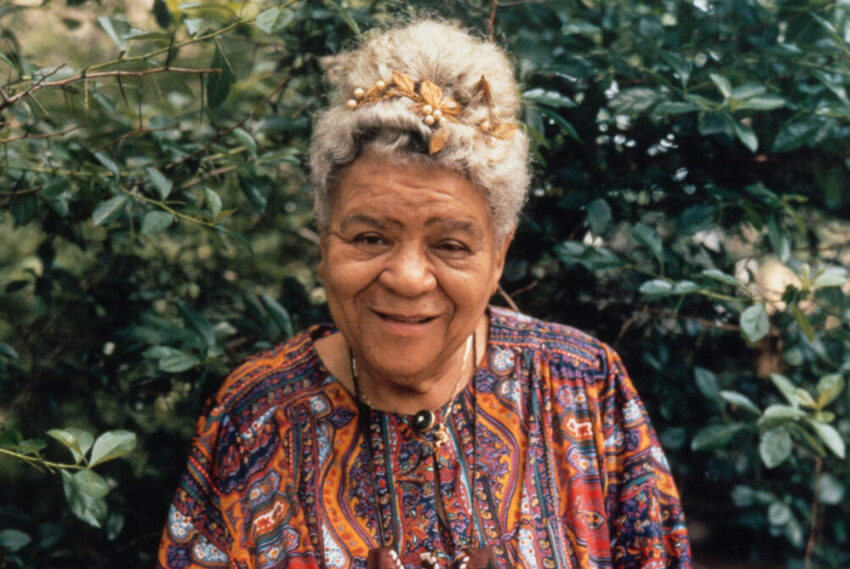
Audley “Queen Mother” Moore’s life and political thought are the subject of a new biography by Ashley D. Farmer. Photograph by Judith Sedwick, Black Women Oral History Project, Schlesinger Library on the History of Women in America. Wikimedia Commons.
on december 20, 1962, an organization called the Reparations Committee for United States Slaves’ Descendants, Inc., filed a reparations claim with the federal government. Arguing that chattel slavery had impoverished generations of Black people while enriching white America, the petition demanded that billions of dollars be distributed to Black Americans and made a case for giving them “preferential treatment,” including quotas designed to quickly achieve racial parity.
The claim was the brainchild of Audley Moore, a former member of the Communist Party and a Black nationalist who had spent four decades in the Black liberation movement. In a pamphlet called Why Reparations?, published the following year, Moore wrote that the claim was “the battle cry for the economic and social freedom of more than 25 million descendants of American slaves,” and called on the U.S. to pay reparations as compensation for centuries of unpaid forced labor and premature death, as well as a century of lynchings, Jim Crow, disfranchisement, rape, and police brutality. The legal basis for the claim, it asserted, was the Emancipation Proclamation of 1863, which had freed Black people from bondage and granted them legal rights, and the United Nations’ charter and conventions prohibiting “cruel and oppressive treatment.”
More than six decades later, the cause to which Moore (who was known as Queen Mother) devoted many years of her life has gone from being dismissed as a utopian fantasy to occupying a prominent place in political discourse. H.R. 40, a House bill mandating a commission to study the viability of reparations for African Americans, now has ninety-six cosponsors (even if its chances of becoming law have dimmed with Republicans in control of Congress). And a recent UN report on human-rights violations by law enforcement called for reparations and an entire “transformative agenda” aimed at reversing “cultures of denial, dismantl[ing] systemic racism.”
Paradoxically, though, even as the concept of reparations has become mainstream, Moore herself has largely been erased from the popular history of the fight for Black liberation. Ashley D. Farmer’s magnificent new biography, Queen Mother: Black Nationalism, Reparations, and the Untold Story of Audley Moore, seeks to remedy that. Farmer wrote about Moore in her first book, Remaking Black Power: How Black Women Transformed an Era (2017), as one of a group of radical Black women who were bridges linking Garveyism, communism, and armed self-defense to the long Black Power movement. In Queen Mother, she builds on that work, showing how Moore blended Black nationalism and communism to produce a radical and transformative vision of reparations and what they could accomplish.
audley moore came into the world a child of privilege. Her father, St. Cyr, was a successful, enterprising landowner, and her mother, Ella, was the descendant of free people and property owners who had lost their land in the whirlwind of racist terror during and after Reconstruction. Both sides of Moore’s family descended from Louisiana’s Creole elite; both sides experienced sudden losses of status and mobility; and both sides stood up to white supremacy. (According to family lore, Moore’s grandfather had been lynched after he sued his landlord for violating their tenancy agreement.) So Moore and her two younger sisters, Eloise and Loretta, grew up on stories about the power of property, the injustice of Jim Crow laws, and the necessity of armed self-defense.
They also learned from experience. When Moore was in grade school, her family moved to New Orleans, where she and her sisters seemed destined for a life of semiluxury. But status and light skin shielded no one from the indignities of racism. Farmer tells an especially poignant story of St. Cyr purchasing a pew in their Catholic church—a display of wealth and piety—only for the family to be told one Sunday to move to the newly designated “colored section.” St. Cyr initially resisted the new order but ultimately joined others in launching an independent Black Catholic church. What began as an affront turned into an act of self-determination.
The family’s prosperity did not last. Ella died in 1904, followed by St. Cyr in 1917, leaving the three girls orphaned. St. Cyr was barely in the grave when his son from a previous marriage threw the girls out of their father’s house, forcing Moore to drop out of school and care for her sisters on the meager wages of a domestic worker.
In 1920, Moore married a Jamaican seaman named Josiah Spraggs. Two years later, she and her sisters attended a lecture by Marcus Garvey, the founder of an international organization called the Universal Negro Improvement Association (UNIA). In addition to promoting racial uplift and Black nationalism, the UNIA called for the expulsion of European colonizers from Africa and the repatriation of the African diaspora. Garvey’s lecture—which was preceded, as Moore told it, by a dramatic standoff between the police and a union hall full of armed African Americans—captivated her, and she and Spraggs promptly joined the UNIA.
The couple considered moving to Africa, but after stints in Los Angeles and Chicago, they ended up settling in the epicenter of Garveyism: Harlem. Garveyism, Farmer observes, taught Moore that “service to the race” was more important than money and status, while the ideal of collective uplift deepened her appreciation for the Black working class (to which she now belonged). And once in Harlem, she not only continued building UNIA membership but also became immersed in local politics. Her work on behalf of progressive Republican J. Dalmus Steele’s campaign for New York State Assembly proved that her commitment to “the race” outweighed divisions of party or ideology.
“You want to make revolution in a capitalist country,” she frequently told her young protégés, “you got to first understand how capitalism works.”
Garvey had been convicted on a bogus charge of mail fraud not long after Moore joined the UNIA, and the organization’s influence soon waned. But in 1931, the campaign to free the Scottsboro Boys, nine young Black men facing execution after being falsely accused of raping two white women in Alabama, drew Moore into the orbit of the Communist Party, which played a key role in organizing the men’s defense. She was especially attracted to the party’s position that African Americans concentrated in the “Black Belt” counties of the South constituted a nation with the right to self-determination. It was not Garveyism, but it validated her own dreams of an independent Black nation. So she joined the party and quickly became one of its most effective leaders in Harlem, orchestrating protests against police brutality and Italy’s invasion of Ethiopia, and helping elect fellow Communist Party member Benjamin Davis, Jr., to city council, as well as building bridges to mainstream Black leaders, such as Mary McLeod Bethune.
Moore eventually grew disillusioned with the party. She resented its incessant micromanaging and felt betrayed when it abandoned the principle of Black self-determination. But she remained a member until 1950. Why did she stay so long? For one thing, the party gave Moore respect, a paycheck, a vehicle to organize Black working people, and a political home. But she also stayed because her vision of Black liberation entailed the redistribution of wealth, working-class empowerment, anti-imperialism, and cooperative economics—in a word, communism. But she eventually came to understand that she did not need to belong to the party in order to fight for the things that mattered to her. And leaving it allowed her to return to her nationalist roots, which in some sense she had never really abandoned. She, Eloise, and Loretta found a welcoming environment at the Frederick Douglass Book Center, a cramped storefront on 125th Street stocked with Black literature and “a sizeable collection of books on Marxism, radical politics and religious agnosticism.” It was owned and operated by Barbadian native and veteran radical Richard B. Moore, whom the Communist Party had expelled in 1942 for promoting “black nationalism.”
In 1956, Moore and her sisters moved back to New Orleans after winning legal possession of their father’s house, and soon after she founded the Universal Association of Ethiopian Women (UAEW). In the years that followed, Moore fought for housing, welfare rights, and prisoners’ rights; collected food for impoverished families; defended Black men falsely charged with raping white women; and demanded justice and accountability for Black women raped by white men. When she and her sisters moved to Philadelphia around 1961, their home became a meeting place for emerging Black radicals, with Moore turning into something of a teacher to figures such as Malcolm X, among the first to refer to her as Queen Mother, and Muhammad Ahmad—then known as Max Stanford—a leader in the Revolutionary Action Movement. She lectured on African history and encouraged visitors to read W. E. B. Du Bois’s Black Reconstruction and other books with a Marxist bent. “You want to make revolution in a capitalist country,” she frequently told her young protégés, “you got to first understand how capitalism works.”
By that point, Moore had already been advocating for reparations for years. The concept was, of course, not new. Even before the Civil War, Black abolitionists had proposed a “national indemnity” for the crime of slavery, and after the war, many freed people believed that they had, through their unrequited toil, earned the right to their former masters’ property, as well as a reward for their loyalty to the Union. They had reason to be optimistic. In January 1865, General William T. Sherman issued Special Field Order No. 15, redistributing rebel land along the South Carolina, Georgia, and Florida coastlines and on the Sea Islands to formerly enslaved families. The first Freedman’s Bureau bill, meanwhile, promised to grant “every male citizen, whether refugee or freedman,” small plots not to exceed forty acres. But the plan never came to fruition. Efforts to gain some recompense continued, though. In 1896, Reverend Isaiah H. Dickerson and Callie House launched the National Ex-Slave Mutual Relief, Bounty and Pension Association in a bid to get Congress to pass a law granting pensions to freedpeople. It failed.
In 1915, House and African American attorney Cornelius Jones filed a class-action suit against the U.S. Treasury for $68 million, the amount it had collected from a tax on cotton between 1862 and 1868. Jones argued that the revenue belonged to Black people, who had produced the cotton without compensation. The D.C. Court of Appeals and the Supreme Court denied the claim, citing governmental immunity, and the government retaliated against the lawsuit by indicting Jones and House on baseless charges of mail fraud. Both were convicted, but only House was jailed.
It’s unclear if Moore knew of House and other antecedents to her proposal. She maintained that she came to her concept of reparations after reading a passage in a Methodist encyclopedia declaring that captives who do not make legal claims “for their liberation within a hundred years are considered satisfied and belonging to their captors.” She took this to mean that any reparations claim had to be filed before the centennial of the Emancipation Proclamation on January 1, 1963. So, beginning in January 1962, she launched a yearlong campaign culminating in the formation of the Reparations Committee for United States Slaves’ Descendants, and on December 20, 1962, she filed a claim with the government. Moore managed to drum up some coverage from the Black press through her frequent speaking engagements, but the claim—and her pamphlet—otherwise received very little publicity.
More militant than monarchical, more humorous than haughty, she pulled no punches.
Moore’s left-wing nationalism profoundly shaped her conception of reparations: she saw it not as an end in itself but as a means to achieve self-determination for the race and help finance the creation of an independent and sovereign Black nation. The path of integration, she argued, was “laden with wrecked hopes, partial victories that change nothing, and ever-recurring frustrations.” The only real solution was to take the “road to national independence and dignity, with freedom to determine our own destiny.”
To that end, she authored a Draft Resolution for the Establishment of an Independent Black Republic, declaring Black people a captive nation subjected to more than three centuries of exploitation and genocide. Six years later, Moore, now universally addressed as Queen Mother, attended the founding convention of the Provisional Government of the Republic of New Afrika (PGRNA) in Detroit, where more than five hundred people responded to a call by brothers Gaidi and Imari Obadele to form a provisional government for “New Afrikans,” with the goal of creating an independent Black nation in the South. Recognized as the movement’s éminence grise, Moore was given the honor of being first to sign the PGRNA’s Declaration of Independence.
In the decades that followed, Moore continued to push for her radical vision of reparations, and her ties to Africa and the diaspora deepened. She made her first trip to the continent in 1972, at the age of seventy-three, and regularly crossed the Atlantic until she was well into her nineties. Given her international stature, she interacted with heads of state more than she did with the African masses. And as Farmer perceptively observes, her view from the perch of state power, combined with her deference to patriarchal authority in the name of honoring “traditional” culture, began to skew her judgment and exposed the limits of nationalism. Moore came to see African leaders as the embodiment of sovereignty and nationalism as therefore requiring fealty to those leaders. So she ended up defending Sékou Touré in Guinea, Julius Nyerere in Tanzania, and, most egregiously, Idi Amin in Uganda. During her trip to Uganda, she attended state dinners and became Amin’s constant companion. “Amin treated her like a queen,” Farmer writes, “and she began to talk of him as if he were her king. Whereas others viewed Amin as an erratic and reckless leader, Moore saw a Black man standing up for Black Africa.” When it came to independent African states, Moore, so it seems, uncharacteristically overlooked or played down internal class conflicts.
Oddly, even as Moore remained a venerated figure abroad, she began to fade from public view at home, at least outside Black nationalist circles. In 1981, I hosted an event for Black History Month featuring Moore at Cal State Long Beach, where I was a freshman. To me, she was an icon. I remembered hearing her name as a kid growing up in Harlem and knew she had launched the modern fight for reparations. So I was worried that the auditorium would be too small to accommodate the anticipated crowd. The Queen arrived on time, decked out in a brightly colored dress and matching headwrap, full of infectious energy. But fifteen minutes after we were scheduled to begin, only six or seven people had shown up.
Moore herself didn’t seem to mind. She spoke to us as if she had just discovered a mass movement on the horizon, but one lacking clarity and direction. More militant than monarchical, more humorous than haughty, she pulled no punches. She tested our knowledge of history, criticized Western education, and forced us to reckon with the contradictions of American citizenship and nationality for Black people. She also reminded us that we didn’t own anything, and that our allies were workers, not millionaires. Above all, she taught us about reparations. It was a bravura performance. It also left me baffled as to why so few people had turned out to hear Moore speak.
as the demand for reparations has gained support in recent years, a new generation of activists has begun to rediscover Queen Mother Moore, although more as a symbol than an architect. Farmer recovers Moore’s political and intellectual contribution to the reparations movement, a contribution that is, in many ways, at odds with the liberal emphasis on monetary recompense over social transformation. And she shows how Moore’s advocacy transformed the movement. By tying reparations to Black nationalism and the condition of the working class, Moore shifted the focus from individual payments to institution building, redistribution, and the addressing of collective needs. And as a committed Pan-Africanist, she understood the fight for reparations in global terms. These principles governed reparations movements through the next couple of decades, and they are worth reclaiming.
At the same time, Moore’s radicalism largely explains why she had all but disappeared by the late 1980s. Her vision of reparations clashed with the neoliberal turn, when privatization, free-market orthodoxy, and an all-out assault on the welfare state came to dominate our economy and our thinking. The dominant discourse around reparations today, after all, treats them as a means to compensate for lost generational wealth, with the goal of closing the “wealth gap” and creating a path for African Americans to realize the American dream. This view of reparations does not challenge a capitalist system that inherently concentrates wealth and produces income inequality—it buttresses it.
What matters is how Queen Mother understood reparations and nation-building as inseparable.
Similarly, where Moore connected reparations to Pan-Africanism, American Descendants of Slavery (ADOS),today’s most prominent reparations advocacy group, insistson limiting reparations claims to only Black people born in the U.S. who have documented proof that they are direct descendants of people enslaved within U.S. boundaries. According to this logic, Black immigrants whose ancestors were enslaved in Jamaica, Barbados, Brazil, Martinique, or any other place outside the states and territories that made up the U.S. in 1865 should not be eligible for reparations, no matter how many generations back their ancestors arrived in the U.S. The group’s position is both parochial and at odds with the Pan-African politics that animate the movement Moore initiated.
Given the current political climate, of course, the prospect of reparations for slavery and systemic racism is dead in the water. Following the Project 2025 playbook, the Trump administration’s goals are to eliminate the social safety net, trade unions, the very prospect of affordable health care, public health safeguards, trans rights, and civil and disability rights, all while promoting mass deportation and a plan of ethnic cleansing with the goal of turning the U.S. into a white country. The legal stigmatization of diversity, equity, inclusion, and accessibility (DEIA) initiatives has effectively reversed the role of victim and perpetrator—“able-bodied,” cishet white men are currently the only protected class, and therefore the only group eligible for something like reparations.
It would be a mistake, though, to respond to this assault by promoting a reparations agenda that simply transfers a fraction of wealth to selected Black families in order to strengthen the so-called free market. If our goal is to root out systemic racism, save the planet, and create a durably just world, we must tie reparations to the battle for a guaranteed income, living wages, affordable housing, and an end to organized abandonment and mass incarceration. We must also address the conditions that render some people vulnerable to poverty, violence, and premature death. The point of self-governance and self-determination, in Moore’s vision, was to create a society that could stamp out systemic oppression and ensure an abundant life for its citizens. Whether such a society is possible is not the point; rather, what matters is how Queen Mother understood reparations and nation-building as inseparable. The goal was never just a paycheck but collective liberation.