The Yale Review is partnering with Shakespeare and Company, the legendary Paris bookshop, to publish select transcripts from its author events—insightful conversations with some of today’s most exciting writers from around the world. Sign up for our newsletter to be the first to know when new interviews go live. Readers can also explore the best of earlier installments, culled from the last decade of the shop’s long-running conversation series, in The Shakespeare and Company Book of Interviews, out now.
Arundhati Roy
The author on how making sense of violence made her a writer
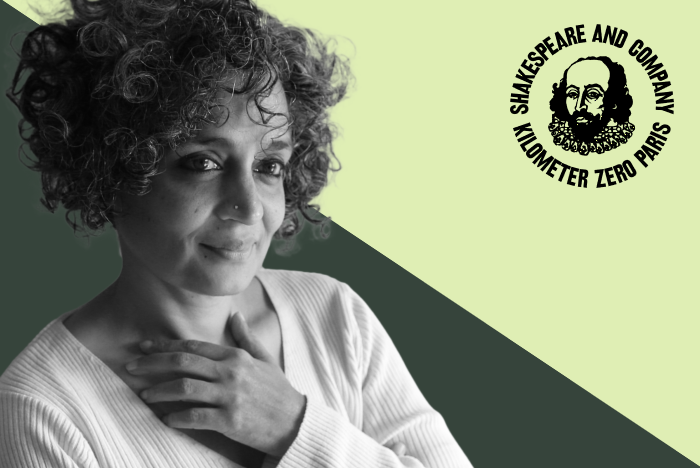
A dear friend of mine once told me that Arundhati Roy was one of the most recognized people in India. This was particularly true, she said, in the state of Kerala, where Roy grew up—the difference there being that people tended to know her not just as Arundhati but also as Mary Roy’s daughter.
The reasons for this become clear early on in Mother Mary Comes to Me, Arundhati’s recent memoir. Mary Roy was well-known for the school that she founded and the children whose lives it transformed, for the legal battles she won and the generations of women her influence helped to liberate from India’s entrenched patriarchy. Perhaps most of all, Roy was known for the sheer enormity of her presence, which drew in and dominated everything in its vicinity.
Yet, despite the book’s title, Mother Mary Comes to Me is not a book about Mary Roy. Indeed, in many ways, it’s more about the author’s struggle to be more than Mary Roy’s daughter, her appendage—a mere “valiant organ,” as she has it—but also more than her antagonist. One might even say it’s about the author’s attempt to free herself from Mary Roy so that she might know her, so that she might love her.
It’s a remarkably compelling glimpse into the life of one of our most formidable living writers, from her competitive childhood—the outsider daughter of an outsider mother—to her architectural studies, her film career, the Booker Prize circus, and her subsequent activism.
We’re an eclectic bunch of booksellers at Shakespeare and Company. But every so often a title comes along that traverses our varied tastes and unites the team in rapturous admiration. Mother Mary Comes to Me is one such book.
—ADAM BILES, LITERARY DIRECTOR, SHAKESPEARE AND COMPANY, PARIS
Adam Biles This book is your first memoir, and comes after two novels and lots of political writing. In one moment, you instruct your reader to read this book as they would a novel. Did you write it as you would a novel?
Arundhati Roy In terms of technique—how to approach it, how to structure it—I thought of it as a novelist’s memoir. To a novelist, imagination can be reality; a novelist’s characters are often more real to them than real people. In some way, everything I write is one big book. I actually sometimes consult some of the characters in my novels about what I should or should not do, or how I should or should not think. The blend of imagination and reality is the same in a memoir as it is in a novel. But of course, there is a discipline when you’re writing, say, about your mother or your brother; I’m not going to invent things about them. But that somewhat fevered imagination is a part of real life when you’re living with a character like Mrs. Roy.
AB Often when people write about their parents, there is this attempt to pin down their psychology, to really understand and articulate why they were the person they were, why they did what they did. And you don’t do that in any definitive way in this book. Was it difficult for you to keep that at bay?
I don’t mean that I was writing things down, but I mean that part of me was taking the hits and the other half was taking notes.
AR I think that I would have failed if I had tried to do that. I have an allergy to therapy speak, where everybody’s defined and boxed and pitted against each other. (I was going to say I don’t mean it pejoratively, but that would be a lie. I do mean it pejoratively!) I really felt that one of the most important things that happened between me and my mother was that I stopped being her daughter and she my mother a long time ago. I grew up and I met her as an adult. And if anything, I might have been her mother. I understood that a woman who has children isn’t just a mother, that she has another life. And for my mother that life was really more important than motherhood. It was up to me not to allow myself to be a victim of that, but to have my own life and to appreciate the battle she had fought and the wonderful things she had achieved. If I had retained expectations that my parents owed me something, I would’ve been a very shriveled-up, bitter person. But I didn’t expect anything from them. I wrote myself out of this bitterness a long time ago.
As a child, you’re not supposed to understand why something is happening—why someone is being violent, why, for no fault of yours, you’re getting hit. But I did understand, from a very young age. It was all so clear to me: the society in which my mother lived, the judgment and the humiliation that people tried to heap on her, which was then sort of transferred to us . . . it was so clear, like being in a lab. So in some ways, I became a writer very early. I don’t mean that I was writing things down, but I mean that part of me was taking the hits and the other half was taking notes.
AB You mentioned the society in which Mary Roy lived and operated. This was India in the mid- to late sixties and onward, and there’s also the context of a micro-society in Kerala, where she moved with you and your brother. There’s a moment in the book when you describe it as a “constellation of extraordinary, eccentric, cosmopolitan people, defeated by life.”
AR It’s fascinating even for people from India, because this Syrian Christian community that my mother belonged to only exists in Kerala. It’s a very small community of pretty elite people; they’re the ones who own the pepper, and the spices, and the tea, and the coffee estates. But my mother married outside. (She married, as she always said, the first person who asked her.) My father was from West Bengal, but he worked in Assam, on the estates, and he was addicted to alcohol. So when I was three and my brother was four, she left my father and came back to this village, which was very conservative and full of caste. But my family was a peculiar one. My grandmother was married to an Imperial Entomologist, and he took the “imperial” part of this very seriously. But he was a very, very cruel person. My grandmother was a violinist, and when she was told that she could be concert-class he smashed her violin. Her older brother was one of India’s first Rhodes Scholars. He gave up academia to come back to Kerala. He was a Marxist, and he started a pickle factory with his mother, which he ran into the ground.
There were all these people who had no money, but they had privilege, education. This was a little village in which my brother and I, as the children of divorced parents, were constantly reminded that we were not going to be afforded the assurances or the security of other people in the community. We were outsiders, but also insiders in a way that outsiders could never be. I was in other people’s houses all the time, and I knew everything about that river and the plants and the fish.
Even up to the time I was a teenager, it was just made known to me that I didn’t have money, that no one would marry me. And I was like, “Fuck you. I don’t wanna marry any of you anyway.” It’s interesting, when I go back now people know me and it’s really sweet. There’s a whole lot of love and affection. Recently, in Delhi, I was coming through the airport and this security guy from Kerala looked at my ID and said, “Oh, you know, in Kerala we also have this Arundhati Roy. She’s always in trouble.” But still the elite who really spurned us when we were young fall in line. And in my head I’m like, “On your knees, motherfucker.”
AB For me, your father is one of the enigmas of the book. And the heart of the enigma is how he and Mary Roy were together for even a short period. I’m still baffled.
AR I’m also baffled! I keep wondering how they even spent five minutes together. They’re so different. As I said, I didn’t know my father. I first met him when I was twenty-five. I had left Kerala when I was sixteen to join the School of Architecture. By eighteen, I stopped going home, and for seven years neither my mother nor my brother had any idea where I was. I hardly had any idea where I was. Then, one day, a person—who later became my husband—came in to this office that I was working in, saw me, and said, “I’m making a movie, and would you like to act in it?” Then my brother found a magazine in which there was a picture of me and a mention of this production company. He called the director and said, “I’m her brother, can you tell me how to get in touch with her?” I ended up calling my brother back from some sweetshop in Delhi. I hadn’t spoken to him for seven years, and he came on the phone and he just said, “Guess who’s with me?” And from the voice, I said, “Baba,” father. Somehow I knew he had gone and found him.
But the thing about a writer like me that really upsets them is that I continue to laugh. We continue to be beautiful.
Before I met my father, I spent the whole night awake for some shallow reason, looking at myself in the mirror and thinking, What’s he going to look like? I had only ever seen one photo of him. When I saw him, I was so shocked. He had been living on the streets, he had been in Mother Teresa’s home, but he was just so happy and so charming. The hotel room where we met was built around this mattress. My brother and I had to climb onto the mattress and shake hands. I describe it like the Yalta Conference: Stalin, Roosevelt, and Churchill.
AB In the book, you say that your younger sibling was a school; that there was you, your brother, and this school, and there was never any doubt who was your mother’s favorite child. It’s fascinating to me, given how Mary treated you and your brother, that she could also be so dedicated to the education and the advancement of the girls and boys entrusted to her.
AR There are so many people who’ve had mothers or fathers who had a calling—whether it’s writers or politicians or other people who’ve done great things in the world—for whom their children were not the priority. I think the only peculiar thing in our case was that our mother’s calling was other people’s children. She started this school alongside a British missionary. Initially, it was seven children in this little town, and she would rent the premises of the Rotary Club, which was two rooms. And in the evenings the men would meet and smoke and drink. In the morning, we would go by bus from the village and sweep up the cigarette stubs and wash the glasses, because Indian men don’t clean up after themselves. Then we’d put out these little tables and it would be a school. I called it the sliding, folding school.
It became successful very quickly. Then my mother moved out of the village and rented a little house next door to the Rotary Club, which became a boarding school. So I never lived in a home as such. It was always a school. There were always other kids there.
Then there was the matter of it being coeducational. There was a lot of discomfort around that in this very, very conservative town. But my mother insisted that this was the way education should be. She raised money from the parents and bought a piece of land and hired this absolutely amazing architect—he was why I ended up studying architecture. He began to build this campus little by little by little, whenever there was money. If you can ever go there, you’ll see it’s a magical place.
AB There’s an irony in that your mother bought this land, she brought in this architect, and that gave you the inspiration to make your escape. This architect, Laurie Baker, was just extraordinary and his methods were so ahead of their time: ecologically sustainable, using local products. But you said earlier that you were forged as a writer quite young. So architecture could seem like quite a swerve.
AR There’s a chapter in this book called “Joe, Jimi, Janice, and Jesus.” It’s about the time when I was a teenager and the only escape from this lack of oxygen and my mother’s increasing violence was rock and roll. And then Laurie Baker started building the campus, and I realized how fascinating I found that. I wanted to be him. If I were honest, the most important thing at that moment in time was not this lofty ideal that I needed to study architecture. It was that I had heard that if I managed to get to Delhi, and if I managed to get into the School of Architecture, by the time you are through with your first year you can start working. You can run away from home. And Mrs. Roy, for all her violence, was like, “You’ve got to do this.” I joined the School of Architecture. I entered the campus and I saw all those stoned students, and I just kissed the filthy car park and thought, I have escaped.
As I studied architecture, I became very political. By the time I was in my third year, I knew that I was not going to be rebuilding houses for rich people. I got very interested in urban planning and in cities and how they came to be, how most of the citizens who I call noncitizens are excluded from the imagination of city planners and how they live in the cracks between these institutions. The politicization of my mind happened through the study of architecture and urban planning.
And I would do it all over again. I think the way I write—the structure of how the story is told, whether it’s in fiction or nonfiction—is almost like designing a building or a map or a city. It’s fundamental to me. Sometimes people think that I jumped from architecture to making movies to writing a novel to writing nonfiction, but to me there is no rupture. And the thing that holds it all together is architecture.
AB When you were in Delhi, out of contact with your family, you built a group of friends into an unconventional family. Your idea of friendship, your idea of marriage, your idea of parenthood is always somewhat that of an outsider, always a bit askew from the conventional way of looking at these things.
AR I really want to hug you for asking me this, because this is so important and is so much a part of this book. We seem to be so obsessed with this therapy business with mothers and fathers. Even when you’re sixty, you are infantilizing yourself and saying, “I had such a hard time, and now I can’t get over it.” To me, this is like a quiet revolution—this way of living, of being in solidarity with each other, of being committed to each other, but also not allowing people to behave badly just because you’re a family. One of the sweetest things that happened when I wrote The God of Small Things, and suddenly went from being broke to getting something like a million dollars as advance for this book, my friend Golak, who was in architecture school with me, said, “Roy, thank God we are rich.” It’s that sense of What I have is for you, and it’s OK. We are all going to float on that raft. And it’s still like that.
There’s a friend of mine here who knows the viciousness that is happening in India. We have friends who are in prison. We have come up against absolute horror. Close people of mine have been killed. But the thing about a writer like me that really upsets them is that I continue to laugh. We continue to be beautiful. If we didn’t love, if we didn’t enjoy our life, our poetry, our music, our literature, then what are we fighting for? It’s a sort of secret army that we have. It has its own rules.
AB Later on in the book, particularly after the success of God of Small Things, and particularly after the Booker Prize, it seems that you felt an extra level of political responsibility. You write that you were regularly trotted out as part of a sort of national pride parade that segued seamlessly into the celebration of Hindu nationalism.
So you’d gone from being a politically conscious civilian to somebody who had a certain cultural power, who things could be projected onto. That seems to be the moment of realization—that now this had been foisted on you, you had to respond properly to it.
AR There’s a running theme in the book, from the time I’m very young, about realizing that the safest place for me is always the most dangerous. That started with my mother—I stopped trusting safety. So I am always destroying things that make me safe because I don’t trust them. I can’t breathe there. I could feel the gilded cage as I walked up onto that stage to win the Booker Prize. I could see it: Step in, baby, and we are shutting the door. I needed to blow that open. There were moments of quite rude behavior there, on my part. People asked when I’d write my next book. And I said, “I’m not going to write a book because I won a prize. I write a book when I have a book to write.” Months after that, the Hindu Right came to power and the first thing it did was conduct these nuclear tests. At that time, I’m on the cover of every magazine; there’s also some Miss Universe or something, and all of us are being paraded as the new India. The new Hindu India is now at the high table and here are its representatives. It was an outrage that I was being so misunderstood. So I wrote this essay called “The End of Imagination.” I talked about the fact that nuclear weapons were dangerous, not just because they could provoke a nuclear war but because of what it does to our imagination to have these weapons. You could see how public language in India had changed, how things that one could never say earlier were being said. It was a Hindu bomb, you know. And then there was the Muslim bomb in Pakistan. So in that essay I said, If agreeing to have a nuclear bomb embedded in my brain makes me anti-Indian and anti-Hindu, I secede. I declare myself a mobile republic. Within seconds I was just kicked off this fairy princess, literary queen pedestal and the whole stream of insults—“Get out, go to Pakistan” and all that—began. And I felt so at home because I had grown up with this mother who was always saying “Get out of my house.” It was fine, I was used to it.
This was not a book of discovery. It is a book of reportage of the heart.
AB Another Booker Prize winner who also refused the gilded cage was John Berger. If I remember rightly, he donated half of his winnings to the Black Panthers. The sections on your friendship with John are beautiful.
AR Yeah, we shared that. I gave all the money that I got in the Booker Prize to the anti-dam movement in India. It wasn’t just that I loved John’s writing, I loved him. A lot of people in Europe figured that the way to get me to go to a festival was to say, “John Berger’s coming.” It’s become a whole lot harder now. On one occasion we were both in Ferrara together. After the festival, I was going to go up to his home in the mountains with him. But before that, I said, “John, I have to go bra shopping for my mother because you don’t easily get size 44 double D in India.” So John and I were lingerie shopping for Mrs. Roy. I’d be hanging back, and John would go into these bra shops, and I would just love listening to him asking for these bras.
Then we went to his home and we had dinner, and then he just turned to me and did what no one else in the world would ever dare to do. He said, “OK, Arundhati, open your computer and read me what you’re writing. Because I know you’re writing something.” So I started to read him the beginnings of The Ministry of Utmost Happiness. And then he said to me, “You have to make me a promise that you go home and you will not write anything else but this. And if anything happens to disturb that, remember that I’m standing behind you like an elephant, flapping my ears to cool you down.” I said, “Thanks, Jumbo.” And from then on I’d call him Jumbo and he would call me Utmost.
I went back, and within two weeks I broke that promise, because I got a note pushed under my door—from the comrades in the forests fighting the civil war in India—about mining corporations that were being given these swaths of indigenous people’s lands. Whole villages were being burned, and there’s a guerrilla war there. So I stopped and I went in. And I wrote a little book called Walking with the Comrades, but John understood. When I did finish The Ministry of Utmost Happiness, the first thing I did was fly to Paris and give him the manuscript. And that was the last book he read, actually, before he died, Jumbo.
AB Has the process of writing this book, the process of going back and looking over your life and looking over your time with Mary, changed you? Did you come out of it feeling differently or thinking differently about Mary Roy and about your life?
AR No, no, no. Because I could not have survived this life of mine without thinking about it and trying to understand it every second. This was not a book of discovery. It is a book of reportage of the heart. It was a writer’s challenge. It was not therapeutic for me. The challenge was whether, as a writer, I could communicate why I believe that this woman deserves to be in the pages of history and literature. Can I write an unpackaged character? I would not have written it if it was about some deep private relationship of trauma and love between a mother and daughter. We were both public women, you know, we were not greenhouse plants. We were out there. And so in the telling of the story comes the story of communism in Kerala, the rise of fascism in India, how literature works, how language works, the search for the language, all of these things. It didn’t change me in any way. Simon, my publisher, is here. I’ll admit that if it hadn’t been for him, maybe this book wouldn’t have been written. Soon after Mary died, I was in London and we were walking, and I was telling him about my mother and I said, “She was my shelter and my storm.” And he just stopped dead. And he said, “Come on, you’ve got to write this.” And I wondered, “Am I allowed to? I don't know if I’m allowed to.” I would write in the day and at night I’d think, What the fuck am I doing? But it was entirely a writer’s endeavor. I understood everything that I could possibly understand about her and about her life. Because without understanding it, I could not have survived it.
Adam Biles is a novelist, and Literary Director at Shakespeare and Company, Paris.
Originally published:
April 30, 2026
Featured
What Happened When I Began to Speak Welsh
By learning my family's language, I hoped to join their conversation.
You Might Also Like
Miriam Toews
The author of A Truce That Is Not Peace on how writing resembles loss