The Yale Review is partnering with Shakespeare and Company, the legendary Paris bookshop, to publish select transcripts from its author events—insightful conversations with some of today’s most exciting writers from around the world. Sign up for our newsletter to be the first to know when new interviews go live. Readers can also explore the best of earlier installments, culled from the last decade of the shop’s long-running conversation series, in The Shakespeare and Company Book of Interviews, out now.
David Szalay
The author of Flesh on moral murkiness, physical agency, and why the body knows things the mind doesn't
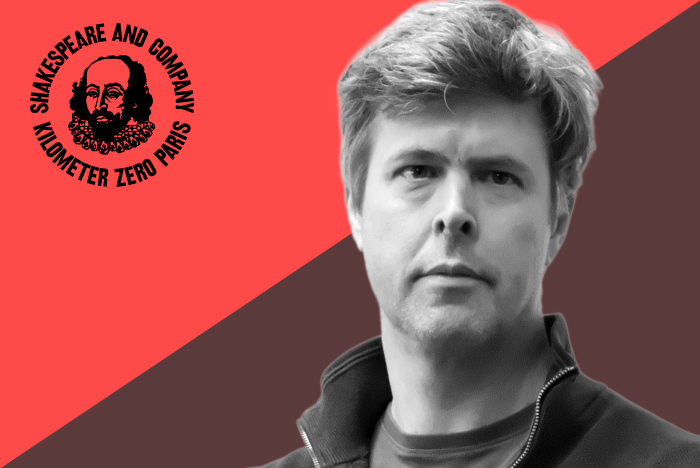
David Szalay’s Flesh, winner of the 2025 Booker Prize, introduces us to its protagonist, István, when he’s fifteen years old, living with his mother in an apartment complex in newly post-Soviet Hungary. István listens to music, grapples with school, watches pornography. Just like any normal teenage boy. But István is soon somewhat arbitrarily carried into troubling relationships, into dangerous jobs, into different countries, and ultimately up to social and financial heights he, or we, might never have imagined. Flesh is an extraordinarily sustained, deeply disconcerting work of writing that rejects so many of the conventions of the contemporary realist novel, especially in how it treats the human mind and ethical life. By divulging so little about what István thinks, if indeed he thinks much about anything, Szalay transfers immense responsibility back onto the reader, not merely regarding how to interpret István’s actions but whether to interpret them at all. In January 2026, at Shakespeare and Company in Paris, I spoke with Szalay about the novel as an interrogation of individual agency, of masculinity, of violence, of sex, and of love.
—adam biles, literary director, shakespeare and company, paris
adam biles Flesh begins in the early nineties, in newly open, newly post-Soviet Hungary. It struck me that there was something very specific about this period of time, and particularly about being an adolescent at that time, as István is when the novel opens.
david szalay I did not grow up in Hungary; I grew up in England. But as a child, I traveled to Hungary frequently, almost every year, to visit my father’s family, who mostly still lived there. My deep memories of Hungary as a small child in the late seventies and early eighties are very vivid to me. But they’re obviously quite fragmentary and vague. Then my memories of the late eighties and early nineties, the period in which the book begins, are quite clear. In fact, I spent a few months in Hungary in the summer of 1991. So that was a period, a time and place, that I had some sort of imaginative grip on. Somehow, writing about a time and place which wasn’t totally central to your life, but which nevertheless had a kind of vivid presence in your life at one particular moment or in a slightly tangential way, is often more interesting imaginatively than writing about places where you have spent enormous amounts of time. I myself, in fact, was roughly István’s age when the story begins. So that, for me, was interesting to summon memories of that now largely vanished world of Hungary at the very end of the Communist period, just when it was opening up. And, obviously, there’s a sort of parallel. The country underwent a kind of adolescence—that’s probably a bit of a florid way of putting it—but at that point where the old regime fell away, which was in some ways exhilarating but also intimidating, it just seemed like a good fit, in that sense, for a story of adolescence as well. The book, I think, is a book about Europe in the last decades. And, of course, 1989, 1990 is an obvious point at which to start looking at contemporary Europe, because that’s when the Berlin Wall fell.
AB We meet István when he’s fifteen, and except for a little moment later in the book, we don’t really find out anything about his life before then. How well do you know István before we meet him, and do you feel that the collapse of the world he knew was a very formative part of his life?
The only axiom, the only starting point—and this is important—is the physical body, the physicality of existence.
DS I have to say, it’s not like I know lots of information about István’s earlier life that I’m hiding from you. I don’t know any more than you do. I wrote the first chapter without feeling the need to know everything that had happened before. I quite enjoyed starting with a blank page, István himself being a blank page, his life being a blank page. The novel begins with the repeated use of the word new and this sense of an absolute beginning. So, no, I don’t really know the background of it. What I can definitely say—and I think this is very much relevant—is that István comes of age in a world where the West is something that is fetishized, that is obsessed over by the society he lives in. It’s a kind of El Dorado. It’s a model of these wonderfully wealthy societies full of happy people who don’t have any serious problems. It’s obviously a fantasy, but it’s nevertheless very much true that people from that part of Europe emerging from the Communist decades had this sense of Now we get to be like them. Now life is going to smile on us. Now we’re going to get all the good things that they’ve got and that we haven’t had. And, to some extent, that was actually true. But to some extent, of course, it’s a recipe for disappointment, because the West is not paradise. It has its own problems. Probably it’s preferable to the old life that existed in Eastern Europe, but it’s by no means paradise. So to set it up as that is going to lead to disappointment later. I think in István’s story, that’s absolutely true. And in the social and political problems you see in countries of Eastern Europe now, that’s a factor too.
AB Quite early on in the book, there’s a scene at his grandmother’s house. She’s got these travel books, and you write that the colors in them look unnatural somehow. They don’t look like the colors of things in reality. This idea of unreality is something that persists with István throughout his life. Is that a hangover from this fantasy he had of the West and its possibilities?
DS I don’t want to overstress this in his particular case. This is obviously going to be part of what forms him as a character, just based on the time and place in which he was born and grew up and came of age. But with those travel books, it’s partly because color printing was pretty crude in Communist Hungary. So there’s that very realist and naturalist aspect of it. But, yes, there’s also a kind of metaphorical or figurative aspect to it, that these pictures of supposedly better places have this air of unreality about them and don’t perfectly correspond to the reality.
AB So let’s talk about the relationship he has with his neighbor early on in the book. This is a woman whom he describes as an old woman, maybe even older than his mother. In a way, this is one of his first experiences of a dislocation, of living in a world that is not necessarily his world.
DS Well, the nature of this event and relationship, this process, this series of events, is not so much a sexual awakening as a kind of initiation into an adult world, not only of adult sexuality but of adult emotion, which is very confusing and bewildering to István at fifteen. And, of course, the book is called Flesh. It’s about the physicality of life to some extent. This particular episode brings that into focus, into a place where it has consequences, where it has an unprecedented intensity and, as it turns out, catastrophic consequences for István.
What really fascinated me about the story of this first chapter when I was writing it was the emotional tangledness. The way that the emotional roles within this relationship keep shifting and swapping and moving. At the beginning, the older neighbor is not really emotionally involved, but she is pushing it forward, and István is being drawn into it somewhat reluctantly, or at least with a sense of its inappropriateness, of its wrongness, with a sort of shame and disgust, but also with a kind of arousal and desire in a way that’s very confusing for him. Then, later, he’s the one who is most invested in its continuation, very naïvely thinking that it means more than it does to her. So in the space of only twenty pages or so, a lot of emotional reconfigurations happen in quick succession, and that was what I found fascinating about it.
I’ve talked, probably too much, about the risk of this being taken in some very negative way, though I guess I had faith, ultimately, that the way I was presenting this was true enough and sympathetic enough. I’m not judging. And that could be the whole problem—that I’m not judging. But I felt reasonably comfortable with the way it came out in the end, the way it stood. But precisely because the narrative voice of the book certainly withholds judgment on what’s happening, there was definitely scope for some readers to supply judgment, against the book almost as much as against the events in the book.
AB There were a couple of books that I kept thinking of while reading Flesh, and while István is not quite either of these characters, both of them resonated for me. The first is Meursault from Camus’s The Stranger, and the other is Bartleby from the Herman Melville story. Was there any literary precedent that helped you get the effect you wanted?
DS “Bartleby, the Scrivener” has been mentioned before, but I haven’t actually read it. But I’m now very curious. Don’t spoil it for me; let me go away and read it. As for the Camus, in a deep way, yes. I read that book, like perhaps many people, when I was fifteen or sixteen. I thought, Wow, this is extraordinary. I gulped it down and was knocked over by it. But it’s not something that I’ve read recently, so it’s not near the surface. But I think it probably penetrated very deeply into me when I read it as an adolescent, and it has stayed there.
I think Flesh is about life taking almost nothing as given. It’s without assumptions, without axioms. I guess the only axiom, the only starting point—and this is important—is the physical body, the physicality of existence. I think we can say that that exists. That is real. We know that. But beyond that, what do we know?
AB Do you find maybe too much moral position taking in other contemporary novels? Was that something you felt you were in some way pushing against by writing this very physical book?
DS I find interesting, as material for a novel, stories and characters and situations that make it very hard to know what my own moral position is. A situation in which it’s easy to know what your moral position is, that is fine, but it’s not a very interesting situation to write a novel about. In this novel, I was drawn to the opposite. I was drawn to situations that seemed morally murky, that seemed morally difficult to resolve one way or the other. I didn’t feel that my job as the author of this novel was to resolve them. I felt that my job as the author of this novel was to present them in their murkiness. Because again, I think that’s a very important aspect of our lives, of existence, this persistent moral difficulty. So I was very keen to get that across.
AB There is also the sense of István’s decisions being made only periodically, at certain moments, whereas most of the time he’s being carried along by events.
To me, the most important thing about him is a kind of bedrock humanity that goes beyond those considerations.
DS Well, those decisions are almost more reactions. They’re not decisions in the sense of sitting down, considering alternatives, rationally deciding which is the best course to take. I think that most of the important decisions we make in life don’t really have that form. I think that even when they take that form, that form is sometimes a diversion, a decoy to distract us from what’s really happening, which is something deeper and less conscious and perhaps more reactive. I always push back somewhat against the suggestion that István is a kind of extraordinarily passive character who just drifts along and says yes to everything, because that’s simply not true. He does show quite dramatic agency at important moments, and that agency often takes the form of physical action, which would have been, in an earlier culture than ours, the main form of agency. But in our culture, the main form of agency is more cognitive.
Also, I guess the way the book is written does, to some extent, play that down, because I did want to communicate this sense that our lives are shaped by things that we don’t control, that we may not even know about, not only major external things having to do with politics and the larger society we live in but also things having to do with what our body wants and needs and tells us. There’s a constant tension there, I think, in everyone’s life. In that sense, István is a prisoner of these forces, and I wanted to try and get that across. But I don’t think that makes him unusual.
AB And that values a different kind of violence. Because the world he finds himself in—particularly the London he finds himself in—is the London of late capitalism, that dog-eat-dog world of finance and industry. So he’s a man who is capable of fighting and capable of violence, but not necessarily the violence of the society he has moved into.
DS Well, the roles that involve potential genuine physical violence—the roles that he finds himself in as a soldier, as a bouncer, and as a bodyguard—are obviously low-status roles. The capacity for physical violence is a low-status thing. I mean, that’s another way of putting what you were saying, that the violence has been sublimated into a more financial form.
AB This book has provoked a conversation, more than a lot of contemporary novels do, and it seems to be around discussions of masculinity. This comes at a time when, in different ways and depending on the country and depending on the culture, masculinity is being reassessed.
DS Sure. I don’t want to make too much of this, though. I don’t want to suggest that István is abnormal or some sort of outlier. He’s a product of a particular time and place, as we all are, but to me, the most important thing about him is a kind of bedrock humanity that goes beyond those considerations. When I was writing the book, I didn’t really view it as predominantly a book about contemporary masculinity. I mean, that’s definitely there. It’s a book with a male protagonist that unfolds over the last few decades. But as I was writing, that wasn’t what I thought I was engaged in. The word masculinity only appears once in the book. I know this because I went through the text at a late stage of editing, thinking, Okay, I don’t really want this book to be labeled as the book about masculinity. So I found and removed a few examples of the word because they did tend towards steering the reader into thinking about this book in terms of a debate about contemporary masculinity. I hope István’s a more complex character than can simply be caught in a net of words like “primitive form of masculinity.”
AB Earlier you said that you wanted to push back against this idea that he is a passive character. One of the things that people have latched on to with this book is the repeated use of the word okay. But it’s not just István who uses this word a lot. Throughout the book, it seems to come at moments when characters find themselves struggling to express something. It seems to exemplify a breakdown of communication or a breakdown of understanding.
Words struggle, in a way, to express some deep essence of our existence. They seem to slide off the surface all too often.
DS The book is full of people saying “Okay,” and by extension, it’s full of people having conversations that don’t really articulate things. They imply things. They point to things. I think the conversations in the book are quite funny in their banality, in their circularity, and in the way they don’t really do anything. I didn’t really think about it too much. I just enjoyed them. But one of the things that the book’s about, for me, is the limits of language. As a writer, as a novelist, your words are your medium. You are familiar with the power of words, but also with their limitations, with their difficulties, with the fact that they often seem powerless. That it often seems impossible to express certain things using words. One of the very early things that made it into the book when I was writing was this sense of trying to express things obliquely, because of a sense that to express them directly was, in a way, beyond the power of words. Now, in a way, that’s a surrender, that’s giving up. But I genuinely feel that there are things words struggle to express, that words struggle, in a way, to express some deep essence of our existence. They seem to slide off the surface all too often. So maybe the way that the characters say “Okay” to each other a lot and just talk about nothing has to do with the same thing.
AB The last thing I wanted to ask you is connected to that. It’s about the power, or lack thereof, of talking—talking as therapy, I suppose, but also just talking generally. Because there are moments in the book when István talks about something important that happened in his life, and it makes a difference, leads to some kind of epiphany, however mild. But there are other moments, for example, when he says he’s been doing therapy for a year and nothing has come of it. So, in a sense, this is not a book that denies the importance of an outward expression of an inner state.
DS No, not at all. István is in therapy twice in the book. The first time, it is sort of unambiguously useful to him. The second time, it’s very complex. I don’t want to leave people with the impression that this book just gives up on the attempt to articulate anything interesting about life. I think that it does directly articulate in actual words some quite interesting things. I think it also, taken as a whole, articulates things. Obviously, it has to be verbal; it’s a novel. But in an oblique way. In an indirect way. Not by pointing at the thing. It’s mysterious to me quite how it does it.
Adam Biles is a novelist, and Literary Director at Shakespeare and Company, Paris.
Originally published:
March 5, 2026
Featured
Reading the Declaration of Independence as Holy Text
How the American creed emerged—and evolved—over 250 years
You Might Also Like
Miriam Toews
The author of A Truce That Is Not Peace on how writing resembles loss