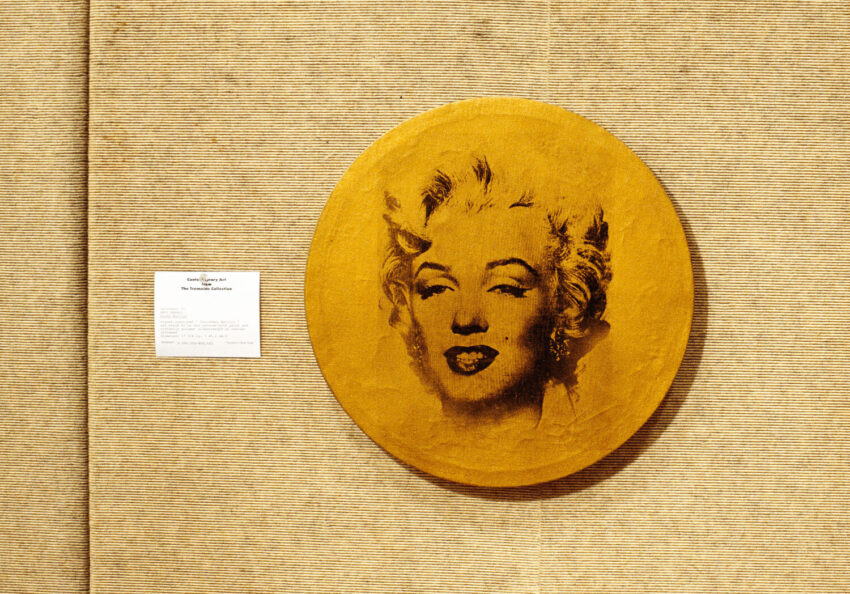
Some of the past century's heights of ingenuity were built from the recycled and the restaged, Audrey Wollen writes—like Louise Lawler's photographs of artworks on the walls of auction houses. Louise Lawler, Does Andy Warhol Make You Cry?, 1988. Courtesy the artist and Sprüth Magers
You could be forgiven for thinking things—art, books, music, clothes—were irretrievably dire. Almost a decade ago, Alex Ross wrote in The New Yorker that “culture appears more monolithic than ever. . . . Technology conspires with populism to create an ideologically vacant dictatorship of likes.” In a 2023 piece in The New York Times Magazine, Jason Farago claimed: “We are now almost a quarter of the way through what looks likely to go down in history as the least innovative, least transformative, least pioneering century for culture since the invention of the printing press.” A headline last year at The Atlantic read: “Is This the Worst-Ever Era of American Pop Culture?” New York recently released “The Stupid Issue,” asking, “Is 2025 the stupidest year on record?” and answering with “12 signs of a culture in decline,” in the same listicle format often blamed for dwindling journalistic standards.
Apparently, I’ve been living in this arid desert of innovation for my entire adolescence and adult life. In 2011, the year I turned nineteen, the music critic Simon Reynolds made the following diagnosis in his book Retromania: “Instead of being about itself, the 2000s has been about every other previous decade happening again all at once: a simultaneity of pop time that abolishes history while nibbling away at the present’s own sense of itself as an era with a distinct identity and feel.” In 2014, in the introduction to his influential essay collection Ghosts of My Life, the cultural theorist Mark Fisher wrote, “It’s clear to me that now the period from roughly 2003 to the present will be recognised—not in the far distant future, but very soon—as the worst period for (popular) culture since the 1950s.” (An odd claim, as the 1950s saw the birth of rock and roll in the United States, major breakthroughs in jazz, and Singin’ in the Rain.)
“very soon” has arrived, the simultaneity of time notwithstanding, inaugurated by W. David Marx’s recent book, Blank Space: A Cultural History of the Twenty-First Century, which aims to historicize the years from 2000 to 2025 as a period of creative emptiness and stagnation so intractable that it will be remembered (or, rather, is being remembered, through the anticipation of remembrance) as voided time, a dark age. Blank Space offers 281 fast-paced, rollicking pages that provide an overview of an extraordinary number of cultural events—including the flourishing of reality television, Web 2.0 and social media, monumental social and political movements from Occupy Wall Street to MAGA—only to culminate with the bewildering conclusion that nothing artistically transformative has occurred.
In his closing chapter, Marx writes, “Culture has been central to the narrative of the last twenty-five years—but merely as entertainment, commerce, and politics. In reliving the first quarter of the century in these pages, we can feel what’s missing—there is a conspicuous blank space where art and creativity used to be.” It is, by its own admission, history presented as negative-space drawing: if you write down all the “entertainment, commerce, and politics,” the absent shape of “art” might become visible. Art evades definition—you’ll know it when you (don’t) see it.
No one could argue that people are making less of it, as this is also an era defined by unprecedented access to the tools of production and distribution. The means to edit a short film, design a poster, or record an album in your bedroom, and then publish that work directly to an audience, are newly affordable and widespread. For Marx, however, most of that creation (or should we call it content?) is not creativity; it is a surplus of material, propelled and inhibited by a wish to make money and gain attention. Poptimism—the idea that commercial pop should be accorded the same critical attention as traditionally “serious” genres such as rock or jazz—has wrenched away our critical ability to assess something’s worth outside of metrics defined by mass-market success: if it makes money, it must be good. (I would argue that the floundering of critical thinking in public life, and of criticism as a professional practice, is not due to the scholarly appreciation of Mariah Carey songs, but that is a minor point.)
If the second half of the twentieth century was a rushing river of culture, many feel that the present has become a brackish wetland, a marsh.
According to Marx, nothing “feels new” or “radical enough to outmode the past,” resulting in a terrible state of affairs in which “Audrey Hepburn, Miles Davis, and Joan Didion remain iconic because no one has emerged who can compete with their cool.” Yet it is the narration and re-narration of Hepburn’s, Davis’s, and Didion’s “cool” that cements them so firmly in our firmament. Not only have all three appeared in mainstream fashion campaigns in the past twenty years (the Gap, Supreme, and Celine, respectively), but each has been the subject of a full-length documentary in the past ten (Audrey, 2020; Miles Davis: Birth of the Cool, 2019; Joan Didion: The Center Will Not Hold, 2017), and at least one major book about each has been released in the past five (Intimate Audrey, 2026, by Sean Hepburn Ferrer and Wendy Holden; 3 Shades of Blue, by James Kaplan, and Didion & Babitz, by Lili Anolik, both 2024). To allow others to “compete,” the cultural historians of the recent past would have to find something to historicize other than the current generation’s perceived inadequacy.
History, as usual, presents a Goldilocks problem—never “just right,” it is always ballooning into overwhelming excess, filling up the room and weighing down the present, or deflating into a slippery pellicular film, impossible to handle or understand. Popular internet discourse delivers jokes about millennials “watching their 173rd once-in-a-lifetime historical event unfold,” as one recent meme put it, as though my generation suffers from too much history, a “too much” that also signifies the end of itself, like the home of a hoarder that has accumulated so many mountains of life detritus that it ceases to function as a place where a person can live. This surplus of past in our everyday lives, which Reynolds has dubbed our retromania, is eased by the flattened, instantaneous libraries of Babel in our pockets at all times, and causes what the Italian philosopher Franco “Bifo” Berardi described as “the slow cancellation of the future,” a feeling of time’s forward propulsion gradually decelerating until it barely moves at all. If the second half of the twentieth century was a rushing river of culture, many feel that the present has become a brackish wetland, a marsh. This is found in the ubiquity of reboots in our movie theaters, the diffuse archive-jumbling of our fashion trends, the collapse of unifying -isms in our contemporary art, the citational frenzy of our popular music, and, most nefariously, the conservative nostalgia that currently dominates Western politics.
And yet it is hard not to hear the claims of our missing originality as a kind of nostalgia in its own right, hearkening back to a semi-mythical past when artists were brave and fun, rent was cheap, and everything was new and meaningful. (Nostalgia for those material conditions, rather than a generalized haze of rebellion and inspiration, is well placed; as Fisher wrote, “If there’s one factor above all else which contributes to cultural conservatism, it is the vast inflation in the cost of rent and mortgages.”) On a rhetorical level, Marx’s sweeping judgment is very difficult to contest: either you dredge up a few artifacts of novelty that have gone ignored, which reads as a little pathetic (please, sir, what about hyperpop?), or you are forced to defend the material he has dismissed as worthless (Addison Rae, Paris Hilton, the Real Housewives; his harbingers of cultural apocalypse—my harbingers of a great night!), which reads as a naive defense of late-capitalist consumerism. It is true that we are a generation stuck in a loop: many tiny loops, looping at different speeds, looping into other loops, as if we were all wedged inside an undulating Ruth Asawa sculpture, but instead of wire it is made of time. Maybe we are living in a marshland. Many creatures do.
“What’s so bad about repetition?” the compulsion asks. But, no, really, what’s so bad about repetition? Or perhaps it would be better rephrased as: What’s so good about innovation? That pesky re- prefix again—Reynolds christened 2000 to 2010 “The ‘Re’ Decade”—which comes from the Latin prefix meaning again, back, anew, against. The again and the back have been covered at length, but what about the anew and the against? If the twentieth century taught us anything, it was that total originality—creation ex nihilo—was not the prerequisite for radicality or profundity, a lesson that might serve us well in this current moment. Many of the objects that are acknowledged as heights of ingenuity of the past century found their form in the recycled, the reused, and the restaged. Take, for example, Pablo Picasso gluing browning newspaper headlines onto wallpaper samples, or Marcel Duchamp carting home a vertebral bottle rack from a department store and claiming it as sculpture. Or Andy Warhol squeegeeing candy-colored ink through ghostly stencils of an old publicity shot of Marilyn Monroe, only a few weeks after her death, or Roxy Music playing tattered shreds of Wagner, the Beatles, and Duane Eddy in a discordant love song. Or Hank Shocklee and the Bomb Squad layering hundreds of three-second 4-bit snippets with the Ensoniq Mirage sampler-synth, collaging together Public Enemy’s enveloping sound, thunderous and encyclopedic. Or Louise Lawler photographing one of those same Warhols at an auction house, decades later, Monroe’s face crinkled against beige carpeted wall, her worth held up by a label pushpinned next to it. I could go on.
It does not surprise me that millennials and zoomers might be wary, unconsciously or otherwise, of contributing anything “new” to a stretch of history that has voraciously eaten newness only to cough up suffering. What about the past fifty, seventy-five, one hundred years makes barreling toward the future seem like a good idea? The Doomsday Clock reads eighty-five seconds to midnight, and for many across the globe a more local apocalypse has already arrived. Some of the archive fever of the past twenty-five years might be a form of emotional anti-accelerationism, a generation desperately trying to produce a wind drag on the forward velocity powered by the deathly machinery of the twentieth century. To approach the world “anew,” we might need to embrace the word’s cyclonic strangeness, its inherent paradox, defined as “once again” (and again, and again, and again, and again, and again), “in a different way.”
in blank space,marx declares, “Only inventive culture supplies long-term benefits to humanity. Kitsch never asks us to change.” Long-term benefits to humanity is a phrase so vague as to become meaningless, while also clearly rife with the potential for ambivalence: What is the “long term” when imagined alongside the unfolding eco-crisis, the normalization of annihilative nuclear weapons, the increasingly alienated state of constant war, the live streaming of genocide? Constant invention as the only route to social transformation is the underlying ethos that helped produce those horrors. Perhaps kitsch and other multiplying relics and wish-objects feel like they might glitch into a different kind of change through their explicit embrace of the unoriginal and the recursive—cryptic tokens for the buying of time. I’ve tried to come up with a concise, working definition of contemporary kitsch for this train of thought, but, fittingly, I’m left grasping at a vestige, a sentimental image from my childhood.
“I do hope it isn’t rumpled,” Wendy says in the movie, armed with her tiny tool kit of aspiring maternity, grabbing hold of the gauzy darkness.
I keep thinking of that scene in Disney’s 1953 film Peter Pan in which Peter’s shadow, unhooked from his body, is retrieved and sewn back onto his slippers by Wendy. (In J. M. Barrie’s original 1911 novel, Peter and Wendy, the shadow is discovered in the mouth of Nana, the dog, after having “snapped” off when the windowpane is shut abruptly over it.) Kitsch has always been described as the attendant shadow of “fine” art, the cheap, disembodied copy—the sprightly, spectral imprint of a true feeling thing. (It bears noting that Peter Pan himself is shorthand for a person caught in temporal stasis, often used to describe millennials: the little boy who never grew up, excised from the world and its passages of maturity and mortality.) In our cultural moment, the shadow seems to be dancing around the room, fluttering up the walls, released from the sole of any corporeal child, from grounded source material and baked-in finitude. The copy of the copy of the copy is whipping around over our heads, darting across the ceiling, and it sounds like Addison Rae’s “Diet Pepsi,” which sounds a lot like Lana Del Rey’s “Diet Mountain Dew,” which sounds a lot like a thousand other things. The question is: Will a Wendy come along, with her needle and thread, and reattach us? Do we want her to? “I do hope it isn’t rumpled,” Wendy says in the movie, armed with her tiny tool kit of aspiring maternity, grabbing hold of the gauzy darkness. The absence, too, can show signs of wear, wrinkles of time.
Across his blogk-punk, which ran from 2003 to 2015, Mark Fisher popularized the term hauntology to describe electronic music of the 2000s, circling acts like Burial, the Caretaker, and the scene (or séance) congregated by the Ghost Box record label. A “puncept” on the concept of ontology borrowed from the philosopher Jacques Derrida, hauntological music reinserted the glimmers of our canceled futures—the Ghost of Christmas Probably Not Yet to Come, let’s say—into the eerie timelessness of the early 2000s. This music embraced the supposed bleakness and blankness of our fin de siècle 2.0, accentuating its “overwhelming melancholy,” as Fisher put it, through a preoccupation with “the way in which technology materialized memory.” A digital recording of the record player’s “crackle” became “the sonic signature of hauntology,” highlighting the lost sounds of previous surfaces and textures, the inescapable artifice of their reproduction in the present moment.
The crackle stands in for more than just another time—a previous era of hope-fueled dance and electronic music, when DJing involved hauling milk crates full of records to clandestine raves in deserted warehouses and empty fields, a past jam-packed with utopic potential. In Fisher’s assessment, it evokes another timescale entirely. Hauntology is a weird, exciting, often contradictory bundle of values and ideas: nostalgia (bad) for a sense of a future (good), as performed through a postmodern (bad) jumbling (bad) of audiovisual relics (bad, but feels good) held in the amber of new technologies (bad?), that reminds us of what it was like to have hope (good!) for a postcapitalist world (very good!). It is a collision of dense, unlikely strategies: not simply turning backward in order to walk forward, but going backward for a bit, feeling really awful, staying there in a strange fugue in order to reignite the idea of going forward, letting going forward exist as a dream in the sleep of the backward-facing now.
Is the hauntological “crackle” a kitsch object? Is Peter’s shadow a Derridean (or Fisher-esque) ghost? Both presences—the spectral trace of erstwhile subculture and the fluttering silhouette of prefab desire—point toward a century governed by “the agency of the virtual,” in Fisher’s words, the nonexistent that has profound effects on our lived realities. It is not simply that we are crushed by a pileup of history; we are all irrevocably mutated by capital and “the abstractions of finance,” whose disembodiments shape our experienced hierarchies of class, race, and gender. The not-real (such as the “personal” “ownership” of “trillions” of “dollars”) has never felt more real in its consequences. For most people, one of the most intimate relationships of their lives is with the reverberations of an all-powerful yet imaginary force, “the economy,” which we speak of in the hushed paraphrasing of the religious, grateful for its beneficence, fearful of its wrath, and ultimately, unsure of how it all works. Risk-taking, artistically or otherwise, often recedes when basic financial stability is rare, craved, exalted, and hard won. Marx observes this, but risks simplifying it as widespread acceptance of “selling out” instead of the downstream effect of structural violence that shapes worldviews.
Furthermore, we can add to this the swells of data, the atmospheric output of mass surveillance systems that can never be held, watched, or read except through further abstracted, exceedingly nonhuman methods of viewership and organization. Maybe that’s another factor in the anti-inventive tone of millennial and zoomer cultural production: already aware of themselves as having been witnessed, logged, and recorded, many pour their material into the oceanic internet, watching it ripple in acknowledgment and then be swallowed. The end goal is an ideal of anonymization via proliferation: becoming a meme.
In a sense, the youth of the recent past know they are pre-remembered, and therefore can concern themselves with the work of being forgotten. Perhaps, because of this, they don’t feel the need to announce or confirm their presence in the archive through a gesture of creative rupture, as previous generations did. Except in the most bodily of ways—they enter history through the politically transformative, exceptionally present, collective rupture of the riot or the occupation of space. See, limited to the United States: Oakland in 2010; Wall Street in 2011; Anaheim in 2012; Flatbush in 2013; Ferguson, St. Louis, New York City, Berkeley, Oakland, and others in 2014; Baltimore in 2015; Baton Rouge, St. Paul, New York City, Chicago, Milwaukee, Charlotte, Standing Rock, and others in 2016; Anaheim, Olympia, Portland, and Washington, DC, in 2017; Memphis in 2019; Minneapolis and practically every other major American city in 2020; Atlanta in 2021, 2022, and 2023; college campuses across the country in 2024; Los Angeles in 2025; Minneapolis in 2026; and many others, many elsewheres, many manys, again and again.
i hesitate to make generational proclamations, which I think is a symptom of, and perhaps a testament to, my generation. I can already feel the ground underneath my argument growing a bit soggy—I am, after all, a product of the cultural marshland of the 2000s. My perspective is history logged, mushy and inexact, my style is patchworked and gleaned, my analysis makes most sense mapped as doodled spirals. I find the declarative mode that is necessary for the construction of an avant-garde (or the loud lamenting of a lack thereof ) kind of cringe, to be honest, not because being born in the early 1990s made me allergic to earnestness, as is often presumed, but because of its absolutism, its unquestioned reverence for clarity and category.
Subculture, and its glowing nimbus of futurity, has become a kitsch object as well.
I can empathize: it must have felt comforting to imagine there was a way to dress and a type of music to listen to and an art to make that situated oneself inside of history in a legible and linear way. But it was always an act of imagination (as evidenced by the various revolutions that once felt inevitable and around the corner, but never actually occurred), just as this whirlpool of stasis is a kind of imagining as well. The fact of the matter is that kitsch is now so overabundant that to not use or misuse it is to leave money on the table, so to speak—stacks of meaning-bucks, just sitting there. What’s difficult to accept, for those not from the marshes, is that subculture, and its glowing nimbus of futurity, has become a kitsch object as well. Not merely the specifics—the hedgehog prickles of a hairstyle, the fog of bass rolling in over a crowd—but the form itself.
In Los Angeles, starting in 2014, a band named Purity had a single live set that it performed regularly across a variety of small venues and ad hoc events: gallery openings, backyard parties, DIY shows. The band members were all in other bands (such as Behavior and P-22) with profuse arrangements and rearrangements of the same people, but the members of Purity never changed: Nicole-Antonia Spagnola, Justin Tenney, and Bedros Yeretzian. They described themselves as “a cover band with a limited repertoire.” A sole LP, Live in Los Angeles, originally released in 2016 by Some Ware and then rereleased in 2021 by Post Present Medium, transcribes this performance as a continuous track. Opening with a delicate, tinkling chime, a New Age–ish wink fades into a low-commitment dance beat. It sounds like a factory setting on a garage-sale synth, the barest hand drum—are they bongos?—but lacking the variance of human touch, looping in a way that is distinctly mechanical. The drum track never ends.
Over this sustained, serpentine percussion, which sounds like it belongs to nobody, Purity performs songs that belong to other bands, borrowed relics “that illustrate some hereditary relationship to a certain subgenre of rock and roll,” as described in the liner notes. The band begins by repeating itself, playing a version of a Behavior song, “Black Dog.” The thrum of sallow electric guitars signals it has learned to play hardcore, a style of early 1980s punk music defined by speed, exultant rage, explicit political commitments, and sharp, unexpected endings. But Spagnola’s vocals are heavy and even slow, as if her vowels are filled with stones. The tinny dance beat picks up a little, shimmering with faintly familiar pop effects.
The listener descends into the mulchy bog, wet and thick. But this mire unexpectedly greens into acute feeling.
Now we are listening to a drained cover of Rudimentary Peni’s 1980 song “1/4 Dead,” hung like a clean sheet over the thick rope of the isolated bass line, which, unlike the original, never gets faster, never escalates into catharsis. In their cover of Negative Approach’s “Ready to Fight,” Spagnola sounds exhausted, ragged, a boxer swaying to a silent waltz after a knockout punch. By the time we’ve reached Minor Threat’s “In My Eyes,” it’s clear Purity has its own unofficial canon of early 1980s hardcore and anarcho-punk, presented by way of echo and embezzlement. In this song, there is no guitar at all, only a rising digital chord as a sample of detached claps comes in over the beat: a ghost chorus. Spagnola scrawls the final lyric onto the wall of sound—“At least I’m fucking trying, what the fuck have you done?”—and her desperation is punctuated with a triangle’s exclamation, cute and cheap: ding!
The performance reaches its apex when a lone trumpet solo, also a digital sample, signals the last song: a cover of the B-52s’ “Dance This Mess Around,” stripped to the bone and played for heartbreak. The B-52s are known for their campy, dancy, off-the-rails pantomime of 1950s and ’60s pop; “Dance This Mess Around,” from 1979, is a playful, high-femme precursor to the more solemn and confrontational forms of punk that followed. The B-52s were already there, hopping and bopping among the ruins of cultural megaliths, throwing brightly colored streamers over forsaken architectures. A cover of “Dance This Mess Around” is a repetition of a repetition, a warping of the warp, a slow decay of the slow decay. The listener descends into the mulchy bog, wet and thick. But this mire unexpectedly greens into acute feeling: somehow, Purity turns the lyric “I’m not no limburger” into one of the most wretched, mournful lines of any music I’ve ever heard.
re-performance, again and again, teases the collected strands of subculture into another kitsch object, towering like the beehives the B-52s used to wear. This isn’t kitsch in the sense of wide consumer appeal, clearly, but I am reminded of how the critic Clement Greenberg, in his canonical diatribe “Avant-Garde & Kitsch,” defines it as a “vicarious experience,” a kind of surrogate. For Greenberg, kitsch is the binky and the avant-garde is the breast (as if we don’t have deep, meaningful relationships with our binkies, or, furthermore, as if all art isn’t the binky of representation in contrast to the breast of the real). Kitsch requires the “availability close at hand of a fully matured cultural tradition,” rarefied and genuine, such as late 1970s and early ’80s punk music as it was received by post-everything millennials, although I’m not sure this is exactly what Greenberg imagined when writing in 1939.
Marx would probably agree on a more Greenbergian line—yes, exactly, old cultural forms of radical possibility have been resurrected as half-hearted ghosts! Tragic! But what he misses, fundamentally, is the vice versa, the backward loop, that is also true: the kitsch object, the dancing shadow of a certain subgenre of rock and roll, is transformed through (re)restaging into a new, sprouting form of subculture, if that can be defined as what goes on underneath the opaque layer of mass commerce. Who can blame the underneath for turning toward the archaeological? Might as well dig around a bit while you’re down there. “Before you break my heart, think it over,” the Supremes sang, in 1965. “Before you break my heart, think it over,” the B-52s sang, in 1979. “Before you break my heart, think it over,” Purity sang, in 2014, somewhere in a backyard, a plea to the entire world. Over means finished, completed, but depending on the sentence it can also mean the opposite: over and over, think it over, start over, meaning to remain, to return, and to begin anew. “Repetition is key here,” the liner notes read, “as is genre, context, being looked at, standing around, etc.”
Audrey Wollen is a writer whose work has appeared in The New Yorker, The New York Review of Books, The New York Times, Bookforum, The Nation, and others.
Support Our Commitment to Print
Subscribe to The Yale Review. Receive four print issues a year—essays, fiction, poetry, and criticism.