the title of this folio on artificial intelligence—“What Was AI?”—is offered in the past tense because the answer to that question will likely have changed by the time you read this issue. Quarterly magazines plan far in advance; AI does not wait on us. Progress that once seemed far away is already old news. The adoption of AI—and the political, social, and cultural changes that come with it—is only accelerating, moving faster than a writer who needs time to think can keep up with. The results are dizzying to contemplate. This folio, then, is a record of a moment that will surely be gone almost as soon as we have begun to name it.
ChatGPT launched in late 2022, five years after the 2017 paper that introduced the transformer—the computer architecture that undergirds today’s “neural networks”—and within two months it had one hundred million users. By February 2026, OpenAI reported that ChatGPT had nine hundred million weekly users—more than the combined populations of the United States, the European Union, and Canada.
When we say “artificial intelligence,” we usually mean “large language models,” or LLMs—a distinction one barely has to make anymore. ChatGPT, Claude, Gemini—they are everywhere among us, helpful and fast, expansive and dulling. The agents have arrived too, tools that, given a task, can head off and work with other AIs, if they choose, or teach themselves to use Microsoft Word, populate a Google Calendar, draft code. And beyond these, we now live amid many kinds of generative AI software, including small language models, Meta’s “large concept models,” multimodal systems that can read images, and more.
The impact of all of this will be—and, in some cases, already has been—staggering. One recent study predicts that by 2030, 6.1 percent of workers will be displaced. A “silent shift” is said to be underway: some companies are not replacing people who leave, instead routing work to LLMs and agents. Among people who have jobs, some are finding that their work largely entails supervising these agents.
Of course, it’s not just the workplace that has been affected; AI has entered our intimate lives too, rewriting our romantic and psychic experiences. AI companion software sites have exploded; character.ai, a chatbot platform that allows users to interact with a library of customizable personalities, has surged in popularity, with more than twenty million users. Many people talk to LLMs about their well-being, developing romantic relationships or friendships with AI companions they create through apps like Kindroid and Replika. Several AI companies, including OpenAI and character.ai, face lawsuits alleging that their chatbots contributed to users’ suicides or self-harm. At the same time, governments aim to deploy generative AI technologies in combat, including to identify targets. The US Department of Defense has pushed to aggressively advance an “AI-first” mode of warfare. AI is everywhere, and yet, as at least one writer notes in this folio, we still have not answered basic questions about what it is and where it is headed.
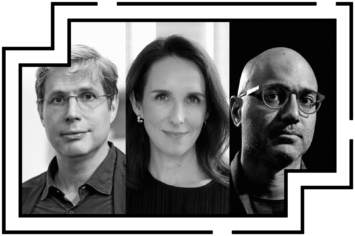
Our folio, then, is a partial, though we hope meaningful, snapshot of what it felt like to watch AI enter our lives: a time capsule of the thinking that literary writers and critics were doing during this strange interval. In “Jagged Intelligence,” the computer scientist and writer Melanie Mitchell traces how we got here and where we may be going. Lauren Oyler, in “My AI Boyfriend,” asks what we lose when we outsource romantic connection to chatbots, and what we gain when we love other humans. In “Chasing Alice,” Sheila Heti remembers the early Chai chatbot she built, and considers how Chai’s users, well, used it—speaking to it violently about sex and more. Christopher Sorrentino’s “How LLMs Set My Fiction Free” explores how AI helped him regenerate his writing practice and renovate the novel as an experimental form. In “Donna Haraway’s Utopian Promise,” the critic Meghan O’Gieblyn revisits Haraway’s “Cyborg Manifesto” and lays out why AI has not, in fact, enabled the feminist hybrid utopia that Haraway hoped for. New poems by Patricia Lockwood and Brenda Shaughnessy animate how AI shapes our inner contours. And last but not least, in April, I spoke at Yale with the novelist Daniel Kehlmann and the playwright and novelist Ayad Akhtar about AI and the humanities; an edited version of that conversation is included here.
We hope these pieces give you new (or least renewed) ways to think about this paradigm-shifting moment, and that they bring two very human experiences with them: pleasure and engagement.
—Meghan O’ROuRke, executive editOR