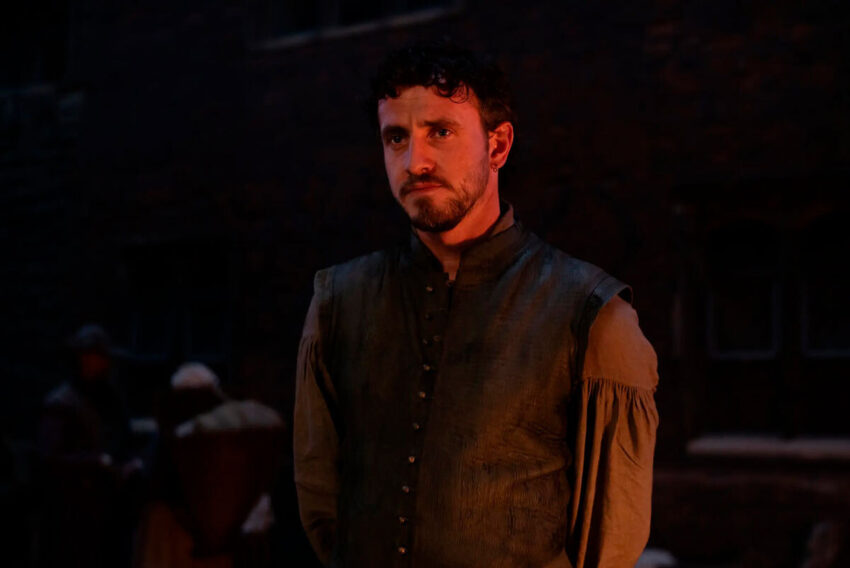
Paul Mescal as William Shakespeare in Chloé Zhao’s Hamnet, 2025. Photo: Agata Grzybowska, courtesy Focus Features
In the fall of 2024, my daughter, a first-year drama student at Juilliard, was rehearsing for a school performance of The Winter’s Tale. She was cast in two roles—the lovelorn Prince Florizel and the clownish Young Shepherd—in a workshop that stressed process (close reading of the text) over product. The play would be staged once, in a black box theater, for an audience of other students and faculty. I would never see it.
Because I couldn’t watch the performance—or, as I secretly wished, take the class myself—I embarked on my own haphazard study of Shakespeare. I read a few of the plays and watched some filmed productions, starting with The Winter’s Tale. But at some point, without having ever planned it that way, I found myself tumbling down the bottomless well that is Shakespeare biography.
My fall into this particular rabbit hole was perhaps predictable, given that I had recently written a sort of biography about the filmmaker and comedian Buster Keaton. My newfound mania for reading about Shakespeare’s life sprang from the same source as the Keaton book had: the paradox that the more one learns about a great artist’s life, the more inscrutable the relationship becomes between that finite span of days and the miraculous living body of work left in its wake. In reading about Shakespeare, as in writing about Keaton, I found myself trying to imagine my own way into the interstices of the documented facts, as if by inhabiting the empty spaces, I might better understand how that work emerged from that particular life. In this, I was far from alone. For centuries, scholars, novelists, filmmakers, and conspiracy theorists have returned to those gaps in the record, trying to fill them in ever-renewed efforts to chronicle the life of our greatest chronicler of lives. The latest artist to venture into this territory is the director Chloé Zhao, whose film adaptation of Maggie O’Farrell’s novel Hamnet attempts to conjure what these spaces might hold.
in shakespeare’s case, of course, the gaps are very large, even if generations of biographers have worked assiduously to close them. This wildly prolific producer of what his most-quoted tragic hero dismissed as “words, words, words” somehow left behind no letters, diaries, commentaries on the work of his fellow dramatists, or even early drafts of his own work. All that we have in his hand are six signatures on legal documents—three of them on his will—and one page of what may or may not be his contribution to a collectively written play.
With no other writer is there so vast a gulf between what we can say with certainty about their time on earth—Shakespeare’s lasted just fifty-two years, from 1564 to 1616—and how much their work seems to know about us in all our knotty, self-contradictory human complexity. There was indeed a glove maker’s son, born in a midsize market town in Warwickshire, who married young, had three children, moved to London, achieved success as an actor and a playwright, and eventually went home to Stratford-upon-Avon to die. But to readers, writers, and conspiracy theorists through the centuries, the mundanity of that bio has felt incommensurate with the immensity of the world the author seemed to contain, a teeming multiverse of kings, queens, taverners, tradesmen, shepherds, magicians, pickpockets, peddlers, and clowns.
To ask “Who was William Shakespeare?” is to open a seductive abyss. The work of many authors, including some from Shakespeare’s own time—think of John Donne or Michel de Montaigne—can be read as the expression of an individual personality, what we would now identify as an authorial voice. But the same protean, quicksilver quality that makes Shakespeare a dramatist of unequaled range and power renders him vexingly elusive as a person. Was he a staunch royalist, as might be suggested by his preoccupation with kingly power and succession, or a champion of the common folk he rendered with such nuance and sympathy? A Catholic or a Protestant—or, having grown up in a violently transitional post-Reformation England, some combination of both, or neither? Gay, straight, bisexual?
They want, as he did, to create vivid invented worlds that shed light on the often-mystifying real one in which we are all consigned to live.
Reading his work, it’s easy to find evidence for any side—or, more often, for all sides at once. He seems to be everywhere and nowhere, to speak in the voices of countless distinct characters while revealing little about his own habits, values, judgments, or beliefs. And while the Bard’s famous 154-poem sonnet sequence marks a rare place where he appears to write in a self-disclosing first-person voice, the poems anatomize so many aspects of being in love—infatuation, disillusionment, lust, jealousy, despair, shame—that it’s impossible to tell whether the speaker is one individual pouring his heart out or a succession of characters not unlike the dramatis personae of the plays.
This everywhere-and-nowhere quality of Shakespeare’s authorial presence may be what makes the lacunae in his biography so tantalizing: if his poems and plays can’t tell us who he was, perhaps his life can. And so it’s unsurprising that over the centuries, those blanks have inspired not just feats of archival recovery but acts of invention. Academics and artists have returned to the scant documentary record and tried to spackle up the holes, if not with newly unearthed historical evidence, then with well-informed speculation or sometimes straight-up fantasy. It’s as if something about the overflowing plenitude of Shakespeare’s language has a mimetic effect on those who seek to understand him. They want, as he did, to create vivid invented worlds that shed light on the often-mystifying real one in which we are all consigned to live.
Most famously, the so-called anti-Stratfordians, unwilling to accept that a provincial tradesman’s son without a university education could have authored such works as Hamlet and King Lear, have proposed alternative candidates, projecting other lives into the void: aristocrats like the Earl of Oxford; Shakespeare’s contemporaries, including Christopher Marlowe and Francis Bacon; or whole conspiratorial collectives, hiding their true identities within cryptic codes embedded in the poems and plays. These theories may not stand up to serious scholarly scrutiny, but all are the product of an impulse not so different from the one that first drew me into the labyrinth of Shakespeare biography. I am not, by any stretch, an anti-Stratfordian. But I can see how they and I, as readers, share a longing to bridge that distance, to make sense of how this seemingly ordinary man produced such extraordinary work.
It was the hope of bridging this distance that propelled me on my peripatetic reading jag, each new book suggested by some citation, footnote, or unanswered question from the last. The journey was enlightening, not just about Shakespeare but about the project of biography, particularly twenty-first-century biography. At its worst, literary biography is little more than footnoted gossip. But at its best, it can function as history and criticism at once, situating an author in their time while illuminating what it is about their art that makes us care who they were in the first place.
James Shapiro’s narrowly focused microhistories of single years in Shakespeare’s life helped me see how a biography need not be a full character portrait but can instead serve as an exploration of the way contemporary pressures shaped the subject’s experience. Jonathan Bate’s Soul of the Age, a panoramic take on the author’s life and times, made clear that a great biography can be, as it were, framed from an aerial perspective rather than in close-up. Stephen Greenblatt’s lyrical Will in the World, a work of imaginative psychological reconstruction, showed me how one can move from the archival record to informed conjecture, creating an intimate portrait in the negative spaces between known facts. Katherine Duncan-Jones’s Ungentle Shakespeareoffered a bracingly different approach: unsentimental, skeptical of bardolatry and received ideas, and tart in its insistence that Shakespeare was not an ineffable genius but a working dramatist embroiled in the rough politics of his day. Making my way through these and a shelf of other books gave me a deeper understanding of Shakespeare the man and the historical milieu in which he lived.
As I read, though, I found myself less interested in resolving the enigmas of the poet’s life than in lingering in the terrain between what little is known about his time on earth and all that will never be recovered. Instead of trying to solve the mystery of the relationship between his life and his art, I preferred to reside within it.
it was with some trepidation, then, that I picked up O’Farrell’s Hamnet. I worried that where the novel swerved from the historical record or supplied details that contradicted what few facts we do know, I would resent it for failing to understand what had become clear to me: that no made-up story could be as suggestive as the real-life gaps. Above all, I feared a banal marital melodrama, a bodice ripper with doublets. But knowing that Hamnet was being adapted for the screen, and that as a film critic I would likely be called on to write about it, I decided to interrupt my nonfiction reading spree to dip my toe into the waters of speculative biofiction. If biography couldn’t fully explain who Shakespeare was, perhaps fiction could?
I found myself unexpectedly enthralled. O’Farrell’s novel explores one of the great mysteries of Shakespeare’s life—the black box of his marriage to Anne Hathaway (whom O’Farrell calls Agnes, a name by which the real-life Hathaway was known in some historical documents). Shakespeare married this woman from a neighboring town at the unusually young age of eighteen (she was about eight years his senior), presumably because she was three months pregnant with their child. The biographical consensus has long held that the Shakespeares’ union was a distant or unhappy one, and even that he regarded her with contempt. Until archival research in 2025 persuasively linked Hathaway to a fragmentary letter addressed to “Mrs Shakspaire,” scholars thought there was no record of Anne having visited her husband in London, and the only mention of her in his will is the notorious final sentence, added in the last draft, in which he bequeaths her his “second-best bed.”
Unlike these works that spin alternate realities, Hamnet builds a world that dwells in the unexplored margins of the historical record.
Faced with this nearly blank slate, O’Farrell took a bold but simple approach, choosing to emphasize not the familiar signposts of the poet’s life but the undocumented domestic spaces of his and Hathaway’s shared lives—a realm that Shakespearean biography mostly passes over in silence. Hamnet takes place almost entirely in those overlooked rooms where, as the novel makes clear without ever spelling it out, the writer whom Virginia Woolf once called, in a different context, “serenely absent-present” was defined mostly by his absence.
Shakespeare’s biographers have long marginalized or maligned Hathaway, presuming that her near absence from the documented record of the poet’s life must mean she played an insignificant role in it. O’Farrell’s novel seeks to rescue her from that marginalization by decentering the figure of Shakespeare, whose name is never spoken, neither by the characters nor by the narrator. Instead, the book’s close third-person narration is situated mainly in the consciousness of Agnes during the period leading up to and following the death of the Shakespeares’ eleven-year-old son, Hamnet. The playwright, an important secondary character but one who appears more often in Agnes’s memories than in the present day, is referred to only as “her husband.” It is not his life story but Agnes’s bereavement that provides the book’s emotional center of gravity.
Though its focus on the domestic life of the author’s wife is unusual, O’Farrell’s novel situates itself within a long lineage of Shakespearean biofiction. In her 1929 essay A Room of One’s Own, Woolf imagines a creatively frustrated sister of Shakespeare who, unable to find a place in Elizabethan society to exercise her gifts, kills herself after being impregnated by a theatrical entrepreneur. In his fantasy comic book series The Sandman, Neil Gaiman casts the Bard himself in a recurring role, imagining him striking a deal with the magical being of the title in exchange for his literary powers. But unlike these works that spin alternate realities, Hamnet builds a world that dwells in the unexplored margins of the historical record—not incidentally, a world inhabited and ruled over mostly by women.
O’Farrell sets most of the novel in 1596, the year Hamnet Shakespeare died of unknown causes. The novel plausibly posits that he might have had bubonic plague, a disease that periodically swept through the Stratford area during both his and his parents’ childhoods. In a heartrending bit of misdirection that could have come straight from a play by “her husband,” it is Hamnet’s frail twin, Judith, who first falls ill. Agnes and her mother-in-law are certain that Judith will die. Instead, Hamnet climbs into his feverish sister’s bed and offers himself up to Death in her place, a gesture whose magical power he believes in so fiercely that the reader, too, is convinced. By morning, Judith’s fever has broken, but Hamnet has developed the dreaded buboes, swollen lymph nodes signaling plague.
Hamnet’s substitution of his own death for his sister’s is not the book’s only suggestion of an invisible, possibly supernatural force at work in the everyday. Agnes, a healer versed in the curative properties of native plants, possesses a kind of psychic gift that allows her to sense another person’s emotional state by kneading the flesh between their thumb and forefinger. In a flashback, she tries this power on Shakespeare—then a young man she knows only as “the Latin tutor”—during their first, flirtatious encounter and receives an overpowering impression of a complex inner life: “It had layers and strata, like a landscape. There were spaces and vacancies, dense patches, underground caves, rises and descents.”
These touches of the paranormal are not indulgences but key to the novel’s success; their intervention in an otherwise realist narrative is presented matter-of-factly, consonant with the folktales, fairy stories, and legends about witches that saturate Shakespeare’s plays, and that likely suffused his and his wife’s semirural childhoods. O’Farrell’s prose is earthy, exacting, and blessedly free of faux-Shakespearean verbiage. Hamnet is meticulously researched, but as a work of fiction, it is freer than biography would be to feel its way into the crevices of the historical record, to conjure the affective matrix from which the plays emerged. Reading it in the wake of all those biographies, I was moved by the care with which O’Farrell treats the known facts of the poet’s life, even as she subordinates them to the fictional story of a woman whose days on earth—like those of most women who have ever lived—were hardly documented at all.
i was happy to be proved wrong in my initial suspicion of Hamnet the book, but as the release date of Zhao’s screen adaptation approached, the same doubts arose all over again. The shift in medium from prose to film might seem to offer some advantages for a project that sets out to explore the gaps in a historical figure’s life story; with its ability to suggest interiority through wordless imagery, cinema can evoke mystery without attempting to explain it. But the long history of Shakespearean biofiction on-screen tells a different story—one of imaginative spaces crammed to the brim rather than left provocatively open.
These biopics flatten their subject into a kitschy, near-caricatural figure, a Shakespeare Pez dispenser stocked with handy quotes.
From Georges Méliès’s 1907 short in which the filmmaker plays Shakespeare struggling to write the assassination scene in Julius Caesar, to the glossy fantasia of Shakespeare in Love (1998), cinematic biofictions about Shakespeare have tended to treat the gaps in his life story as narrative problems to be solved, not as places to be inhabited. The twenty-first century has brought its own variations on this theme. In 2011, Roland Emmerich’s Anonymous offered an anti-Stratfordian polemic in which the “man from Stratford” is merely a dimwitted actor, filching the noble Earl of Oxford’s plays and passing them off as his own. Seven years later, Kenneth Branagh directed and starred in All Is True, a melancholy portrait of the aging, world-weary dramatist’s late-life retirement in Stratford. Both films have their charms, but when it comes to the problem of the poet’s life, they take the same maximalist approach as Shakespeare in Love. Nary a detail is left unexplained, from the “second-best bed” bequest to the social embarrassment of ink-stained fingers. By filling in every lacuna in the historical record, these biopics flatten their subject into a kitschy, near-caricatural figure, a Shakespeare Pez dispenser stocked with handy quotes.
I was hopeful that Zhao, who won the 2021 Academy Award for Best Director for Nomadland, would avoid these pitfalls in Hamnet. Given O’Farrell’s collaboration on the screenplay, perhaps Zhao could find a way to tell Agnes’s story without letting her world-historically famous husband steal the spotlight. As a fan of both Zhao’s and O’Farrell’s work, I take no pleasure in reporting, along with Helen in All’s Well That Ends Well, that “oft expectation fails, and most oft there / Where most it promises.”
Zhao’s film initially seems poised to reinvent the Shakespeare biopic. Its early scenes are its most powerful, as the camera lingers wordlessly on the lush green forests around Stratford and the sunlit apple shed where Agnes and her future husband have their first sexual encounter. (No bodices are ripped, but linen shifts are definitely rumpled.) The stillness and sparing use of dialogue in this opening section gave me hope that Zhao’s adaptation would be able to capture the novel’s sense of historical spaciousness.
But once Agnes (a superb Jessie Buckley) finds herself pregnant and wedded to the still-unnamed poet-to-be (an appealing but miscast Paul Mescal), the biofictional clichés that O’Farrell’s novel so elegantly sidesteps come clomping into view. A perennial problem in translating novels to film is how to handle narrative voice and point of view—elements that distinguish a great novel from an adaptation-friendly potboiler. Zhao’s film mostly avoids the clumsy use of voice-over, but it falls into another trap: overliteralizing the relationship between the artist’s life and work. To some extent, this effect may be inherent in the medium. By casting any one actor as a cultural figure as universally recognizable as Shakespeare, a director literally gives body to our collective image of that long-dead icon, replacing the wide-open space of imagination with the mortal reality of a single human frame.
On the screen, Hamnet’s lapses in taste almost invariably have to do with the character of “the husband.” Zhao’s film is, in part, an account of what are called Shakespeare’s “lost years,” the seven years between 1585 and 1592 when he disappeared from the historical record, only to reappear in London as an ascendant playwright. While O’Farrell’s treatment of Shakespeare during this period makes the reader a party to Agnes’s slow realization that her spouse is withdrawing into depression, Zhao gives us the morose young Shakespeare at his desk, reciting full couplets from plays he won’t write for many years. “But soft, what light through yonder window breaks?” he mutters as candlelight flickers on his furrowed brow. Then, as the viewer digs her nails into the armrest of her theater seat, praying he will stop, he continues: “It is the East, and Juliet is the sun.”
Another scene shows the young author already workshopping Hamlet’s future last words—“the rest is silence”—years before the personal loss that supposedly inspired them. What grates about these moments is how, like the conventional Shakespeare biopics before it, Zhao’s film drains the mystery from the relationship between art and life. Is the implication that Shakespeare was born with his complete works already inside his head, like eggs waiting to hatch? If his authorship is simply a matter of incubation—if the experiences we’re watching him live through are not in fact formative—then why bother dramatizing his life at all?
Hamlet speaks directly to us, the groundlings pressing toward the stage even now, four centuries later.
Late in the film, after the death of his son, Shakespeare stands beside the Thames, reciting Hamlet’s “To be or not to be” soliloquy as he struggles with the urge to…not be. It’s a dramatically effective if unsubtle scene, but its impact is undercut by our memory of him back in Stratford all those years before, already dropping finished lines from the same play before he had ever experienced the loss that supposedly led to its composition. What might have been a meditation on the process of becoming an artist gives way to biopic literalism.
The ending of O’Farrell’s book is among my favorites of any contemporary novel—a tour de force set piece that brings together Agnes’s and her husband’s previously separate experiences of parental grief. The final pages hint at the possibility that the semi-estranged couple may yet find their way back to each other, without granting either them or the reader the catharsis of a full-on happy ending. They offer the promise that in certain rare, heightened moments, life and art may converge in a way that allows each to elucidate the other.
The film’s closing scene preserves the basic shape of the novel’s ending, but once again the screenplay pushes too far, making explicit what the book leaves to the reader’s imagination. (Celia said it best in As You Like It: “That was laid on with a trowel.”) Yet heavy-handed though it is, I couldn’t help but be moved by the film’s final image: the entire Globe Theatre audience reaching out as one toward the young actor pretending to die onstage, having collectively agreed to collapse—for just a moment—the distance between Hamlet and Hamnet, art and life. That longing for convergence is what sustains my fascination with the riddle of how the boy from Stratford grew up to be a conjurer who could summon a universe on the stage. But the simple existence of the riddle—the fact that this life and this work did somehow, inexplicably, happen—is more thrilling than any imagined answer.
In Shakespeare’s play, as Hamlet lies dying in the final scene, he breaks off from speaking to his loyal friend Horatio to address a few words to “you that look pale and tremble at this chance, / That are but mutes or audience to this act.” In that instant, as Shakespeare’s characters so often do, Hamlet speaks directly to us, the groundlings pressing toward the stage even now, four centuries later. What is it that he wants to say? Is it something that might shed new light on this confounding character—or his even more mysterious creator? Hamlet continues: “Had I but time (as this fell sergeant Death, / Is strict in his arrest), O, I could tell you— / But let it be.” It’s that caesura before “But let it be” that captures me: a moment when the chattiest of all Danish princes acknowledges the limits of language, renouncing even the need to finish his story. We’re left with the sense that, for Hamlet as for Shakespeare, leaving some things unsaid was always part of the design.