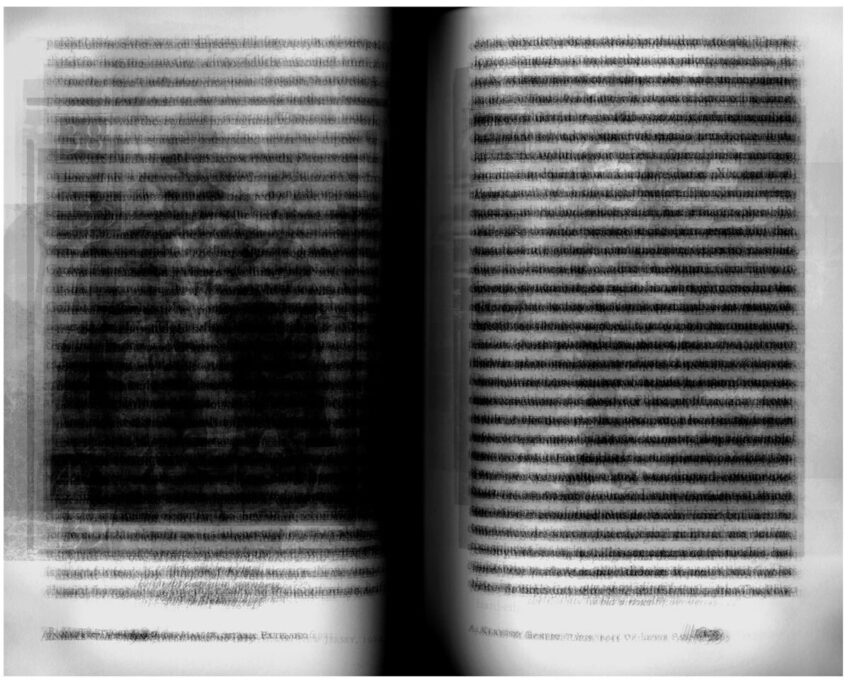
Idris Khan, Every... page of Roland Barthes' book Camera Lucida, 2004. Courtesy the artist and Sean Kelly, New York
Let’s say I have bought a book, a novel. I wait for a quiet hour, close the door to my room, sit in the most comfortable chair I have, maybe put up my feet. I know virtually nothing about this novel, about its characters and themes, nothing about the tone. Since I don’t know what to expect, I can expect everything. It’s all anticipation and promise, the delicious moment when the lights go down and the curtain rises. But as soon as I begin reading, there is a disturbance. It’s a voice in my head, and it’s asking: How long is this going to take? When will it end?
Finishing the book should be straightforward enough. The writer has gone to the trouble of arranging the words one after the other. My task is to follow: start with the first and go in order until I have reached the last. How hard can that be? Very hard, it turns out, if you are a nonfinisher like me.
Every word I read comes with a built-in off-ramp. At the first hint of trouble—say a description stretches a bit long—I stop to remind myself of the virtues of patience. At the second hint, fretfulness takes hold, and I count the pages to the next chapter break. I jump to the book’s end and discover that the last page is, still, 378. Every nonfinisher knows what happens next. My eyes fall on the spines of the stack of unread books next to my bed, and I idly wonder: Had I not planned on reading one of those first?
Finishers, on the other hand, are made of less crooked timber. Their virtues are many. They have faith in the author, and in the written word. They have hope: they do see a book’s flaws, yet they are steadfast in believing that just around the next corner things could get better. If pressed, they would admit that this is unlikely, that in fact it has never happened to them that a book, after fifty hapless pages, suddenly hits its stride on page 51. But you never know, do you.
Finishers also have constancy, which gives their faith and hope backbone. When they start a book, they don’t rest until they have reached the end. They are what novelists would make if they manufactured their own readers. And finishers are richly compensated for their trouble: in the eyes of the world, they, and they alone, are entitled to pass judgment on the novel, to have any thoughts and feelings deemed legitimate, because they have gone all the way.
And I? I have not gone all the way and likely will not. Faithless and feckless, I am condemned to dwell down with the nonfinishers, a disgrace to the written word.
sometimes—too seldom—I ask myself: Where did guilt and virtue enter the picture? I read by myself; I read for myself: Why should I be answerable to anyone but myself?
I prefer this way of seeing things. Now the books lying all over the house, books I have started and will probably never finish, are signs not of fickleness but of a robust indifference to societal norms. Now I am no malingerer, but rather a champion of the erotics of art.
And it’s true, in a lifetime of nonfinishing I have learned that the practice can be its own way of reading, even a way of admiring the book I seem to be spurning. Sometimes I am so intoxicated by the beauty and the intelligence of a novel that I must set it aside. The charge it delivers is so inordinate that I need to measure out the doses I permit myself. (Giuseppe Tomasi di Lampedusa’s The Leopard is one such book for me.) Or I put the book down because I fear its force. It’s so good I worry it will smother every last spark I need for my own writing (which is how Virginia Woolf felt about Proust).
But then why am I nagged by guilt when I fail to finish a book? Is it that I still hear the “voice of authority”—parents, teachers, and the rest—admonishing me to finish what’s on my plate? That’s surely part of it, yet the real power, and the real mystery, of the pressure to finish a book comes not from society nor from some neurotic impulse in my head, but from the work itself. Something in the structure of the work demands it, demands it because it touches something in the structure of our lives. This is true of any work arranged around a plot, however loose, and it is true because the worlds of these works (novels, plays, movies, TV series) have a beginning, a middle, and an end. They have a beginning and a middle because they have an end. When dealing with them, like it or not, we must deal with the end, their end and ours.
like every reader, I know instinctively that events gain in significance as the end draws near. There are ups and downs throughout, but once you enter the homestretch, the up-and-down logic changes. Time no longer flows but starts ticking, and the space of possibilities narrows. Take Edith Wharton’s The Age of Innocence, in which Newland Archer, in deference to social norms, never dares to marry the love of his life, Madame Olenska. By the time he makes it to the doorstep of her building, there’s only a page and a half left in the book, and though he has longed for her all novel long, I know he won’t knock. He can’t. Had he gotten himself there fifty pages sooner, there would have been a chance. But like that? In another novel, maybe, but in this novel there aren’t enough pages left for it to happen. There is room only for loneliness and regret.
Here, there are no more moves, no second chances—no chances of any kind. The end is the end.
Newland walks back alone to his hotel not because the novel ends; it ends because his walking away alone signals the end of everything that holds significance in the novel. We understand that. Everything we know from life, everything that rouses us in life and plagues us—the whole tangle of hopes and uncertainties—is now foreclosed. In life, there is always room for one more move: room to stir up a dormant impulse that would urge Newland off the park bench where he sits looking up at Madame Olenska’s apartment and send him toward her door, room for a late, desperate phone call, for expressions of sorrow, of yearning, of forgiveness, of anger. The novel goads me into wondering what would have happened had Newland changed his mind, but I know such reveries are vain. In The Age of Innocence it could not have been otherwise. Here, there are no more moves, no second chances—no chances of any kind. The end is the end.
This is a terrible truth that should frighten me, and it does. It calls to mind the unimaginable paralysis we know from death. Yet oddly, it also draws me in. Why?
Unlike life, the novel does not just break off midstride; it ends, which means that things come to a close—not all things, but enough of them. Plotlines are tied up—sometimes neatly, sometimes not. What seems like a knot is in fact an unknotting (the literal meaning of dénouement in French), an untangling. Look at how Wharton orchestrates the end of the book. When Newland arrives at Madame Olenska’s, the day is “fading into a soft sun-shot haze,” and he sits on that bench “for a long time…in the thickening dusk.” By the final lines, there’s just enough light for him to catch sight of a servant stepping onto the balcony of Madame Olenska’s apartment to close the shutters. Then things go dark: The sun sets. The day draws to a close. A window, once open, shuts.
Right away I understand that Wharton has closed the window to the open-endedness we know from life. Yet this does not make the novel feel like an airless contraption, or make me feel stifled. That is because the gesture that closes one window opens another. As the novel robs me of the idea of a future (there’s no sense asking what Newland will do, say, next week), it compensates me for this loss by offering me a past open to meaning. Because the book ends the way it does, the past—Newland’s past and Madame Olenska’s, the past of every character and every object in the novel—is now not a jumble of incidents, meaningless in their isolation, but a sequence with a logic, a logic I know to be there even when I fail to name it. There is a logic because there is an end. That, finally, may be why people read fiction: it creates a world in which it makes sense to ask about sense.
The end is more than just the last bit of the story. It shapes the whole narrative. If things had to end this way, then everything leading here could not have been otherwise. Once the end is fixed, so are the beginning and the middle. In fact, the end does more than govern the beginning and the middle; it brings them into being in the first place, which simply means that it brings into being a past answerable to the question of meaning—a past I can understand, or misunderstand, or fail to understand.
That is why the end carries such weight. It promises that the events I’ve been reading about, including those the narrator has labeled chance events, have been not haphazard exertions, but vectors of purposeful activity that led somewhere—to the end, this end. By virtue of ending, the novel sucks the oxygen out of life, but it rewards me in return with something of immense significance—namely, with significance itself.
“A man…who died at thirty-five will appear to remembrance at every point in his life as a man who dies at the age of thirty-five,” the critic and philosopher Walter Benjamin wrote. It’s a shrewd remark about the power that the end holds over us. The man was many things in life: a small-town dentist, say, a promising drummer in high school, balding at twenty-five, prone to insomnia, his mother’s darling, and countless other things, but in remembrance—in the stories told about him—he is a man who died at thirty-five, and he is that at every point in his life. It seems unjust, cruel even, that all of life’s endless variety and endless possibility should be shoved under the thumb of this one moment. But then ask yourself: How to speak of endless variety and endless possibility, how even to pick these out, without a fixed point of reference?
Not all novelists compose symphonic finales; they might even scorn such endings for being cheap and showy, but a twisted or ironic ending is still an ending; it cannot help but bestow significance on events, those it names as well as those it passes over in silence. One can stop short and defer the ending to the white space beyond the last words of the book, but it will project its force from that no-man’s-land, just as a vanishing point, even when it has been moved out of the frame, continues to order the elements of a painting.
There was painting before there was a vanishing point, and there was a time when stories simply stopped rather than ending, perhaps because they were embedded in a world that itself had beginning, middle, and end. German fairy tales close with the formula “And if they haven’t died, they’re still alive today.” They live happily ever after. Like Scheherazade, heroes in fairy tales thrive on eluding the grasp of death; their world goes on and on. Novels, on the other hand, arrive too late in history, so they must fabricate their own end.
benjamin pointED out that characters in a novel are like the man who died at thirty-five. “The ‘meaning’ of their life is revealed only in their death,” he wrote, whether that death be real or symbolic. At every moment of his life, Newland is the man who, in the end, fails to knock. It’s because he can never return to Madame Olenska’s that his walking away in solitude acquires the meaning that it has. Without end, no meaning.
Meaning doesn’t mean good meaning. When we say of a life that it is, or was, meaningful, we often think uplifting thoughts, but to call a life “squandered” I must make use of meanings too. Only a meaningful life can be squandered. The life Newland lives—the life he ends up living—fills me with sadness because I feel he has squandered it. I can feel that because his life has meaning, and it has meaning because it has an end.
Support Our Commitment to Print
Subscribe to The Yale Review. Receive four print issues a year—essays, fiction, poetry, and criticism.
Does that mean that we think of the end of a novel as a death? Perhaps, but the reverse strikes me as being closer to the truth: we think of death as the end of a story, the culmination of a plot. Or rather we like to think of death as the end of a story; we wish it were so. The good scenario would be that a life has a beginning, a middle, and an end, and therefore some meaning. Benjamin thought that the reason we read fiction is to help ourselves to the meaning lacking in our lives. “What draws the reader to a novel,” he wrote, “is the hope of warming his shivering life with a death he reads about.” That’s one reason I cannot be indifferent to the end, even—especially—when I leave a novel unfinished.
The other scenario, the bad one, the one that can never be discounted and that fills us with dread, is that life is shaped nothing like a novel, that it has no beginning, middle, and end, but is middle from start to finish. In which case death would be the culmination of nothing. Words whispered on a deathbed would carry no extra weight, and a man’s life would have no more, and no less, meaning than a snail’s. “The End” would have one sense only: Game Over.
At the end of The Age of Innocence, Newland does not die. But this makes his failure to knock sadder still, since now we know that he will have to live with his loneliness and his regret for the remainder of his years. His symbolic death, the death that arranges life into meaning, has arrived midlife. That’s terrible for him. Yet because it traffics in meaning, Newland’s end can help us make sense of our own lives, help us in a way the lives of other mortals, mixed up in their own mess, cannot. I know of a man who, at Newland’s age and in similar circumstances, borrowed some of the novel’s meaning for his own life and decided to knock.