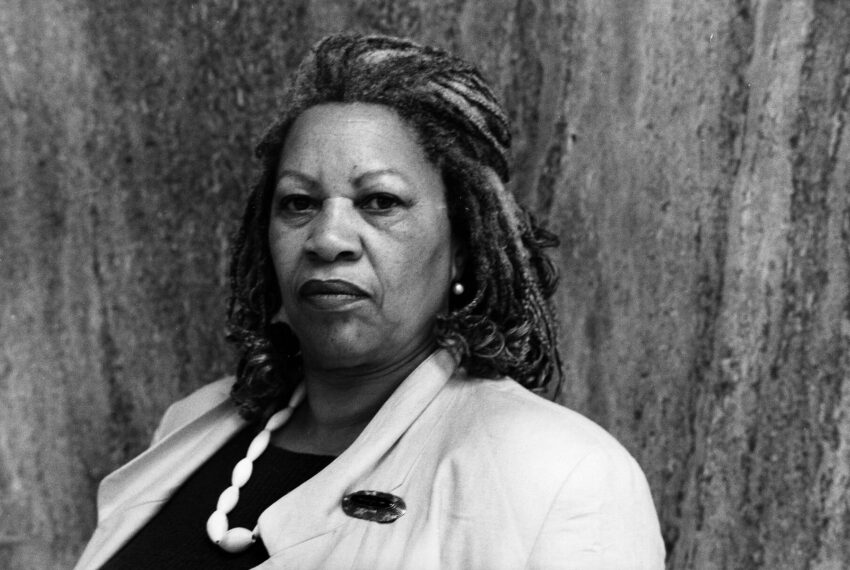
Toni Morrison's troubling depictions of Native Americans have provoked umbrage in readers old and new. We might understand them, Namwali Serpell argues, by using Morrison's own critical tools. Getty Images
Toni Morrison has lately been bestowed with a dubious distinction: the patron saint of cancel culture. Beyond her cutting remarks about whiteness in widely memed television interviews, her literary criticism interrogates racialized language in a way that, on the surface, resembles so-called activist scholarship. Take this footnote from her 1989 essay “Unspeakable Things Unspoken” about an encounter with prejudice on the page: “It should have occurred to Kenneth Lynn in 1986 that some young Native American might read his Hemingway biography and see herself described as ‘squaw’ by this respected scholar, and that some young men might shudder reading the words ‘buck’ and ‘half-breed’ so casually included in his scholarly speculations.” This comment is emblematic of how most people think of Morrison—as someone who drew attention to how racism can pervade art and discourse in insidious, even if unintentional, ways.
So what do we make of the fact that, in the classes I teach, some young men and women—Native American, black, mixed, and otherwise—shudder when reading the words Morrison herself seems to have casually included in her writing? Many students over the years have expressed feeling disturbed by her unflinching depictions of pedophilia, rape, murder, infanticide—which often appear through the point of view of the perpetrators. I once received a course evaluation complaining about how “comfortable” I seemed to be with saying the word “nigger” when I read aloud passages in class from her 1987 novel, Beloved.
More recently, my students have taken issue with the way queerness appears in many of Morrison’s novels. In Sula (1973), for instance, the eponymous character adds to our repertoire of clichés for unlikely events—“when pigs fly,” “when the fat lady sings”—by invoking a time “after all the faggots get their mothers’ trim.” In Song of Solomon (1977), a straight man calls a peacock, of all things, a “white faggot.” In Tar Baby (1981), another straight man, dismayed by the sight of “beautiful males” wearing “weighty wigs” and “feathery eyelashes,” suggests that they have “snipped off their testicles and pasted them to their chests.”
These convolutions in Morrison’s argument seem to appear whenever she approaches the Native American literary figure in her criticism.
When talking to my students about how to make sense of these passages, it is helpful to emphasize that Morrison always distinguished between a character’s beliefs and an author’s. She also adamantly opposed censorship, complaining of the canon wars of the 1980s that they threatened both to destroy a canon precious to her (“I, at least, do not intend to live without Aeschylus or William Shakespeare”) and to degenerate “into ad hominem and unwarranted speculation on the personal habits of artists, specious and silly arguments about politics.” Nevertheless, I have found one literary “sin” of Morrison’s rather more difficult to defend in these terms: her strange, often awkward representation of Native Americans.
This is especially noteworthy because Morrison claimed to have Native American ancestry herself. In a 1976 essay, she wrote that her grandfather had “lost all 88 acres of his Indian mother’s inheritance to legal predators.” She recalled other family members recounting the traditions of “Indians who were married to some slave people in my family.” In a late interview, she said, “I’m part Indian, my great grandmother, on my father’s side, maybe on my mother’s side.” Her response to the follow-up question about that relative’s tribe—“What was she?”—is startling, though. She replied: “God, she was hateful! I think she was Cherokee but she was old by the time my mother knew her. I never knew her, but that’s the blood that runs through.”
She was hateful / she was Cherokee. My mother knew her / I never knew her. Morrison’s double answers reflect an anxiety that was perhaps bound to emerge from a history of oppression that severed black people and Native people from their bloodlines, and pitted them against each other.
But even this storied family affair doesn’t quite explain or justify Morrison’s troubling depictions of Native Americans, which have provoked umbrage in readers old and new. As a purported bigotry among so-called people of color, it presents an interesting case for rethinking the relationship between politics and form in our current moment. And as it turns out, Morrison herself gave us a useful set of critical tools for how to do so.
morrison’s landmark 1992 book,Playing in the Dark: Whiteness and the Literary Imagination, diagnoses racially loaded imagery—what she calls the “Africanist presence”—in the white American canon. It offers both a sense of her method and a glimpse of her lapses. At one point, Morrison paraphrases a historian’s remarks about how an eighteenth-century European white man’s self-perception might change the moment he crossed the Atlantic:
Whatever his social status in London, in the New World he is a gentleman. More gentle, more man. The site of his transformation is within rawness. He is backgrounded by savagery.
. . . Absolute power [is] called forth and played against and within a natural and mental landscape conceived of as a “raw, half-savage world.”
Why is it seen as raw and savage? Because it is peopled by a nonwhite indigenous population? Perhaps. But certainly because there is ready to hand a bound and unfree, rebellious but serviceable, black population.
The thrust of Morrison’s argument here is that the presence of an enslaved “black population” would have bolstered the European man’s newfound sense of power and social status. She acknowledges the other obvious presence at the time (the “indigenous population”), but her rhetorical pivot—“Perhaps. But certainly”—then displaces that “nonwhite” population in favor of the “bound and unfree, rebellious but serviceable” black figures she wants to focus on.
Later in the same book, noting a pattern in Hemingway of black male helpmeets, whom she calls “nursemen,” Morrison again invokes Native Americans in an odd way:
Other male nurses serve the narrator reluctantly, sullenly, but are excessively generous in the manner in which they serve the text. Cooperative or sullen, they are Tontos all, whose role is to do everything possible to serve the Lone Ranger without disturbing his indulgent delusion that he is indeed alone.
The reference is pertinent here, for not only is the Hemingway Ranger invariably accompanied but his Tontos, his nursemen, are almost always black.
Comparing the black “nursemen” in Hemingway’s work to Tonto, perhaps the most recognizable Native American figure in popular culture, is strange in its own right. Yet even more curious is Morrison’s insistence that her reference is pertinent because these Tontos “are almost always black.”
These convolutions in Morrison’s argument seem to appear whenever she approaches the Native American literary figure in her criticism. In her marvelous readings of Herman Melville’s Moby-Dick, for example, she never mentions the sole Native American character, Tashtego. And in an interview from 1990, talking about what she calls Melville’s “black-white pairings of male couples,” she says instead: “Each one of those white people in Moby-Dick has a black brother. They’re paired together. Fedallah is the shadow of Ahab. Queequeg is the shadow of Ishmael. They all have them.” Illuminating though this may be, it is, again, curious that Morrison describes a Polynesian and a Parsee character each as “a black brother.”
They are literary forms, a matter of aesthetic representation, not political representation.
One might be tempted to read this, if not as a sign of Morrison’s ambivalence about “the blood that runs through” her mixed-heritage family, then as a version of cross-racial or inter-ethnic solidarity under shared conditions of oppression. As a character in Song of Solomon says, “The earth is soggy with black people’s blood. And before us Indian blood.” But these moments of elision—in the sense of both omission and conflation—suggest some deeper disturbance that she herself primed us to scrutinize in the written word.
Morrison’s portrayal of Native American culture has, unsurprisingly, attracted plenty of critical attention along her own lines. For instance, the writer Louis Owens takes Morrison to task for the above passages in Playing in the Dark, critiquing her “surprising refusal or inability to acknowledge the Native American presence in the figuration of whiteness in racialized America,” and claiming that she “simply ignores the Native ‘red’ presence that shadows her critical map” such that it is “implicitly invoked and routinely erased.” The critic Craig Womack calls out “the Native absence” in Morrison’s fiction as well; tallying their speech, he calculates that Native Americans have a total of just eighty-five spoken words in her first nine novels, and he complains in particular of her frequent failure to include or name Native people in the 1970s Oklahoma town where she set part of her novel Paradise (1998).
Other critics make a less censorious, more positive argument for Morrison’s depiction of Native Americans in her fiction. Keely Byars-Nichols proposes to interrogate Morrison’s texts for “a Native presence” just as Morrison interrogates “white texts for an ‘Africanist’ presence,” but she acquits Morrison of any racial “anxiety” and compliments her for being “ever self-aware of the loaded imagery she crafts.” Virginia Kennedy argues that in Morrison’s novels, African Americans and Native Americans come “together in the American landscape” and “relate to each other on American ground” in their encounters; this model of solidarity “critiques the European quest for dominance over land and people.”
Whether eager to condemn Morrison or quick to excuse her, these critics all take her analyses of race as a remit to apply that lens to her own writing. To treat literature as if it has a responsibility to fill historical gaps or adjudicate demographic imbalances, however, is to ignore the fact that fictional characters are not sources of historical, sociological, or anthropological truth. They are literary forms, a matter of aesthetic representation, not political representation. A focus on aesthetics is in fact key to Morrison’s close readings in Playing in the Dark, which she says are less about any “particular author’s attitudes toward race” than about “the origins and literary uses of this carefully observed, and carefully invented, Africanist presence”—one that bears only an oblique relation to the real human beings to whom white writers were responding.
Fictional characters are more accurately described as figures. Figure is a word with many different senses. In visual terms, a figure is a geometric shape or design, a representation of a human or animal form, or something that stands out from a backdrop. In literary terms, a figure is a word or phrase used in a nonliteral or rhetorical way, as in a figure of speech. The word crops up when we talk about stock characters or stereotypes, such as “the figure of the Noble Savage.” A figure can also be an important or a distinctive person, which comes from one sense of the verb to figure: to be a noticeable or significant part of something.
Looking more closely at form, at the “literary uses” of the “carefully invented” Native figures in Morrison’s novels moves us beyond the quest for identitarian “representation” as a way to give a voice to the voiceless or fill out some idealized census of America. It allows us to see instead how, as Morrison sometimes put it of other writers’ aesthetic designs, “the structure is the argument.”
native americans are, in the most obvious sense, minor figures in Morrison’s major novels. With only one exception, Native American characters float like filaments in the more substantive stories of her protagonists. They appear in lists among other ethnic types, as in the 1983 short story “Recitatif,” where “the New York City Puerto Ricans and the upstate Indians ignored us,” or in Paradise, where “Oklahoma is Indians, Negroes and God mixed,” and the narrator refers to “all kinds of artists: Indians, New Yorkers, old people, hippies, Mexicans, blacks.”
The knotty history of black-Native intermarriage, meanwhile, makes only the occasional appearance in her work, more often as a bane than a blessing. A character in Song of Solomon says of the tangled racial roots of the novel’s hero, Milkman, “Colored people and Indians mixed a lot, but sometimes, well, some Indians didn’t like it—the marrying.” Conversely, a genealogist of the all-black community of Paradise remarks of her records that any romance with a Native American “could get you ostracized…as may have been the case (it would explain the line through his name) with Ethan Blackhorse,” a minor character whose surname and “stick-straight hair” mark him as possibly having hidden Native heritage.
Many Native Americans in Morrison’s novels seem spectral, on the threshold of death or the spirit world.
Reinforcing this tokenism is the repeated use of the clichéd trope of cowboys and Indians that we saw in Morrison’s reference to Tonto. In Song of Solomon, a black woman compares her son to “a plain, on which, like the cowboys and Indians in the movies, she and her husband fought.” In Paradise, the walls of a burned-out farmhouse seem to bear the marks of two-dimensional “ash people” that include “a man, eight feet tall” with “sturdy cowboy legs,” pointing his finger to stake a claim, beside him a series of Native “Eskimos” or “fish people.” Images of fire flicker around others of Morrison’s Native figures, such as the Sac and Fox men in that novel who warn a black man who’s lost his way of a sundown town.
Many Native Americans in Morrison’s novels seem spectral, on the threshold of death or the spirit world. In Paradise, Arapaho girls educated at a convent beg for the compensation overdue to them: “Their voices chanting, soothing, they swayed their hair and looked at her with the glorious eyes of maidens in peril.” Morrison’s Native figures are sometimes like ghosts, present yet silent, as when attention is drawn to “the glint of the horses on which watching Choctaw sat.” And sometimes they literally are ghosts, as when an enslaved black man in Beloved asks “the Redmen’s Presence” in a cave for permission to bring a woman there for a tryst, or when another black man’s route to work takes him through a cemetery “as old as sky” and “rife with the agitation of dead Miami no longer content to rest in the mounds that covered them.”
If they do speak, Native Americans often offer words of wisdom that are connected to the land. In Beloved, Cherokee men “describe the beginning of the world and its end,” before one of them points a black fugitive north: “‘Follow the tree flowers,’ he said. ‘Only the tree flowers. As they go, you go.’” Indeed, Native Americans are everywhere associated with nature in Morrison’s work: they appear near or with a special relationship to flowers and trees; animals, especially horses and bison (American buffalo); the seasons, the weather, and the sky; and bright, natural colors, especially red.
We know, from the notes and sources collected in Morrison’s archives at Princeton University, that she conducted extensive research on the history, mythology, and geography of Native Americans for her novels. One scrawled note asks, “When did Indians start calling themselves ‘Indians’?” In short, she tried to get it right. But while Morrison’s evocation of Native American culture in her novels may be accurate in some respects, the effect is nonetheless disappointingly general. It suggests what Roland Barthes termed the studium: “an average effect” that promotes “a kind of general, enthusiastic commitment” in the audience to “receive [images] as political testimony or enjoy them as good historical scenes.”
Morrison’s late novel A Mercy (2008), set in the seventeenth-century New World, offers the only real exception to this generality. At one point, a black teenager named Florens encounters a group of men: “All male, all native, all young. Some look younger than me. None have saddles on their horses. None. I marvel at that and the glare of their skin but I have fear of them too. They rein in close. They circle. They smile. I am shaking. They wear soft shoes but their horses are not shod and the hair of both boys and horses is long and free.” The Native boys, who are again aligned almost too closely with nature, tease Florens, frighten her with words she can’t understand. But ultimately they give her water and food, and ride off without harming her.
Beyond this picture of lively, verbal, unpredictable, yet humane people, A Mercy also gives us the only fully fleshed-out Native American character in Morrison’s oeuvre. Lina is the first person an Anglo-Dutch trader purchases as a worker for his farm. Morrison’s notes suggest that she initially considered calling this character “Lila” and making her a member of the Nanticoke. In a profile, Morrison confessed that writing about a Native character at first gave her pause: “‘Oh God, now I’ve got to know all about these tribes,’ she says she thought. But she didn’t, she soon realized, because Lina’s people were all dead from disease.”
In the novel, the Presbyterians who adopt the surviving child name her Messalina, clip the beads from her arms, scissor inches from her hair, and retrain her in how to eat, bathe, and mourn. This means that Lina’s cultural practices in the novel are only nominally “Native”: “Relying on memory and her own resources, she cobbled together neglected rites, merged Europe medicine with native, scripture with lore, and recalled or invented the hidden meaning of things.” Of course, these creolized rituals, which have Lina talking to animals and plants in stereotypical fashion, cannot be judged as inauthentic.
Which came first? The green bird or the mother eagle? The biological black mother’s song or the adoptive Native mother’s story?
A story Lina tells young Florens has the quality of a half-remembered Native fable. It is about a mother eagle protecting her eggs and an intruder who disrupts their peace. Surveilling the beautiful landscape, the traveler laughs and claims it, saying, “This is perfect. This is mine.” The last word echoes, booming like thunder over the valleys, and cracks one of the eagle’s eggs. She “swoops down to claw away his laugh,” and the traveler, “under attack, raises his stick and strikes her wing with all his strength,” until, “screaming, she falls,” is “still falling . . . falling forever.”
It is unclear whether Lina is remembering or inventing this myth of a Native American Eden destroyed by intrusive, extractive settlers. And in the last chapter of A Mercy, Florens’s birth mother from Angola sings a similar “song about the green bird fighting then dying when the monkey steals her eggs,” throwing the reader into further doubt. Which came first? The green bird or the mother eagle? The biological black mother’s song or the adoptive Native mother’s story? Even in the novel that features Morrison’s most substantive depiction of Native Americans, then, she threatens to substitute an African ground for an Indigenous one, to put the black before the red.
In a sense, this late correction to her oeuvre’s distortions around this figure is the exception that proves the pattern. The Native American figure in Morrison’s work tends to be: displaced, under threat, and in competition with other oppressed people; a spectral, watchful presence; silent or of few, wise words; and indelibly embedded in the natural world. This looks a lot like the myth of the Noble Savage, the idea that the Indigenous peoples of the Americas were wildings, innocents, who had not yet been corrupted by European civilization. While this trope initially idealized Indigenous people, it also condescended to them and eventually provided justification for paternalistic and even violent treatment of them.
Morrison knew all of this, of course. Not only was she more than well versed in the history of colonialism and genocide, but she also knew a great deal about the rhetoric around race in pseudoscientific and philosophical writing. So I think we have to give her the benefit of the doubt that she was painting in red, so to speak, on purpose. If the Native American in Morrison’s fiction is generally a stoical, solemn, dignified, watchful, wise, spectral Noble Savage, perhaps what we are seeing is that figure being evoked precisely in order to be crossed out—like that line through the name of Ethan Blackhorse in the genealogical records of Paradise. Or, from another interpretive angle, perhaps what we are seeing is that figure being transformed into a ground.
when we focus solely on a writer’s use of stereotypes, and overlook the formal choices she makes in how she uses them, we neglect the ways that literature can play with and in fact subvert stereotypes. Morrison made use of black tropes such as the Tar Baby, the Jezebel, and Rastus in her writing, but she often heightened their artifice, intensified them, ironized them in order to explore their uncanny power. In interviews, she explained that she liked “to work with, to fret, the cliché,” and even claimed her stories came to her “as clichés. A cliché is a cliché because it’s worthwhile. . . . A good cliché can never be overwritten; it’s still mysterious.”
What if we were to go beyond reading the cluster of “Native figures” in Morrison’s work—the characters she included, the figures of speech she deployed—as merely a reinforcement of the stereotypical associations that still circulate in contemporary discourse about Native Americans? Rather than treating these figures as evidence that she objectified Native people or erased them from the historical record or made them into so-called flat characters, what if we analyzed them in terms of their aesthetic effects, in terms of the argument they might be making as a formal design?
If we consider The Bluest Eye (1970), the Native American figure appears only once, yes—and in an unusual simile. A little black girl goes to the store to buy candy:
The gray head of Mr. Yacobowski looms up over the counter. He urges his eyes out of his thoughts to encounter her. Blue eyes. Blear-dropped. Slowly, like Indian summer moving imperceptibly toward fall, he looks toward her. Somewhere between retina and object, between vision and view, his eyes draw back, hesitate, and hover. At some fixed point in time and space he senses that he need not waste the effort of a glance. He does not see her, because for him there is nothing to see.
This description of the racist “vacuum edged with distaste in white eyes” is like a surrealist Rockwell painting. Morrison emphasizes colors and lines of movement: the gray head looms over the counter, the eyes move forward, then draw back and hover. And in the midst of this diagramming of bodies and parts, a simile appears: “Slowly, like Indian summer moving imperceptibly toward fall, he looks toward her.” What is this figure of speech doing here?
“Indian summer” refers to a period of unseasonably or extended warm weather; evidently first used in 1778, it is of unknown etymology. But in Song of Solomon, Morrison makes an associative link between “Indian summer” and actual “Indians.” The novel’s hero, Milkman, is on a bus going south and sees the landscape as “merely green, deep into its Indian summer but cooler than his own city,” and the road signs—“the names of towns, junctions, counties, crossings, bridges”—as merely repetitive. Weeks later, having now learned about his mixed familial ancestry, Milkman is back on a bus speeding home and everything looks different:
Far away from Virginia, fall had already come. Ohio, Indiana, Michigan were dressed up like the Indian warriors from whom their names came. Blood red and yellow, ocher and ice blue.
He read the road signs with interest now, wondering what lay beneath the names. The Algonquins had named the territory he lived in Great Water, michi gami.
The signs now glow with the history latent in their names. That uniformly green “Indian summer” has transformed into “Indian land” dressed in warrior colors. And though this visual field of beautiful landscapes and colorful seasons might seem to reduce individuals and communities to flat emblems, it also seems to unify them into an ecstatic aesthetic oneness.
Morrison often uses Native American figures to stylize her ideas in this way, even as she remains aware that to prettify can be to objectify. In Tar Baby, the Native American figure appears precisely as an avatar for this tendency to exoticize. A wealthy white woman proudly tells a lower-class black veteran about her son: “He’s been working on an Indian reservation. . . . Most of them live in terrible conditions and they are very proud people . . . but Michael encourages them to keep their own heritage intact.” At another point, her white husband gives his opinion of this do-gooder son: “Michael was a purveyor of exotics, a tropical anthropologist, a cultural orphan who sought other cultures he could love without risk or pain.”
The veteran, Son Green comes from a small black town in Florida, so rural that his first wife, Cheyenne (a name she shares with a Native tribe), knew how to “drop a pheasant like an Indian.” When Son first visits New York with his new, sophisticated lover, Morrison again uses a Native American simile to express his disillusionment: “Like an Indian seeing his profile diminished on a five-cent piece, he saw the things he imagined to be his, including his own reflection, mocked. Appropriated, marketed and trivialized into décor.” The two-dimensional Native American figure on a coin again signifies a flattening of a living being to mere image.
The “Indian head” or “Buffalo” nickel was a copper-nickel five-cent piece struck by the United States Mint from 1913 to 1938—a backhanded honor given that bison, misnamed “American buffalo,” were extinguished alongside the Native Americans who relied on them for literal and cultural sustenance. This coin reappears in a simile in Morrison’s 2003 novel Love, where the profile of the charismatic, villainous hero is “like the one on a nickel minus the hairdo and feathers.” The “buffalo” on the flip side also recalls a moment in Beloved when we learn that the Cherokee name for black people means “Buffalo men.” The image of this coin thus invokes the archetypal “Indian” as well as the buffalo and buffalo men destroyed by American empire.
Does this grandiose biblical image flatten them into the backdrop of a devastating American tragedy?
Morrison’s novel Jazz (1992), too, juxtaposes Native American and black history using a figure of speech. As a young woman tells her lover about her parents’ deaths in the East St. Louis riots, a purple city sky with “an orange heart” drifts past “unnoticed and as beautiful as an Iroquois.” Morrison reprises the figure: “The Iroquois sky passes the windows, and if they do see it, it crayon-colors their love.” This double figure, both a simile and a personification of the city sky, seems to lament the erasure of Native Americans from the American landscape—and to redress it. Its glowing palette echoes those warrior shades of fall in Song of Solomon, but also recalls the moment in Beloved when the burial ground of dead Miami is said to be “as old as sky.”
There is a similar constellation of Native-inflected atmospheric images in a conceit in Paradise. The sky, “behaving like a showgirl: exchanging its pale, melancholy mornings for sporty ribbons of color in the evening,” eventually gives way to “lilac shapes running after a Day-Glo sun.” A mineral-scented air sweeps down “from some Genesis time,” having “once lifted streams of Cheyenne/Arapaho hair” and “parted clumps of it from the shoulders of bison, telling each when the other was near.” Note how the slash mark in “Cheyenne/Arapaho” cleaves the tribes just as the wind cleaves their hair and cleaves bison fur, parting and joining them at once. It is a tell for how ambivalent—not indifferent but internally contradictory—this Native figure is.
Morrison draws here on a veritable archive of stereotypes: the colorful sky, the landscape, the streams of hair, the shoulders of bison, the mineral mists “sweeping down from some Genesis time,” as if casting Native Americans back to an ancient, practically prelapsarian, existence. Does this grandiose biblical image flatten them into the backdrop of a devastating American tragedy? Or does it represent the fact of that flattening, and try to make an aesthetic or structural argument with it?
it is no coincidence that all of these moments surrounding Morrison’s Native figures draw on visual logics: the gaze, reflection, flatness, color, silhouettes, edges. I want to raise the possibility that this manipulation of almost painterly figures enables Morrison to enact a sly reversal of the figure/ground distinction that undergirds our visually inclined analysis of race in America. Recall that the critic Virginia Kennedy spoke of the encounters in Morrison’s novels between black and Native peoples as taking place “on American soil,” “in the American landscape,” and “on American ground.” Now, when we picture these ideological backdrops to nationhood, do we not assume that they are racially “white”? Settler colonialism, manifest destiny, and the concept of race itself historically aimed to instantiate this background whiteness as the American default.
We know this logic well, and still use it all the time in our discourse on race: there’s white America, and then there’s everybody else, fighting over, assimilating into, or forging solidarity against it. If we were to represent this model visually with regard to European, African, and Native Americans, it might look like a “white” background against which the “black” and the “red” encounter one another, whether in competition or communion. I want to suggest that, with her aesthetic choices in depicting Native American figures, Morrison swaps this schema around. What results is a “red” background over which “black-white” racial relations play.
Morrison does this precisely by leveling the Native American presence in her novels to a figural flatness over which silhouettes are inscribed, an originary backdrop that evokes the land, the natural world, the weather—or, rather, what has always been there: the sky. In this way, she transforms the Native American figure into a ground, then elevates it so that it becomes the default against which black and white racial figures come into conflict.
So, if we revisit Playing in the Dark, we note the European gentleman who arrives in the New World “is backgrounded by” a purported savagery that is “perhaps” Indigenous, “but certainly” African. With this diction, Morrison pushes the Native American population, already associated with the backdrop of the landscape, even further into the distance. And Tonto appears not as a person but as a figure for a figure, a metaphor for a metaphor, black “nursemen” who “are Tontos all”—this equation again makes white-Indigenous (“cowboy-Indian”) relations recede, but as they do so, they thereby become the larger context for black-white relations.
Her piecing together of Native and new traditions in fact suggests a foundational hybrid Americanness, a mosaic as ancient and motley as the sky.
Let’s look again at the novels through this lens. We find the gazes of a white man and a black girl moving over the figural backdrop of a slow “Indian summer.” That Indian summer takes over the scenery seen through a window by a black character discovering the Native geography of America: that earth soggy with black blood but before that, Indian blood. A black man converses with a white woman about her son’s work on an unseen, exoticized “Indian reservation.” A man comforts his lover about the race riots that killed her family as the city sky drifts by behind them, unnoticed and as beautiful as an Iroquois. An ancient wind that once parted Native tribes, people, herds, and hair chases their colors from the sky.
Read in this way, even Morrison’s most three-dimensional Native American character, A Mercy’s Lina, is not the imperfect or partial fulfillment of an identitarian demand, but the culmination of an aesthetic logic. Lina may be conveniently deracinated, but she is no token Noble Savage. She is everywhere in A Mercy, the only character who has a significant role in every chapter and in relationship to every other character. Her piecing together of Native and new traditions in fact suggests a foundational hybrid Americanness, a mosaic as ancient and motley as the sky. In this sense, Lina is truly Native American, the original, the default, the backdrop against which the new black, white, and brown national figures arrange their political dramas.
Seeing Lina like this also recasts the story she tells about the mother eagle and the human invader who struggle for dominion, reminding us that their battle takes place against the backdrop of a sky that Lina describes twice this way: “Over the turquoise lake, beyond the eternal hemlocks, down through the clouds cut by rainbow.” This allegory of the violent founding of America crystallizes many facets of Morrison’s Native figure: as animal and human image, as visual geometry and figure of speech, as nominal reference and significant player, and as the figure naturalized into a background. And though Morrison raises the possibility that it comes from Angola, the effect of this double origin is perhaps less a displacement of the Native American myth in favor of a black one than it is an exchange or layering of two archetypal stories.
Morrison believed that racial blackness and whiteness and redness—potent though they may be—are just that: stories. As she once said in an interview with Charlie Rose: “The racist white person . . . doesn’t understand that he or she is also a race, it’s also constructed, it’s also made, and it also has some kind of serviceability.” Race is as fabricated as the “Indian Head nickel” Morrison used as a figure: called a nickel yet partly made of copper; picturing a misnamed animal on one side and a stereotypical silhouette on the other; flat yet inscribed; two-faced and with an edge to it; still in circulation but with no inherent value beyond what we decide to make of it.
In other words, race is just a name for one of the serviceable fictions we have created to structure our complex reality, to rewrite our torturous history, to justify our will to power. Morrison could not hope to undo or destroy an ideological discourse this foundational, this entrenched. But with her artistic designs, she could at least draw attention to the thinness of the fiction of race, flip it like a coin, turn its figures to ground, and reveal that ground to be a Native background “as old as sky”—one that arcs over what we now call America, unnoticed and beautiful.