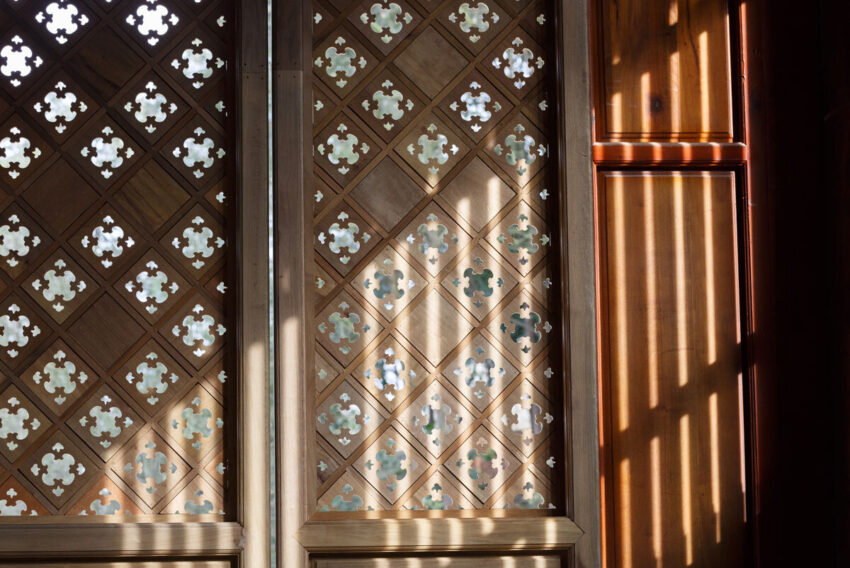
The kissing booth was my daughter’s idea. Here’s how it was supposed to work. Ella and her friend Audrey would set up near the polling place at the Seventh-day Adventist temple. Their Get Out the Vote operation would rely on a repurposed lemonade stand they’d found in Audrey’s basement. Audrey’s mom once ran tech for a theater in Miami, and this lemonade stand was an impressive affair: a wooden counter with a framed opening above a painted wooden sign, looped with bright triangular flags cut out of felt. The sign used to say “Lemonade, 50¢” and below that “Save the Tigers!”
They repainted the sign to say #KissingBooth2024. Of course they didn’t need our help this time. They were fifteen. They traveled around the city on their own and understood precalculus. Their skin was incredible, even when they hadn’t slept enough, and their eyes were clear like marbles. Still, Ella sometimes complained about how she looked. I’d heard that the right response to this was always “You look beautiful.” No details. One weekend she emerged from her room dressed for a party in a lavender slip dress, her dark hair meticulously straightened, tiny dabs of silver glitter at the corner of each eye. I looked at her eleven-year-old brother, Ben, the only other person in the house, and saw him tear up.
“You’re crying!” Ella crowed.
“No I’m not,” Ben said, turning to hide it. I don’t think he knew why he was upset.
Audrey’s mother, Jen, and I had some concerns about the kissing booth from the beginning—namely, predation, germs, and public opinion. Also something else that was harder to put into words. But when we raised the first issue with our daughters, they became defensive.
“You think we can’t decide what to do with our own bodies,” Ella suggested. “You think it’s ‘inappropriate.’”
Audrey looked smug. “That’s what I said they’d say.”
“This is a big city . . .” Jen began.
I tried to help. “It would be different if—”
“If we lived in the suburbs?” Ella glanced at Audrey, incredulous.
Audrey shook her head in disgust. “See?”
Jen and I insisted that we would have the same concerns about a suburban kissing booth. We’d already agreed it never would’ve occurred to us to do something like this at their age, because it was a different political moment—and also a different kissing moment. Most of the teenagers we knew, including our own daughters, didn’t seem to be kissing anyone. They gently mocked the ones who were, as if the sort of dating our generation had done—the pairing up and sneaking out, the baseball metaphors—was a quaint vestige of the past. Maybe they were right. When our daughters first became teenagers, we’d been eager to show them the movies of our adolescence. We’d made popcorn and settled onto the couch, but it hadn’t taken long for them to be appalled or for us to be ashamed. How could we be nostalgic for those days?
that fall, i started running in the park. I could do this at night, while the kids finished their homework. I couldn’t help with homework the way I used to, because everything had changed: long division was now short division, the atom was an electron cloud, and Pluto—which had seemed so far away as to be unassailable—was just a lump of rock and ice in the Kuiper Belt. “Don’t use the algorithm!” Ben warned. “It’s not allowed!” Ella, meanwhile, studied the modern Middle East and didn’t have a single textbook. She had some tasks that had to be done with AI and others for which those programs were expressly forbidden. So I went for a run.
I had time to run during the day, too, especially with the kids spending half of each week at their father’s new apartment. But there was something about the halo around the lights in the park at night, especially if it was drizzling, and the adrenaline I got from needing to stay alert. Also from doing something that was supposedly inadvisable.
I had the idea that as long as I kept running, and kept him distracted, I might save the world.
The last time there had been an assault in the park was June of the previous year. The suspect attacked a woman near the dog beach, right where the path enters a wooded area. He lifted up her skirt and pushed her against a chain-link fence, but she managed to get away. The suspect was described as medium height, medium build, with a medium skin tone, wearing a green baseball cap. The woman was twenty-seven and clearly a fast runner. Was it foolish to think my age would protect me? The worst thing that had ever happened to me while running was being bitten on the leg by a little brown-and-white terrier during off-leash hours. His owner was very apologetic, and the dog had all his shots, so it could’ve been worse.
One night I was doing my usual loop when I heard heavy footsteps behind me, and my already-racing heart sped up. I half turned to find a man passing on the right, just inside the pedestrian lane, so close that the air moved between us. He could’ve made a wider detour, but he was probably annoyed: the slower among us are supposed to stay to the left. The man was young, tall, and very fit, and soon he had disappeared around the curve that led to the hill.
During the president’s first term, there was a dream I kept having. I was running in the park, and he was chasing me. I knew I was running away from some sort of personal danger; it wasn’t his policies that were making me afraid, at least not in the dream. In fact, I wasn’t really afraid. It was the type of dream in which the laws of physics undergo some lunatic transformation, and the president was hanging on to the cuff of my trousers, trailing along behind me, his long tie flapping. I had the idea that as long as I kept running, and kept him distracted, I might save the world. When I woke up, I was embarrassed by this subconscious notion of my own power.
If I ran during the day, I listened to a podcast, occasionally one about parenting. There were helpful tips for talking to your teenager: for example, when she said something offensive—such as “All the girls in my grade are bitches” or “You are exactly like Grandma”—I could say, “Let’s try that again,” or “I don’t think that came out the way you meant it.” This hadn’t been supereffective in practice, but I may not have had the right inflection. The psychologist’s voice was low and soothing, and sometimes I found myself letting one episode run into the next, even when the topics weren’t relevant to my children. “My Teen Is into Sports Betting . . . Help!” Or: “My Daughter’s Nude Selfie Got Out. What Do We Do Now?” Each one was like a little pat on the back—nope, not my problem.
Eventually, I did have to listen to the divorce episode, though. The worst things you could do, it turned out, weren’t moving the kids frequently back and forth or running out of money or lying. The worst things were (1) having fights in front of them and (2) criticizing the other parent. I was three-quarters of the way through my run—in the middle of the hill—when Dr. Lisa Damour dropped this bit of wisdom, and I slowed to a walk. Ordinarily, I hated to do that because afterward it felt as if I hadn’t run at all, as if I were a failure.
one saturday that september, I met Drew at the door when he brought Ben home. For a while after we’d separated the previous spring, I would tidy up before he arrived. Drew is an architect and we’d always argued about the apartment, about the extent to which external order was tied to more fundamental issues. The fundamental issue might have been that we disagreed about which issues were fundamental. This time, though, I hadn’t bothered. His eyes moved over the living room, the laundry on the couch, and my empty coffee mug on the table. Mugs. I gave Ben a hug, inhaling his yeasty smell. I used to be relieved when the kids went on short school trips, to the museums in D.C. or camping upstate, but now that they were with their father a few nights a week, I counted the days until they got home. I had to be careful about saying “home”—because Drew said that the apartment he’d had for five months was now equally their home. “OK,” I agreed, “language is important.” That made him roll his eyes.
Ella was at volleyball practice and wasn’t going to be back at my place for a while, so it was a good time to discuss some things. Not a great time because Ben was right there in the kitchen, getting his favorite snack: a slice of Muenster cheese wrapped around a dill pickle.
“Did you know that the bar-headed goose is one of the highest-flying migratory birds?”
“Nope,” I said.
“But the Rüppell’s griffon vulture can fly even higher. One flew seven miles above the earth and hit a plane.”
“Was it OK?”
“No,” Ben said. “It got sucked into the engine. That was in the 1900s.”
“Oh, well, the 1900s,” said Drew. “Ella said to tell you she’d be here by six.”
“How’s she doing?” I didn’t mean to suggest that she wouldn’t be doing well after three days with her father. I was only trying to steel myself for whatever was coming when she got back. Her moods were various and spectacular.
“She called me an effing a-hole,” Drew said. “And so I’m just wondering where she heard that.”
“I don’t know,” I said. “Who’s been calling you an effing a-hole most recently?”
“Hilarious,” Drew said. “This was after I bought her the tickets, by the way.”
“You bought her the tickets?”
At the end of the story, she uses it to poke the Balloon Witch, who zooms and buzzes around the room until she’s just a piece of rubber on the floor.
I think he brought up the a-hole thing just to pass along this piece of information, because we had definitely settled on not buying the tickets for Ella, because the cost was excessive and because it felt like a bribe. We had talked about not letting Ella manipulate us into things simply because we felt guilty about our separation.
“She’s so excited,” Ben said from the kitchen. “She hugged Dad, and then she called Rachel.”
Drew looked nervous. “Rachel said that it was the event of the decade, and that if she didn’t go, she would always regret it.”
“Is Rachel paying for the tickets?”
Drew sighed. “Can you leave Rachel out of it?” Then he lowered his voice, as if this were a much larger apartment and the kitchen weren’t steps from the front door. “She’s been acting perfectly toward the kids—do you know how hard that is to find?”
“She’s the needle in the haystack.”
There was a story I made up for the kids when they were little about two children who go into a closet on a rainy day and come out in a magic land. (OK, not totally made-up.) The magic land is ruled by the Balloon Witch. Early on in the story, one of the children finds a golden needle and slips it into the pocket of her overalls. At the end of the story, she uses it to poke the Balloon Witch, who zooms and buzzes around the room until she’s just a piece of rubber on the floor.
“She’s really trying,” Drew said.
“A for effort.”
“Fuck you,” Drew said.
“La, la, la!” Ben yelled from the kitchen. “I can’t hear you!”
Since I hadn’t secretly bought expensive concert tickets or used the f-word in front of our son, I decided to take the opportunity to be the grown-up in the room. “Even though we don’t love being a couple anymore, we do love parenting you together!” I called after Ben, who was running down the hall.
“Don’t use your podcast-lady voice,” he shouted back.
drew said the separation was my fault. He said he had tried and tried but I didn’t want to work on the marriage. That’s why he’d had the affair—the at-first-only-emotional affair—with the woman he met on the discreet married dating app Ashley Madison. I hadn’t heard of Ashley Madison before I learned about the emotional affair, and at first I thought Drew was having an affair with someone named Ashley Madison. I have to admit I was a tiny bit relieved when I discovered that her name was Rachel and she was a marketing executive in New Jersey.
I told Drew I was glad we’d talked about the affair before it became an actual affair, when it was mostly just texting. But I said that I also thought written conversations could be more intense than in-person ones. He said he didn’t find that to be true, but he wasn’t surprised I thought so, since it had always been obvious to him that I liked books more than people—except for the kids. Even when the books weren’t that good! He said he could stand being third in my affections but not 312th. I wondered at the time how he’d come up with that number, and how many books I actually did prefer to Drew—honestly, three hundred and change wasn’t so many if you were starting with the classics. But I said I knew what he meant, which annoyed him even more. Another of my problems, according to Drew, was that I could always see things from someone else’s point of view and so I failed over and over again to take a side.
by october, ella and Audrey’s TikTok about the kissing booth had fifty-six thousand likes. For a while it seemed as if there were going to be several other booths at polling places in the city. They were mostly being organized by female-identifying young people around Ella and Audrey’s age, but a pair of young gay men in Brooklyn had also hopped on the bandwagon.
“Are you worried about germs?” I asked Ella. She was in her room studying Spanish. It took a second for me to realize that Audrey was on FaceTime at her elbow. Ella turned to the screen. “Are you worried about germs?”
Audrey shrugged. I’d read somewhere that green eyes don’t actually exist, so what would Audrey’s eye color be called? Seafoam? Pistachio? Her hair, unlike the hair of many blond children, had never turned any darker. It hung in mermaid-y tendrils around her shoulders.
But this kind of abstract speculation was one of the things Drew seemed happy to be rid of.
“There are so many germs at school already,” Audrey said, making an expansive gesture. “It’s a petri dish.” (Audrey was into science and hoped to study microbiology one day.)
Ella glanced at me. “We’re not worried. Except about this test—we have to learn eight tenses.”
“And three moods,” Audrey added.
“I’ll leave you to it,” I said.
Drew was appalled by the kissing booth. He brought it up during one of our calls, the agenda of which was supposed to be paying for Ben’s summer camp and Ella’s service trip to Costa Rica.
“How’s it even supposed to work?” Drew said. “How do they know who someone’s voted for? Couldn’t everyone say they voted the right way and then kiss our daughter?”
“Maybe I should volunteer at the polling place,” I suggested. “I could ask everyone to please not actually kiss the girls. They could blow a kiss or something.”
“Good luck with that,” Drew said.
“You wouldn’t even know about this if I hadn’t told you.”
Drew ignored that. “It must’ve been Audrey’s idea.”
Actually, I knew it had been Ella’s idea—she was proud of it. “I’m glad they’re engaged in politics. I certainly wasn’t at their age.”
“Totally different time,” Drew said.
“I think they may have started a movement.”
“Fantastic. They can put it on their college applications.”
He was being sarcastic, although I have to admit it had occurred to me. There was so much pressure on teenagers these days. Dr. Damour used the words input and output: they took in exponentially more information than we had, and they were supposed to perform at a much higher level. I was going to bring this up with Drew, along with something else I’d been thinking about, which was how great a gulf there was between us and our children, much bigger than the one between our parents’ generation and our own. Our gap had more in common with the one between parents and children born on either side of the Industrial Revolution.
But this kind of abstract speculation was one of the things Drew seemed happy to be rid of. He was doing something else while he was talking to me, maybe unloading the dishwasher. There was a clattering sound followed by a muttered curse.
“Everything OK?”
“It’s like they’re asking to be sexually harassed.”
I took a breath, as Dr. Damour had suggested. “I don’t think that came out the way you meant it.”
a week before the election, Ella and Audrey had a fight. Audrey accused Ella of talking behind her back to a girl named Sadie. Ella said she hadn’t, that Sadie had told a lie about Audrey and Ella was just defending her. But when Audrey asked what the lie was, Ella didn’t want to say.
“What was it?” I asked.
“I don’t want to tell you either!”
“OK—but something unkind.”
Ella made an exasperated sound. “She said I betrayed her!”
“It sounds more like a misunderstanding than a betrayal.” We were in Ella’s room; Ella was lying on her bed with her head on an old stuffed giraffe.
“She hates me now.”
“I doubt that.”
“Also, Rachel hates me.”
“Dad’s Rachel?”
Ella nodded.
“Wasn’t she the one who convinced your dad to get the tickets? She couldn’t hate you that much.”
Ella hugged her knees, looked at the ceiling. There was an aluminum hook up there where we’d once attached a canopy to hang over her bed. It kept falling down during the night, and in the morning Ella would wake up in a tangle of pink netting.
“She’s jealous of me.”
“Why do you think that?”
“She said I was high-maintenance.”
“She told you that?”
“No,” Ella admitted. “She texted Dad.”
“Why were you looking at your dad’s phone?” I tried to be stern, although it was true that in this area I hadn’t set a shining example.
Ella looked at me in an unfamiliar way, as if my opinion really mattered to her. “Do you think I’m high-maintenance?”
“I think people who don’t have children might have different ideas about the maintenance involved. I certainly don’t think it’s fair for her to be jealous of the time your dad spends with you.” Was this OK? I wasn’t necessarily criticizing Rachel, who was, in any case, not Ella’s parent and therefore (I hoped Dr. Damour would agree) fair game. Plus, I was reminding Ella how important she was to her dad and thereby paying him a compliment.
“You didn’t forgive him?” She sounded strangely hopeful.
“It’s not about time.”
“Oh.”
“It’s because I’m young. And she’s middle-aged.”
“It depends on what you consider middle-aged.”
“Sorry,” Ella said. “I wasn’t talking about you.”
“I don’t mind being middle-aged that much, actually.”
“Uh-huh.” Ella’s phone pinged. “It’s her.”
“Rachel?”
“Audrey.”
“Oh—what does she say?”
“She says, ‘I’m going to fail Spanish.’”
“See,” I said. “She’s not mad at you.”
Ella threw the phone across the room, but carefully, so that it landed on a discarded hoodie. She flipped onto her stomach, buried her face in the giraffe. Her voice was muffled. “That’s not an apology.”
“It’s an olive branch. People aren’t perfect. You can forgive her.”
Ella turned toward me, her mouth a quavering line. “I’ll never forgive her.”
“Of course you will. That’s what friends do—Jen forgave me for forgetting to pick up Abe with Ben that time. And I forgave her—well, I can’t think of when. Jen is very thoughtful. But I’d always forgive her.”
“Did you forgive Dad?”
“That’s a different situation.”
“You didn’t forgive him?” She sounded strangely hopeful.
“No—no, of course I did. Your dad and I are friends now. That’s what friends do.”
Ella looked at me, considering. “What do powerful people do?”
in the end we decided to put a stop to the kissing booth. Jen and Dan said they were going to talk to Audrey together, but I told Drew I would do it myself, since I thought I owed him for not coming down harder in the first place.
Ella was at her desk when I came in. I sat down on the bed, but she might’ve sensed what was coming, because she snapped at me for sitting on her comforter in my “outside pants.” And so I brought up the kissing booth while hovering in the doorway.
“It’s just not safe,” I told her.
“Safe?” Ella exploded. “God, I can’t believe you! Think about people who actually aren’t safe. Think about immigrants. And trans people.”
Ella turned abruptly in her chair, knocking her elbow against a white plastic LED lamp, its arm decorated with beaded bracelets. The lamp crashed to the floor, scattering beads, and the light went out.
“Look what you made me do! I can’t even do my homework now.”
“It still works.” I righted the lamp, but the beads were everywhere. “There are a lot of different kinds of meaningful action you could take. Your grandmother is part of a group that registers people to vote in Pennsylvania.”
“Step-grandmother,” Ella corrected me. “Taylor Swift registered thirty-five thousand people with one post.”
I acknowledged that my father’s second wife, Judith, didn’t have that kind of reach. “But they take buses there. I know they love having young people along.”
Ella was busy doing something on her phone.
“I just think the type of people who are going to take advantage of a kissing booth aren’t the type of people you’re trying to engage.”
Ella looked aghast. “Ew.”
“What?”
“Take advantage.”
“We have to be a little careful with anything on social media.”
Ella’s eyes narrowed. Their solid walnut color was our only identical feature. I realized I sounded as if I were talking to a child.
“I read this article about social media and porn,” I started again. “There are scholars who study it.”
“Mom!”
“What? There’s a lot written about strangling, for example, and how common that kind of thing . . .”
But Ella was tapping furiously.
“What are you doing?”
“I’m recording you—for my story. Otherwise no one’s going to believe how insane you are.”
“You’re putting me in your story?” I understood that it wasn’t a compliment, but I was weirdly flattered.
“Just the private one.”
“I know it’s hard to talk about this stuff.”
“Can we just . . .” Ella begged. “Please?”
When I left the room, I heard Ella calling Audrey, then Drew. After she confirmed that the adults were a united front, though, she backed down. She might even have been a little relieved.
I was talking about our purpose, and what we owe other people—the kinds of things that someone else might examine with faith.
When I came into her room at eleven thirty the night before the election to ask if she was wrapping up her homework, she gave me a hollow-eyed stare. Her voice was scratchy, as if she had a sore throat, and she reminded me that things were much more competitive than they had been in my day. I didn’t disagree. Even the pictures we had of my day looked washed out and unrealistic, like the one on my desk: my sister and me in bikinis on Will Rogers State Beach, a lifeguard station in the background, some Spanish-style mansions in the hills behind our heads. It didn’t seem like the past so much as something that had never existed in the first place.
Ella didn’t cry on the morning after the election, as she had when she was eight. In the months that followed, I noticed an expression that was much worse: a sidelong look, lips pursed, a mixture of pity and disappointment. It was like she’d seen through us—not only through our failed marriage but through the supposedly coherent framework behind all the answers we’d given to her and her brother over the course of their lives. Ben still wanted to know the distance to Proxima Centauri, the average annual salary of a cryptozoologist, the difference between an autocracy and a dictatorship, but Ella had stopped asking questions altogether—or, at least, she was getting her answers somewhere else.
Looking back, I guess I’d always worried about this. When I was pregnant with Ella, I’d told Drew that I thought we had to figure things out before she was born. “What things?” he’d asked. I was talking about our purpose, and what we owe other people—the kinds of things that someone else might examine with faith. But Drew had said that no one really figured it out. “Everyone makes it up as they go along.” Drew was an expert at vanquishing uncomfortable thoughts before they became too overwhelming. That was a big part of why I had married him.
in the fall of the president’s second term, Ella and Audrey started their junior year. In the winter, Drew moved into a bigger apartment with Rachel. Normally, Drew and I had a monthly call to coordinate our calendars, but one Saturday in February, he told me he was going to be in the neighborhood, and did I mind if he dropped by? Ella was at a volleyball tournament, Ben at a dress rehearsal for the middle school play. We sat across from each other at the kitchen table with our phones, mapping out the games and performances and orthodontia. Then the calendar was set, and we didn’t have any more tasks to complete.
In the lull, I said I was sorry I didn’t have any food to offer, and Drew said he was glad because he was trying not to snack. He’d found himself eating more, now that Rachel was pregnant. Of course I knew about Rachel’s pregnancy; Drew had told me before he told the kids. Then Ben had told me again, looking terrified and thrilled at the same time. Ella had said that I obviously knew, and Ben had looked resigned to the fact that everyone always had more information than he did.
“You gained weight when I was pregnant with Ella too,” I couldn’t help reminding him.
“But with Ben I was in that swimming phase.” Drew sighed. “I should have kept that up.”
“Who knew you were going to have so many children?”
“Ha ha,” Drew said. Then he gave me a questioning look. Could we really talk about this?
“Do you know the sex?”
Drew shook his head. “Rachel wants to be surprised.”
“That’s exciting.”
Drew looked skeptical. “It wasn’t my idea,” he said finally. “But it seemed unfair to say no.”
Was he talking about the surprise or the baby itself? Either way, there was a secret pleasure in hearing his ambivalence. It made me feel charitable. “But you don’t look any different.”
You look beautiful, I might have said. No details.
“I can’t even imagine being back there,” Drew said.
“The diapers and no sleep and everything, you mean.”
“Not only that.” When Drew was unhappy, his eyebrows were very involved. They were darker than his hair in general, which was sandy and hid the gray. “I mean, starting again. With a baby, and all of this.” He gestured toward the world outside the window. “I guess I should’ve thought of that before.”
“It might give you a break. Remember how we barely looked at the news for a while each time?”
It was a bright, blustery day, very cold, and a tree threw racing shadows across the kitchen table. You could hear traffic and the Saturday morning crowd of little kids at the playground. I had thought in advance about Rachel getting pregnant, and about how I would feel—maybe bereft was the right word. But that didn’t make a lot of sense, since I had already lost Drew, and if I was honest, it wasn’t really Rachel’s fault. I also didn’t want another baby, although there were times when I missed pregnancy, that limitless possibility. Maybe what I was mourning were conversations like the one we were having now. With a new family, Drew wasn’t going to have time for anything like this.
Was this the fate of all the things we’d loved about each other?
“Ben called me a sleazeball.”
I tried not to smile. “He did not.”
But Drew looked wounded. “Did you say that?”
“No!” I raced through my memory, the way you do when you’re suddenly accused. Then I remembered. “It wasn’t me—it was Ella. But she wasn’t talking about you, I promise. There’s a boy at school named Liam.”
“Liam’s a sleazeball?”
“I’m sure not. But she said it, and then Ben wanted to know what it was.”
“What did you tell him?”
“Someone who behaves badly, especially in a romantic situation.” I’d thought it was a pretty good definition, especially on the spot.
“What did he say?”
“He said, ‘Like the brown antechinus.’”
“What?”
“It’s an Australian marsupial. The male has sex for two weeks with no break, apparently. Then it dies.”
“Does that make it a sleazeball?”
“We decided no. It’s sort of like a mouse but with a pointier face.”
Drew grimaced.
“We looked it up,” I said, to distract from the unfavorable comparison. “I mean sleazeball—not the antechinus. It first appeared in the eighties.” I have the OED app on my phone; my interest in etymology was something Drew found charming when we met, less so eighteen years later. I felt the same about the beautiful physical spaces he created—arranging furniture and letting in light—which eventually began to feel controlling. Was this the fate of all the things we’d loved about each other?
“But there’s another definition. From the seventeenth century: sleaze is an adjective that means ‘loose’ or ‘flimsy’ when it’s describing fabric.”
“There’s maybe a connection there,” Drew said gamely.
“Or as a verb—‘to separate.’ I think it’s like a badly woven fabric, coming apart.” Then the analogy was too neat, and it made my face flush.
Drew hurried on politely, to spare us. “I’m worried about Ella.”
“Yes?” I found myself leaning forward. Recently, I’d been having trouble reading. Even old favorites didn’t appeal. I wondered if there was any book I needed as much as I needed to talk about the kids with someone equally invested in their well-being.
“She’s so . . . impatient.”
“Like when we’re trying to get out the door.”
Drew nodded.
“She does that with you too?”
“Well, I don’t take as long to get out the door.”
I looked at him.
“She does plenty of other stuff, though,” he said quickly. “She kicked the wall in the living room—made a mark.”
“She knows how to push your buttons.”
“And the other day she locked me out.”
“Not on purpose?”
Drew frowned at his hands. We had automatically sat at our accustomed places at the table.
“You should take the table. For the new apartment.”
It was the size of a moving box, or a moving truck, or the whole block where the truck was moving.
He’d chosen this unusual table with its zinc top, which the salesperson had said would wear over time, gaining a “patina.” That was true, but the dark-gray spots were only in front of our four places, where we’d sponged off crumbs and spills thousands of times. Sometimes I left my computer or a pile of Ben’s homework sitting at the place that had been Drew’s, as a kind of camouflage. I’d thought the kids wouldn’t notice, but now, with Drew occupying the space so solidly, that seemed delusional.
“Don’t you need the table?”
“I was thinking of getting a new one.”
But Drew was already shaking his head. “It would cost too much to move it.”
“But what you were saying about Ella—”
“Ben too,” Drew said, as if I were in danger of forgetting him. “In a different way.”
“Like the long-term effects, you mean? You think they’ll be damaged?”
“Rachel says no. She’s a child of divorce.”
I refrained from pointing out the idiocy of that phrase.
“She said it was a relief—to stop pretending things were perfect. Or even good.”
I was offended. “They weren’t never good.”
I’d been thinking a lot about when the kids were young. Once, right after Christmas, we’d taken them on vacation to the Dominican Republic. The hotel had turned out to be nicer than we’d expected, on a bluff above the ocean, with a grassy area where they could run around under the palm trees. The grass was sort of sharp but springy; I could remember the feeling of it under my feet.
“I was talking about Rachel’s parents,” he said.
It was only a three-day trip, anyway. It wasn’t a memory of our actual life, and so it probably didn’t count. But Drew was suddenly looking at me in a different way, as if, for the first time in a long time, I had something he needed.
“What?”
“If you could do it again—”
“Have a baby?”
“Not another baby,” he said quickly. “I meant—go back . . .”
It was wrong to call it a lump in the throat. It was much bigger than that. It was the size of a moving box, or a moving truck, or the whole block where the truck was moving.
“I’d compost more.”
“That’s good advice.”
“Why are you asking?”
“You’re right,” he said. “It’s not fair.”
We sat there for a few moments in silence. Then Drew pushed his chair back from the table and stood up.
“I’ll lock you out,” I said.
Drew smiled grimly.
Drew gave me an infuriating look, as if he knew everything about me.
“Not like that.” I stood up too, then decided it was awkward to follow him to the front door, as if he would need help with the sticky top lock like any other visitor. Instead, I hovered in the living room, where there was more laundry in a pile on the couch. I folded Ella’s pajamas and paired Ben’s socks while I watched Drew put on his shoes. At the top of the framed opening that separated the living room and the front hall, there was a wooden screen, a decorative piece that dated back to the nineteenth century. It was what real estate brokers called an “original detail,” and Drew had always admired it.
He straightened up. I knew he remembered all the things that I did: the softness of the air on Hispaniola, the strange chart (designed to measure pain) on the wall of the delivery room where Ella was born, and, even further back, what he’d said about the Natchez–Vidalia Bridge that led to our first conversation. We were on either side of the framed opening, and I suddenly thought of the kissing booth. It had seemed shocking and transgressive, but it was really an antique idea, the kind of thing that had once been popular at carnivals and fairs.
“I’d lay things out.”
“What?”
“Our . . . goals, maybe. I’d write it all down.”
Drew gave me an infuriating look, as if he knew everything about me.
“You wouldn’t have to write it. It could be done another way.” I tried to sound less defensive. “And I’d take more trips. Even if we couldn’t afford them.”
He nodded. “I’m terrified, though.” All of a sudden, Drew’s chin, unshaven, with the divot I’d always loved, moved in a familiar way, and I realized there was a chance he would cry. If he cried, I would cry.
“I’ll see you,” I said.
He recovered himself. “Wednesday?”
“Isn’t Wednesday your pickup day?”
We consulted our calendars and determined that it was. Then he left, expertly jiggling the lock so that it fell into place.
Two pieces by Annie Ernaux, including a print-exclusive essay. Plus a folio titled "What Was AI?" — with contributions from Sheila Heti, Lauren Oyler, Christopher Sorrentino, and others.
Two pieces by Annie Ernaux, including a print-exclusive essay. Plus a folio titled "What Was AI?" — with contributions from Sheila Heti, Lauren Oyler, Christopher Sorrentino, and others.