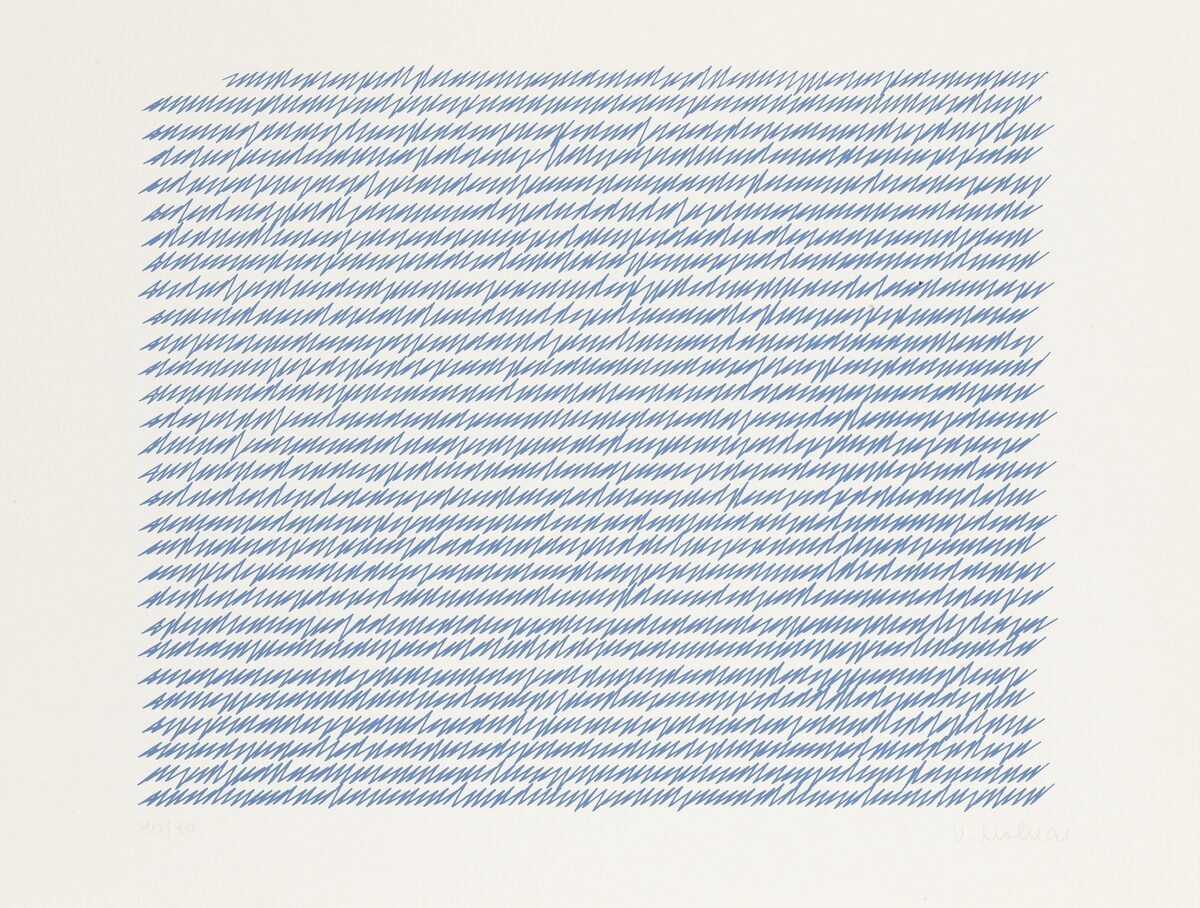
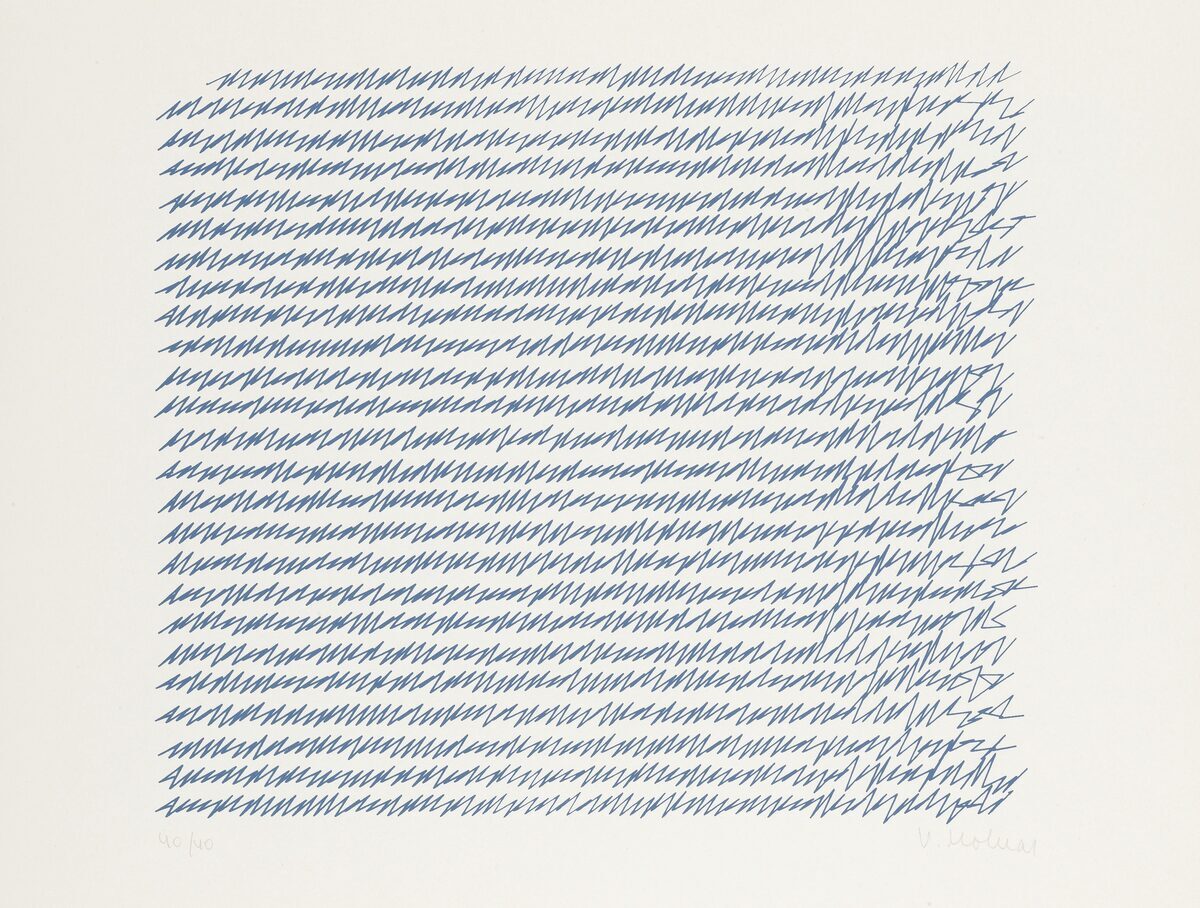
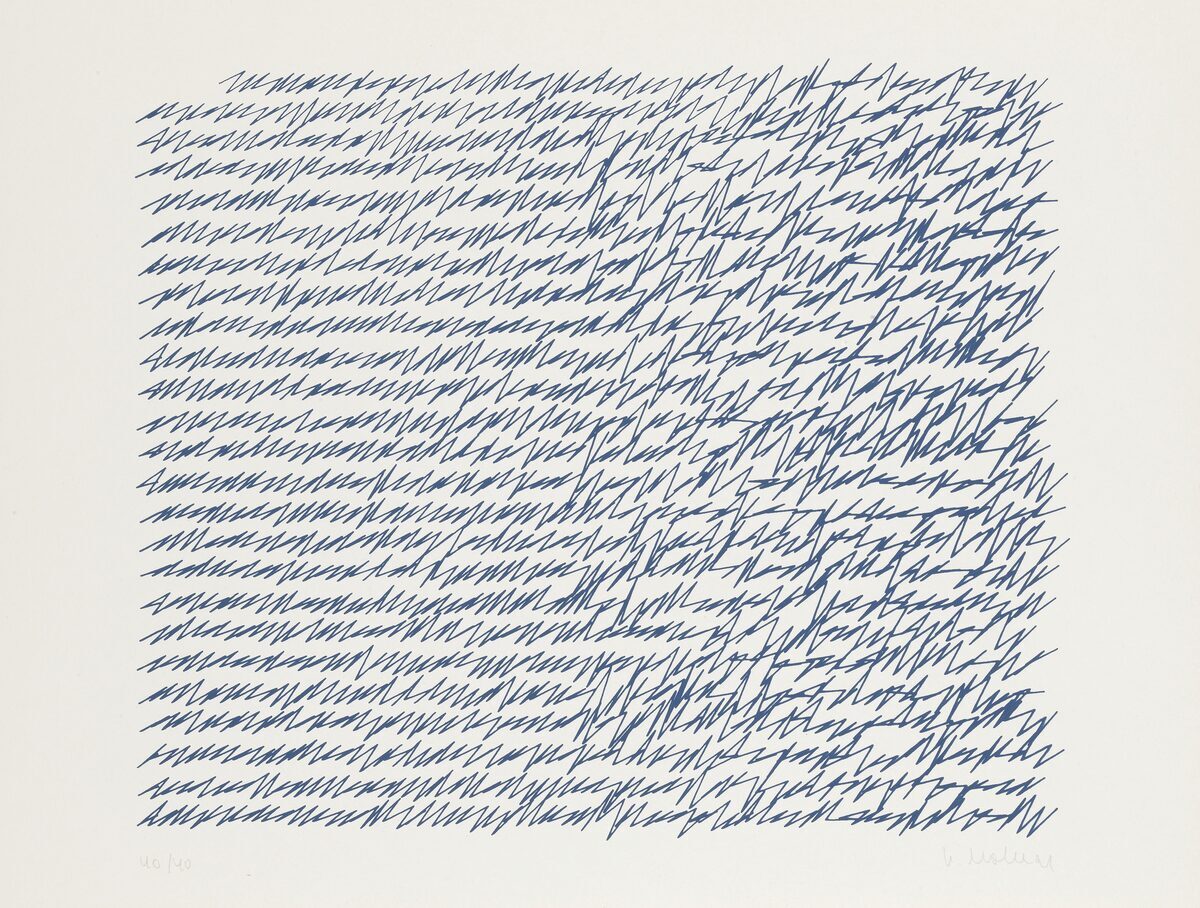
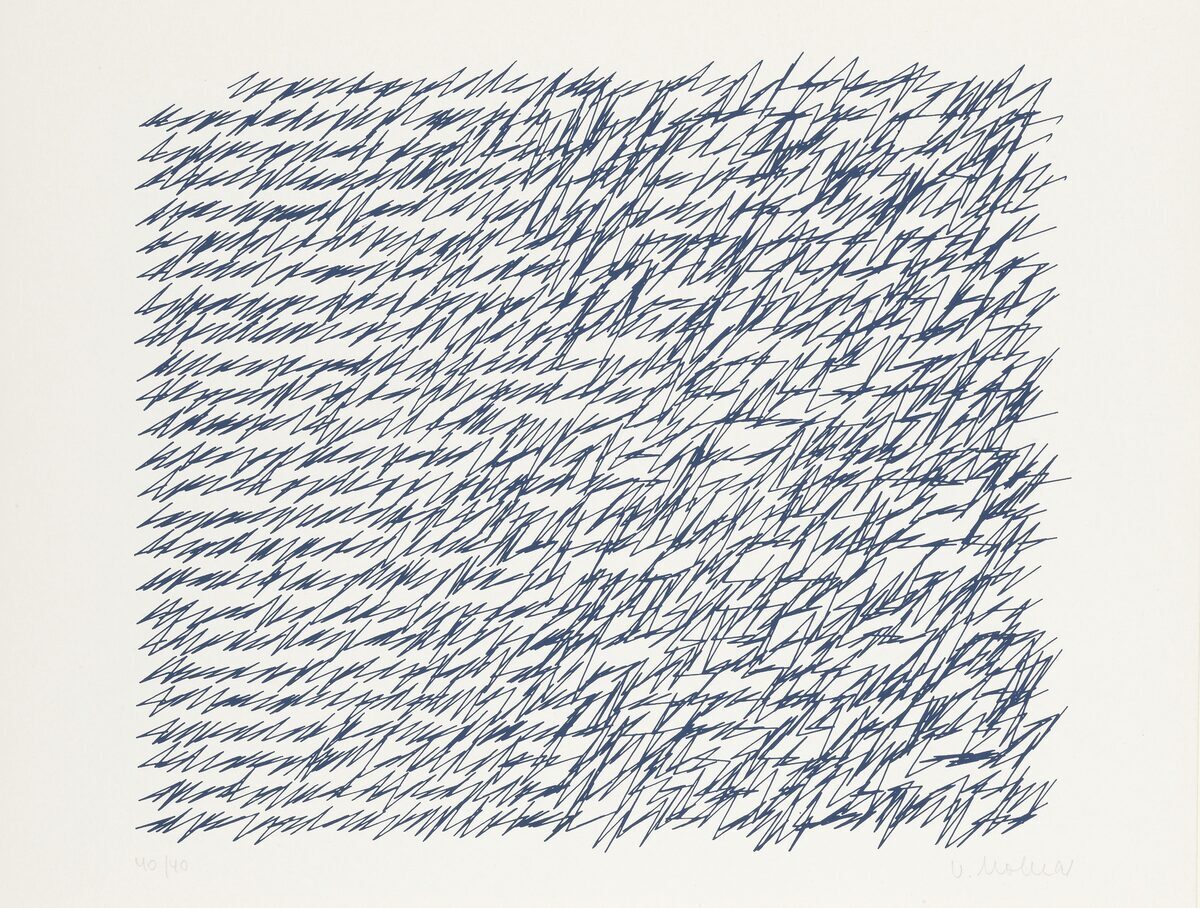
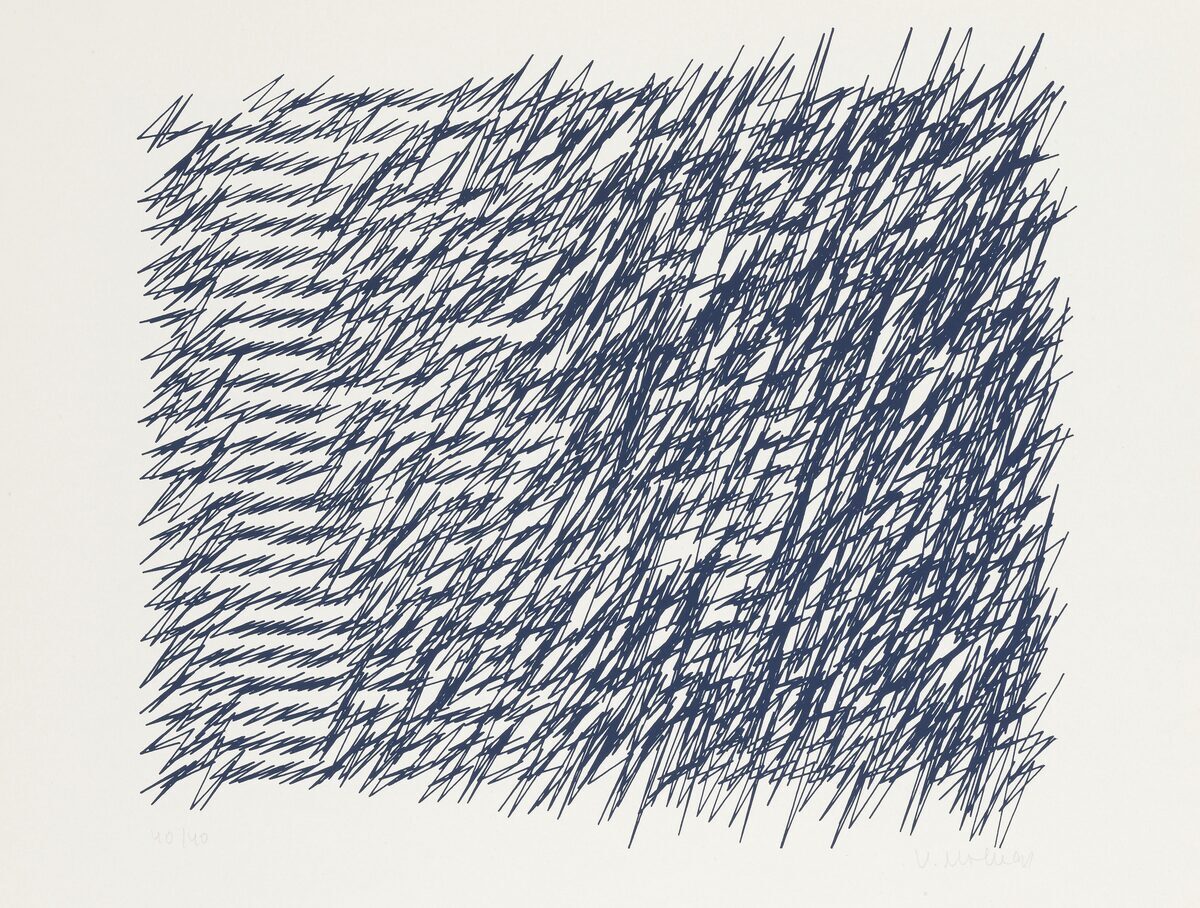
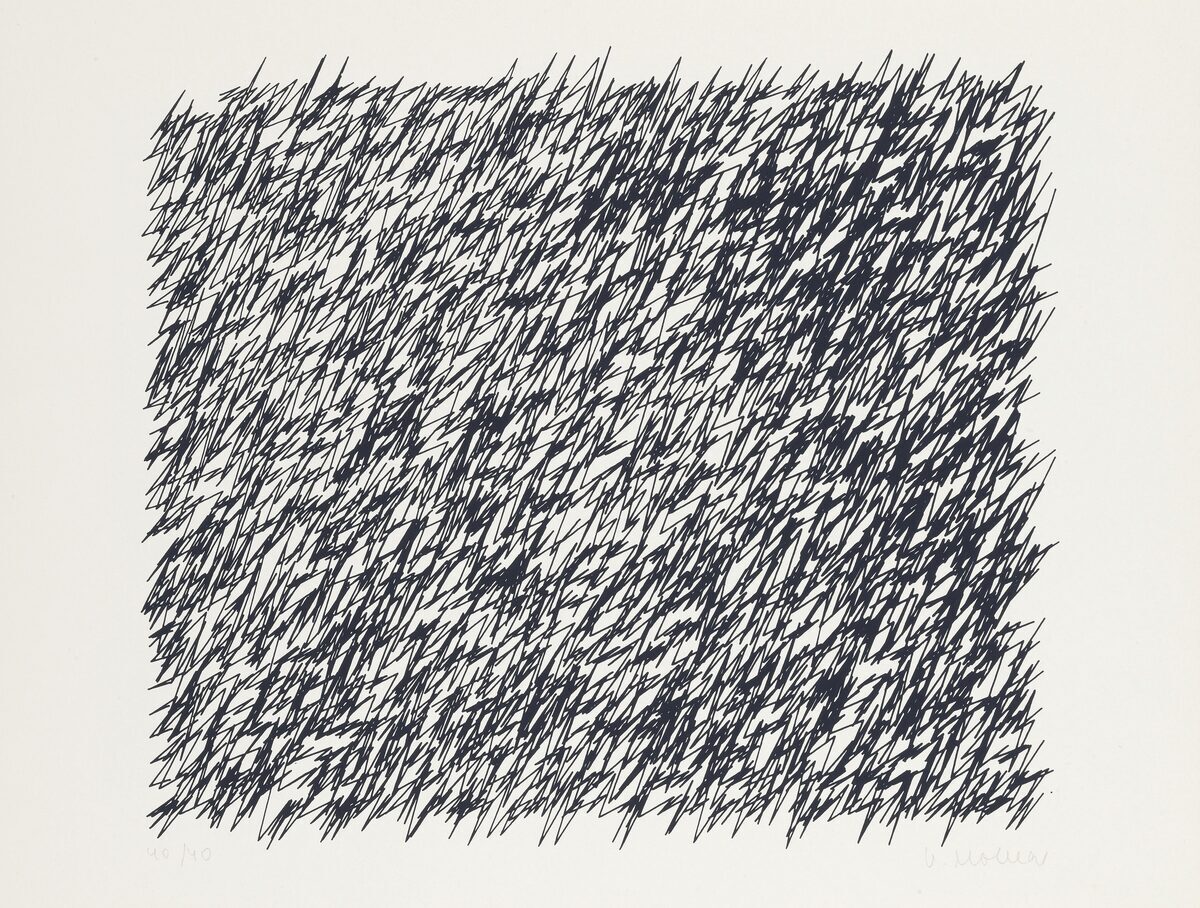
“MOTHER HAD A WONDERFUL handwriting—somewhat Gothic, somewhat hysterical,” the artist Vera Molnar once wrote, recalling the weekly letters her mother sent from Budapest to Paris, where Molnar lived for most of her life. In 1981, a decade after her mother’s death, Molnar began making Lettres de ma mère (1981–91), her own asemic versions of the correspondence: lines that look like writing but contain no actual words. She created dozens of variations, primarily with a pen plotter—a machine once widely used for making technical drawings. To make each piece, Molnar wrote alphanumeric code on a computer, which was translated into instructions for a mechanical arm to draw onto paper. She’d tweak the code to introduce patterns and variations, imitating her mother’s “restless, nervous” hand. Throughout her life, Molnar’s central experiment—shared with her husband, François Molnar, and their milieu in Paris—was to minimize subjectivity, to see how much of art-making could be “programmed.”
Nested in this folio on generative AI, Molnar’s work feels both prescient and distant. The basic structure is familiar: prompt in, art out. As recently as 2022, in the early days of DALL-E and Midjourney, two of the first widely available generative AI tools for image-making, the prompt and the resulting image were loosely related—the model spewed out something dreamlike or grotesque, only surreally approximating what it was asked to create. Lately, these tools have rapidly matured, edging toward Molnar’s level of precision, where even the chaos of a mother’s writing could be carefully scripted using prompts. As Molnar’s mother aged, the letters “became quite troubled, perturbed,” Molnar wrote, though they always “looked very pleasant.” The six screen prints reproduced here, all from the original plotter drawings, proceed from measured to wild, reminding us of the indelible particularity of the human hand.
—will fRazieR