translated by Alison L. Strayer and Emma Ramadan
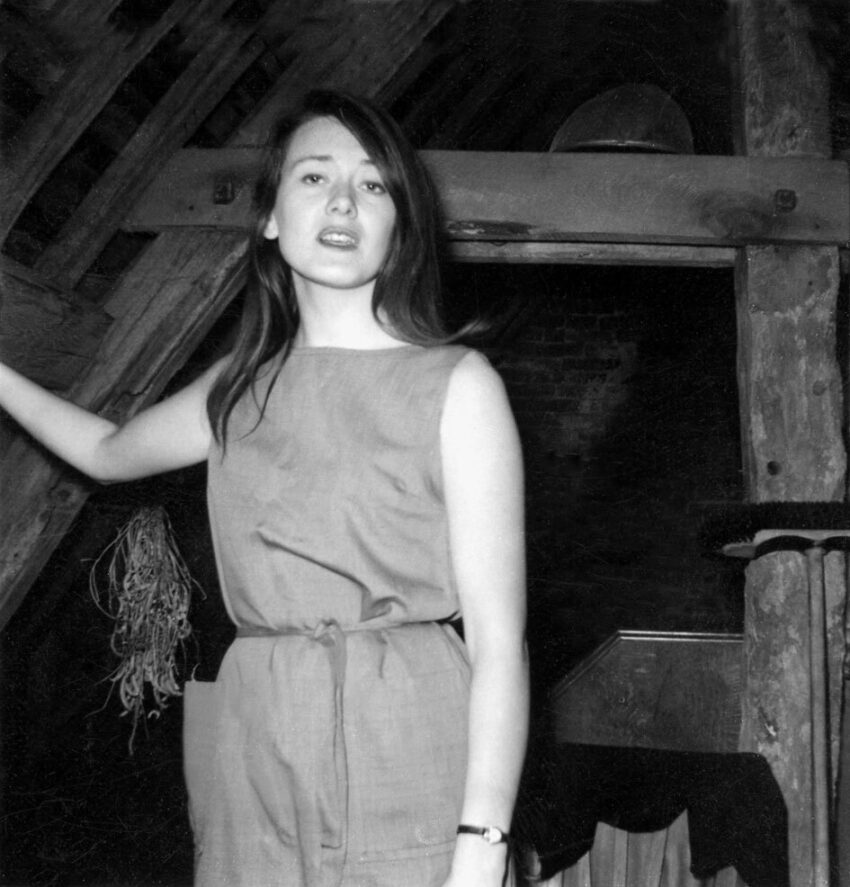
Thursday, April 4, 1963
Without realizing it, I am widening the gap between my parents and myself, but I need them, and because of them I’d be capable of many things, as if I wanted to take on all the suffering, the humiliation they’ve been through, and avenge them. It is partly because of them that I’ve written, but it wasn’t the right book. I’ll start over, probably with short stories. Why have I always wanted to do bad things, but in other respects I’m always suffering? Sometimes, like today, I’m afraid—“scruples.”
Monday, August 5, 1968
Useless revolt, and such dreadful boredom sometimes that I’d like to get on a train and flee to a place where there isn’t a yard cluttered with rubbish and where there would be sunshine. I’m reading a novel by S. de Beauvoir, She Came to Stay, and it’s a strain. I’ll never write that way.
Monday, January 5, 1970
For me, writing would be a better way of being. It’s as if the person I am when out in the world had no balance or depth, as if things were alien to me or, even worse, threatening. Nothing has any reality for me either, not my profession, or other people, except when there’s an attachment that is almost animal, as there is between my children and me. But as long as my research has not culminated in a complete, finished body of work, it will only be loose pages with no connection to me, nothing essential. Do I only want to talk about myself now? To write in the way a painter does a still life, adding the world in like an extra? Which of course puts an end to characters, even the “I.”
Monday, January 1, 1973
No sun. Nearly alone. Éric downstairs, the cat upstairs. Last year was one of the worst ever, though I expected everything from it. The only bright spot was Chile. In fact, my only hope for 1973, the only worthwhile goal, the only salvation, even, is the novel I’ve started [Cleaned Out, 1974], unbeknownst to anyone. And I’d like to see it through, that is, finish it and see it published. As for the thesis, I would like to get on with it and stay afloat. Basically, the only possible unity in my life at the moment would be the true achievement of my long-standing goal—writing for myself.
Friday, March 2, 1973
I’ve had an image of happiness inside me for days: a house full of sunshine, roses, and apple blossoms—and in the afternoon, because that’s the way it is, my time to write, to build and correct. It’s the only life I’ve ever dreamed of. I know deep down that I don’t aspire to be a university professor.
At the moment, on days like this, I’m afraid I won’t succeed, afraid I’ll fail, afraid I’ve let myself take the easy way out. But I can’t give up, it’s as if I were being dissected, stripped of my marrow, of my only reasons for living. Mar[ivaux] interests me, but my book is myself, there is no comparison.
Saturday, September 1, 1979
Birthday. Thirty-nine. No regrets. Finish this book [A Frozen Woman, 1981], which sometimes makes me very anxious because it touches my life too closely. I dread its publication (though it is necessary) as much as I did that of Cleaned Out. A difficult dream—how to interpret it? I am helping a woman give birth, I am convinced that it’s not time yet, “stay calm,” etc. She screams that it is time, and I refuse to believe her. And then the baby comes out brutally, covered in blood. I try to cut the cord but the scissors won’t cut. I get the feeling that everyone is mad at me for my lack of foresight, the woman seems seriously ill (no more news of the baby, and it’s not much of a baby, more like a package). I learn that she is pulling through, and my guilt lessens. It is possible that my dream refers to my relationship with Philippe and my book. I get the distinct impression from time to time that I’m not going to be able to publish it, not because of the publishers but because of its content, which touches on my personal life. Really, I can only finish dangerous stuff, risky books, awful unveiling.
Monday, August 25, 1980
Still nothing from Gallimard. I end up doubting more and more. The ending seems botched. The worst thing is that I can’t do anything unless I’m sure my book will be accepted. And what is written is completely detached from me, dead.
Reread [Sartre’s] Nausea. Realized the full impact the book had on my life, although this time I didn’t feel the same shock, surprise, and absolute feeling of adhesion. In my memory it was a yellow book. It is green and black, roots and vegetation. I can see that at sixteen or seventeen, I made the entire ending my own, a record, a justification of existence: “A time would come when the book would be written, when it would be behind me, and I think that a little of its clarity might fall over my past.” A book of revelation.
Friday, September 5, 1980
Dreamed that my manuscript was returned to me with a rejection letter. Woke up, it was just a dream. I fell asleep again and had the same dream. This time I had no doubt that I was awake: my book will not be published. Second awakening. An excruciating feeling. I’d lived two years “for nothing.” I thought of what a blow to the head Seuil’s rejection was, seventeen years ago. Maybe that’s why I got married. Not bad. What anguish beneath a quiet life, these days. The postman stopped in front of our house with letters and then went into the back of his van, as if he had a parcel, and I thought the dream was coming true. There are reasons for it to be rejected: the meaning isn’t clear—it’s a feminist subject so may be overstated. Still, I remember what this book cost me.
Wednesday, August 4, 1983
My book [A Man’s Place, 1984] has already been accepted by Gallimard. The thorniest one yet! Can it be released, as I would so much like it to be, for the start of the school year in September? My mother hospitalized last night—remorse, anxiety. I’ll have to think of a solution. Uremia. Suddenly I think: Proust’s grandmother had uremia. But there has been a century of medical discovery since then.
Sunday, October 14, 1984
A superb October Sunday, cold, sunny, the time of year when everything lives delicately. Terrible yesterday to see the deference all these people had toward me because I wrote A Man’s Place. The urge to flee and no longer be that successful person. After each success I’ve been like this, overcome by deep disgust, weariness that made me cry. For the first time I realize this with absolute clarity. I always want to do things that seem to me difficult and important, and to be recognized. But when I am recognized, I don’t want to be recognized anymore; I want to sink back into anonymity and do something else. Or maybe I’m feeling the imposture of all glory, which has always to be started over again. I get ahead of the game, running away from it before it’s there. I couldn’t go see my mother today, a new guilt added to the old ones. I sometimes think my mother’s dementia is caused by my books and my divorce.
Sunday, September 1, 1985
Birthday. Forty-five years, halfway through my forties. Lunch with P.
The great desire is to start a book [A Woman’s Story, 1987] without concessions. Choose between two directions, one of them (mother) easier than the other (the great reckoning, long planned). Another turbulent year, unfortunately, sell Boisgibault, and then where will I go? Don’t make a mess of it. And I would like to be reborn after my operation, which I barely imagined nine months ago—to walk as before and have a little flexibility.
Sun, wind, how I love September. I remember last year in the park of Ermenonville, Rousseau’s empty tomb, the temple of Philosophy. What will I remember next year?
Sunday, November 10, 1985
I can only write dangerously, really dangerously, in form and content. I waver too much over technical problems—as a way of rejecting dangerous “content,” things about my mother and me? The other dangerous book is the one about P., and maybe others. Getting to the bottom of things is all that interests me with my mother. Does that involve a book, as I’ve undertaken to do? What other approach?
—A. L. S.
Thursday, August 8, 1991
I was about to bring the text to Pascal Quignard this afternoon when I heard “Éthiopie,” associated with S., when we were on the sofa, downstairs, another time when I was on my way back from the Russian cinema, driving at 130 kilometers per hour in my jealousy, my passion. And everything culminates here. The final act. I felt the urge to cry, as I am crying now, tonight. This mystic quality of love that can only reach its end in literature. But no, no, it’s not that: tonight, S. became that “glorious body,” invincible, distant, because I loved him so much that I couldn’t do anything other than wish that for him.
It’s getting to the point that I’ll want to die if no one finds this book beautiful, if P. Quignard doesn’t reassure me right away, if . . . Life is unpredictable, I didn’t think that tonight I would rediscover S., that I would measure the strength of the attachment, of the fantasy that made me write this.
I listened several times to that haunting American or English song “Just a Dream” with a feeling of absolute emptiness. The role I give to writing is no doubt terrifying, a mode of knowledge, a communication of consciences through emotion, and also something else unknown to me.
Tuesday, August 13, 1991
Last night, on the answering machine, Pascal Quignard: “Your book is extremely beautiful.” Today again, also on the answering machine, decisively: “Your book is magnificent.” But I know nothing of this book and I am still living it, I am in that “structure” that surpasses the composition, something that is the real presence of the book, its own reality, created over time. Can I make it even “more beautiful”? From the day S. left, I “knew,” subconsciously, that this is what I wanted to write, and everything kept me from doing so, my previous writings, S. himself. I did it anyway. Desire is stronger than everything.
Thursday, August 15, 1991
What more can I do for this book? The desire for perfection. I imagined that one day I would write my Mad Love, but I didn’t know its form, its voice. How much I suffered for it to make itself known, for it to finally break through. And it’s neither chic nor tasteful.
—E. R.
Sunday, December 2, 2001
Viewed from the time in which I am now living, many facts appear to me more clearly, but I am not sure this simplicity, this purity of meaning, is any truer than the opacity, the complexity of the way they once appeared. We have to die old with the impression of having “understood everything,” and even accept dying because of it, when it’s only an impoverishment of thought.
Evening. Spent all day thinking about the book I have to do, the one that only I can do. If I don’t start it now, I never will. The only thing is that it isn’t dangerous, transgressive, and that bothers me a little. Maybe more than I care to admit. But is leaving a testimony of the life of a woman in a new form (especially that) nothing? For myself, first, for the record, for others.
See this book as the measure of a world, basically the yardstick of a generation of women.
Wednesday, December 19, 2001
I am back in writing hell. As if each time I start writing, I have to go through the same hell again. I can’t get around it—reduce it to a few days. It is of unlimited duration.
Sunday, December 23, 2001
I have so little sense of living what I’m living while I live it that I have to relive it to finally live it.
Thursday, December 27, 2001
I realize I’m working on two texts that are both, in different ways, a refusal of the self, a refusal to exist. One, the “anonymous text” (because intended as such for publication), the other, the “empty autobiography” in which writing transforms a singular vision into a collective vision and experience and is even prepared (this not yet quite decided) to eliminate the “I” altogether.
Perhaps the “collective” text I’ve begun, like A Man’s Place and Shame, is more related to things that will not be preserved in literary histories, according to the tastes of descendants, like my journal, Simple Passion, The Possession. But I absolutely have to do it, as something that only I can do.
Sunday, April 20, 2002
Pentecost. I spend hours—without being very productive—on what I have been doing for quite a while, “History” (not in the Claude Simon style). I have a strong feeling that I’m dissolving completely into the movement of history, the time of the years ’45–’50 (for the moment). Is this the right path? As it is, I’ve spent my life trying to figure out how to render the world (in every sense of the word). For the moment, I don’t see how I could arrange the individual/collective relationship any differently (especially the “one”). No one talks here, or everybody does.
Saturday, July 20, 2005
Difficult to start writing every morning. Remembering the importance of reading and literature in my life, from childhood until my marriage, the birth of Éric, having to teach. Roberte, in England, pointed out that I always took my examples from literature. A reproach. I was surprised because it was so natural for me. Was I in some way “cut off ” from life? Later, my literary madness of ’61–’63. In those years, I told my father that as in Victor Hugo’s family, in the Duménil family there were mad people (Suzanne, Marie-Louise) and geniuses (my mother’s superior intelligence). He didn’t say anything, I could tell he was bewildered. The same thing happened in ’64, in Caudéran, when I spoke to the landlady, Madame Julien, quite naturally, about Maupassant’s mother, and there was a gleam of absolute dismay in her eyes!
11:45 a.m., so haven’t written yet.
Sunday, July 21, 2005
Reread my journal from ’68–’74 for my book. I’m appalled by my violence, by the pain of being trapped in my marriage with Ph., his lack of love and respect for me. The journal concentrates all the rage and forgets the times when nothing happens. The repetition of the same words, hatred, family, red, and then sun is telling. I love the strength I had, the ebullience and ambition, very much like my mother’s. I feel too conciliatory, appeased—a bad sign.
Then it is hard to return to the impersonality of the text, to generalization, when I emerge from such a powerful, violent “I,” the “id self,” as Bernard Desportes writes.
Saturday, January 14, 2006
Winter sunlight pouring in, so beautiful. Haven’t started writing yet at 1:15 p.m. More and more difficulties, more and more doubts, perhaps due to the urgency of submitting a manuscript this year. For the first time, I have a contract with Gallimard, and this expectation of my book is making me feel stressed. Should I reread what I’ve already written? But what would be the point of that, would I have the courage to start again differently? I don’t think so. And if, like the other times, I feel Yes, that’s it, I’m not sure it will help me with the rest. I am currently in 1980, the trip to Spain; the memory here is too heavy, shapeless, nothing but confinement. How am I going to do the rest, twenty-five years, when it took me three years to do forty?
Tuesday, February 14, 2006
Day for day, how many years already since that Valentine’s Day when S. came here? Seventeen years—how many doesn’t matter now. I went back and read because a reviewer asked me about Simple Passion and Getting Lost; the weather was beautiful, and what madness.
Read in a text by Flaubert the word s’accouver and it took me a while to see the gesture it signified—to crouch down—and to understand that the word belonged to my childhood, a Norman word. I could hear my mother saying it, sometimes as an order, “Accouve-toi.” Only now do I see the kinship with couver, “to brood, to incubate.” This word gives me back the distance, the frightening distance from my childhood, from the me of the 1950s. It is a precious word, one that is personal and at the same time shows me a link with a territory, a community to which Flaubert belonged. It is an archaeological relic.
Apparently, I’m due to have an operation on my right hip in December. I was expecting that. Obligation to finish what I’ve started, which is getting harder by the day, and doubts. I didn’t reread. Running ahead, but without pleasure. I grasp the emptiness of time in a text without actors. I’m not sure that changing the text—’58—would make me any more optimistic.
Thursday, March 2, 2006
Instead of working, I reread my first novel, without preconceptions, stripping away my contempt and shame that were mainly due to what I wrote afterward and the rejection by the publishers. I was stunned by the breadth of the ambition and by the themes: the self, life, memory, the imaginary. The dream that opens the text is astonishing, with the dog barking, dying, and the door (I hadn’t yet read The Trial), the streets, the nameless city, the quest clearly indicated. Then a maelstrom of bodily sensations, touch, and so on. And a tremendous nonexistence, the bed from which I do not rise . . . It’s all written in the present tense, deliberately (hard to read), with literary and poetic clichés but also many phrases that people still find brilliant in the work of “poets.” Am I being overindulgent toward something I wrote when I was young? Hard to say. The persistence of the deep themes disturbs me. History and society are completely absent, though at the time I was very close to the Communist Party and read Marx. But art is above all derealization, and my model, the New Novel, is politically disengaged.
Basically, I don’t know what this text is, I only know that it makes my head spin. As when I finished writing it in March ’63, I feel crazy after rereading it, today, forty years later. I went through it once in ’72 to send it to J.-F. Josselin on my return from Chile, but I gave up when I realized how lame—no, not that word, how absolutely strange it was.
It’s incredibly hard to write at the moment—doubts, doubts.
Evening. My confusion of this morning is still with me. I’m at the birth of my writing now. Forty-three years later, the evening, the silence, descends and I’m still writing, in such a different way, History, the world, are no longer derealized but the stuff of my empty self. Another thing: I really immersed myself in my first book, trying to understand my project, revisiting the images I’d conjured, which were familiar but caught unawares by a lot of the details, sensations, thoughts, and I’m afraid of reliving that moment of writing. It’s as if I can feel the rough blue blanket on the narrow bed on which I wrote in the residence halls, the tree in the window (it’s gone now), the desk. I was removed from the world, in a state of clairvoyance, trying to reach beyond reality, as in the poems I’d written six months before.
Thursday, December 16, 2006
Every book, especially this one, is a circle around me, and I enclose myself in it completely, until I finish it and come out. Everything I say about the text seems to me like a window through which the substance spills out. Image of an egg or a pregnant womb?
Tuesday, January 16, 2007
Again I’m as if being cooked alive—violent pruritus. A bran bath, only the water soothed me.
Sunday, the little corporal was “crowned” (the journalists’ word) at Porte de Versailles. What a formidable talent, this time playing on sincerity and personal injury on TF1 in the evening. Have the feeling he’ll be elected. If I live to see the day. At times, I feel so bad, plagued by all kinds of pain (left hip, unbearable cramps in bed at night). Every morning I rip the end of my book out of myself, just twenty or so lines before I’m engulfed by the devouring sensation that invades the skin of my arms, shoulders, face, and eyelids, on fire each day for the past seven months. Last night I was walking around the house bare-chested, unable to bear having anything on. Spa treatment is my last hope.
Friday, January 19, 2007
I’ve been twice to that sophrologist in Conflans, with the vague feeling that I’m indulging in charlatanism. It’s hard not to laugh when he makes me say “I feel hysterical—I’m conscious” as he follows a pencil with his eyes, twiddling it in front of me. And the Bach flower drops, useless or harmful, beneficial, I don’t think so. All this is humiliating, a way of funding quasi-spiritualist practices and giving them credence with my assent.
Strong wind, warm rainy weather. Immeasurable disgust at writing. And I’m still afraid that something will happen to M.’s cat every time it goes outside. Like now. As much as I’d like to, I can’t bring myself to spend a whole day in bed, bored out of my mind, just to get back to writing. When was the last time I was happy? A drive in the Vexin with M., one Sunday in November, the weather was like spring, and the car, with its shadow in front, seemed to drive itself. We were in the air, in the light.
Sunday, February 4, 2007
Two days of absolute sunshine. More and more, I’m enjoying doing nothing in the dazzling light of the room, where the sun shines through the bow window from late morning into the evening. Crocuses have sprung up in the garden. Alone as usual, and writing. I go through peaks of certainty and dismay. I don’t want to reread until I’m finished. I’m “at” September 11, 2001. I remember, episodically, February 1984, the meeting with P., the rue de Rome, the afternoons of November ’61, in my room in Yvetot: I watched the sun go down each evening, I studied French literature. For two years I was crazy about literature, from ’61 to ‘63, crazy, I no longer know how to recall it; literature more real than life (as a student, the daughter of grocers in the rue du Clos des Parts), to the point where I forbade myself to flirt because boys threatened this reality. One day I went to the Hospice Général for a plantar wart, and I was literally possessed by Flaubert. I was living and walking through the streets exactly as if things were about to turn into words, sentences. Nobody in Rouen, at that time, could have been crazier about literature than me. I subscribed to Les lettres françaises, I hunted down new publications in Yvetot’s municipal library, which was pretty much identical to the way it must have been in the nineteenth century (the translations by Nisard!!). In November ’61, I repeated to myself the verses of Anna de Noailles (whom no one knows anymore, nor Marie Noël the Catholic), “I leaned on the beauty of the world / . . . I held the scent of the seasons in my hands.” And that was me.
Dreadful evening of skin misery. Was forced to take a bath in wheat starch at half past nine in the evening, which doesn’t calm me, nor does cold cream, or finally sweet almond oil. Is this the result of my discouragement yesterday afternoon in the face of what I’ve written, patiently, painfully, for about four years, and which seemed to me inane from start to finish? I wondered if I was not pursuing a path in the blind way of an ant, having ceased to think about the structure, the whole when it is read.
Saturday, May 12, 2007
Here I am again before my text, a mass of pages I don’t dare reread. Afraid of having to tell myself that nothing’s right and everything needs to be redone. What will rereading give me? The dread or the desire to carry on? And what if I don’t reread? I carry on in pain and uncertainty—horror, even. It’s terrible either way. If I’m to live in any sort of tolerable way, I need to do a bit of writing each day. Even today, it’s that fear of coming to a standstill, of emptiness, that stops me from looking back at the whole. And perhaps it is making me persevere in an error. What error? Perhaps the detouring, at a certain moment, toward too many generalities, the detachment from my real history and from the movement of History; the “we” is no longer really mine, or is indistinct toward the years ’95–2000?
I started writing this, a bit earlier, to untangle my desire to see things clearly. No, mainly to make up my mind. I am not going to reread the whole thing (the desired effect has therefore been obtained), nor even what immediately precedes it (the last Christmas lunch). This is the probationary function of the journal for me.
I’ve got to stop watching the news, reading Le Monde, or looking for news on the internet. I’m disgusted, overwhelmed: 65 percent of those “polled”—a new species, the polled, a model for our lives—are not shocked by Sarko’s three days of luxury on a yacht in Malta. To what extent are they afraid of being seen as envious or “resentful,” which is so frowned upon, or is it a question of accepting the privileges of people judged as being of a different essence, i.e., we’d like to be in their shoes, but since we never will be . . . ? The notion of equality is increasingly contested or, worse, disappearing.
Tuesday, May 15, 2007
What exactly about this text is making me suffer? The fact that I’ve been working on it for too long—four and a half years? Not being sure that it’s acceptable or can be read without boredom? No longer “discovering,” not inventing a reality in a new form at every moment? Gide: When you hesitate, you’re lost. I am indeed, horribly, lost. And am I going to dare to face the whole thing, to reread all 189 pages (today)?
Friday, June 8, 2007
I have been entering my text into the computer for a week now. At moments, terrified to see the work of editing and formatting. In the end, what I thought was good, written in 2002, no longer seems that way. I’m oscillating between two irreconcilable extremes: tranquillity, the certainty that it is exactly right in terms of what I wanted to do, therefore, lack of worry about the judgment of others; and collapse, the feeling of being a failure—that’s the judgment weighing on me now, their expectations that I’m not fulfilling.
But what also weighs on me is the memory of the drafts of A Man’s Place that I rightly abandoned. Reason may have failed me—as it did Flaubert with Bouvard et Pécuchet—because I was mired in health problems, and the roller-coaster ride of my relationship with M.
Sunday, June 17, 2007
Rain for two days. I don’t know how I’m going to make my manuscript publishable, even minimally. I’ve typed 50 pages in which there is a lot to rewrite. There are still 150 pages to type and the ending to write. All I’ve done, I think, is persevere with a project without reexamining it at every moment as I should have done.
Saturday, September 1, 2007
I’m sixty-seven. What have I done in a year? I have the greatest doubts about my undertaking as it draws to a close. The shame of handing over something I consider to be a nameless object.
Desires: Find a beautiful “form” for what I’ve written, the one I feel when listening to the Divine Comedy’s song “A Lady of a Certain Age.” And finish by the end of October, at the latest.
Saturday, September 29, 2007
I am desperate. Working for four years, five years on a text that is improbable and, shall I say, unpublishable in its present form, as is? All the books I hear about, or read, condemn me. Each fragment in itself “holds up,” but the whole does not. It would take me months more to do something (how humiliating to say it) “clean.” Or to make huge cuts, as I did for A Man’s Place. Does this form contain my life, my time? I don’t even know how to answer that today. All I know is that it ate me up, doing nothing the way that everyone else does and wanting the world to accept what I do.
From October 1 onward, I will face the text squarely, in its entirety, try to evaluate it, to give it a tiny little chance.
Sunday, November 4, 2007
I have to finish my book today and hand it in tomorrow or the day after. My impression of it is disastrous, or almost (some passages are very accurate but closed in a loose, linear, bizarre structure). I fell short of my plan. Writing these lucid sentences undoes me even more, throws me into the final anguish: the end to be reestablished, made coherent, this Sunday. Later, I will have to ask myself why I continued unabashedly to refuse to look at what I’d written in the two or so years before. Because of illness, perhaps, and the economic need to finish something; the two mixed together, I think. Cancer, at the time I started this work—a sign? A desire to see it through to the end? Well, here I am. In a state of horror. As for doing it again any other way, I’d be incapable of it, hence the sense of necessity, even in error, in relation to this text. I have the feeling that no book has cost me so much, and this is the one I know the least about.
—A. L. S.
“Writing,“ translated by Alison L. Strayer and Emma Ramadan, and “The Memory of Rooms and Other Places” (in print only), translated by Dan Simon, are drawn from Writing, the Other Life, by Annie Ernaux, edited by Pierre-Louis Fort, which will be published by Seven Stories Press on October 27, 2026.
alison l. strayer has been the English translator of most of Annie Ernaux’s writings since 2018. She has received the Warwick Prize for Women in Translation and was shortlisted for the 2019 Man Booker International Prize.
emma ramadan is a literary translator whose work includes Sphinx and Not One Day, both by Anne Garréta, and Zabor, or The Psalms, by Kamel Daoud. She is a recipient of the 2021 PEN Translation Prize, the 2018 Albertine Prize, and two National Endowment for the Arts Fellowships.
Annie Ernaux was awarded the 2022 Nobel Prize in Literature. She is the author of some twenty works of fiction and memoir, including The Years and Simple Passion.
Featured
What Happened When I Began to Speak Welsh
By learning my family's language, I hoped to join their conversation.
You Might Also Like
The Talented Ms. Highsmith
I worked for the novelist in her final months. I thought she wanted to kill me.
Support Our Commitment to Print
Subscribe to The Yale Review. Receive four print issues a year—essays, fiction, poetry, and criticism.
Subscribe