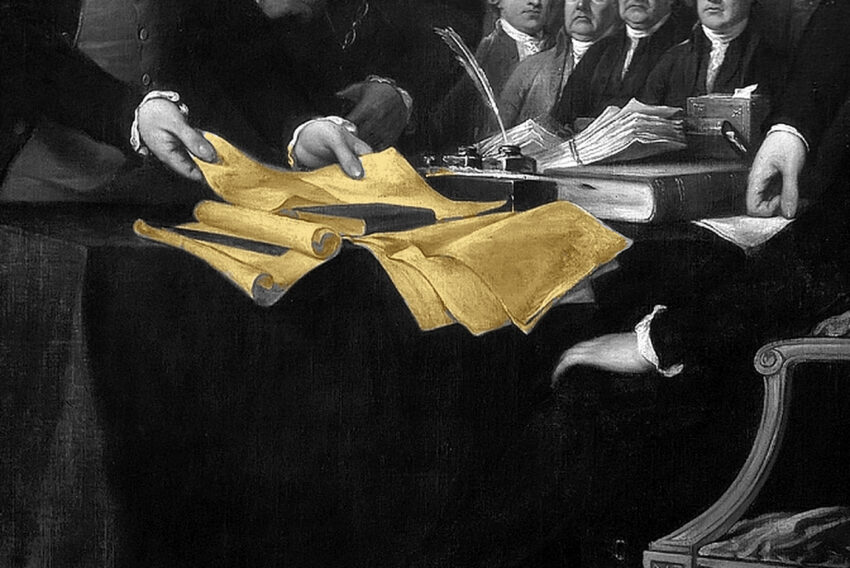
Beginning in the decades after independence, Americans remade the Declaration into scripture—venerating its scribes "as immortals and its liberty as consecrated." Illustrated detail from John Trumbull's Declaration of Independence (1818). Source image: Wikimedia Commons
This march, the treasurer of the United States announced plans to mint a commemorative gold coin honoring the 250th anniversary of the Declaration of Independence and “the enduring spirit of our country and democracy.” There was, his statement continued, “no profile more emblematic for the front of such coins than that of our serving President, Donald J. Trump.” Under federal law, living people cannot appear on American currency, yet the design was approved by the U.S. Commission of Fine Arts. The coin, which will enter circulation this summer, features the president with furrowed glabellar lines, prominent nasolabial folds, and a cantilevered overhang coiffure surrounded by inscriptions of libeRty and in gOd we tRust.
In the history of religions, the deification of a person, sometimes recorded in hagiography, normally occurs after death. That cult of the saints has informed the Western culture of fame, which shaped President Trump, and which he in turn has shaped. As the scholar Leo Braudy writes in The Frenzy of Renown, being the least-liked person fuels notoriety: “For those ignored or persecuted by the world, the venerated martyr promised that the last would be first, the rejected in the past become the only true heralds of the future.” Trump, a skilled American celebrity, has pursued and received such veneration. His decades of personal branding are a form of mythmaking: the repetition of a story that explains his superhuman force. The story he keeps repeating is that he is not restrained by earthly law. He takes all liberty because he has a higher power.
Is a sitting president glowering from a gold coin, an image that violates the law its subject swore to uphold, an abasement of the spirit of 1776 or a proper sacralization? Answering this question requires thinking about what the Fourth of July honors and recommends to this country’s people. It requires knowing what the Declaration of Independence’s creed instructs.
every religion has a cosmogony, or creation myth: a story of how and why things came to be. Legend has it that our country began on a single humid day in July of 1776, at the Second Continental Congress in Philadelphia. Many children’s histories depict this beginning with images of colonial white men in various white wigs gathered around a table with an overlarge piece of white paper. Usually, someone with name recognition is portrayed as being the tallest, even if they weren’t: Thomas Jefferson, John Hancock, or—depending on the level of fantasia—George Washington. (He was in New York City that day.) This narrative is true only in the sense myths are true; it supplies a story to explain something otherwise hard to believe. Historically speaking, factually speaking, saying that a country started on a single day is bonkers.
There was no collective signing like the one often depicted. As historians explain, only twelve of the thirteen colonies had officially voted for independence by July 4, 1776; New York abstained. Some signatories were not in town that day, and several more were not yet elected to the Congress. The portrait of an assembled group manufactures unity long before the country had very much. In reality, it took several decades for the States to begin to practice being United: some nerds argue that the War of 1812 was what forged the nation; others contend that the states didn’t come into coordinated being until Reconstruction.
But this is just quibbling if you have a creation-myth mindset. Defiance of natural law is a regular feature of cosmogonies, which exist to remind us that birthing is something humans do but can’t control. The very first sentence of the Declaration makes this clear:
When in the Course of human events, it becomes necessary for one people to dissolve the political bands which have connected them with another, and to assume among the powers of the earth, the separate and equal station to which the Laws of Nature and of Nature’s God entitle them, a decent respect to the opinions of mankind requires that they should declare the causes which impel them to the separation.
The cosmogonic tell is “assume among the powers of the earth.” No creation myth is more important for the Declaration than the book of Genesis, sacred to the Christian movements that predominated late eighteenth-century colonial society. In Genesis 1:2, creation is initiated by “a wind from God sweeping over the water.” The Hebrew word rûaḥ can be translated as wind but also as spirit or breath. Creation, and revolution, require an elemental push. Such “powers of the earth” cannot be predicted or bossed. When they arrive—when the Lamaze breathing commences, or the windows start to rattle, or the streets begin to fill—humans better bow down. The spirit is sweeping, and no individual can stop it. Deference is commanded.
They centered the Declaration of Independence as a cosmogony, recorded its scribes as immortals, and their liberty as consecrated.
Cosmogonic narratives explain a society’s origins to justify its future, showing how things begin with details that determine how things will be. As the historian of religion Charles H. Long has put it, “These myths set forth a tonality and stylistics for the modes of perception, the organizing principles, and provide the basis for all creative activities in the cultural life.” In her fantastic study American Scripture: Making the Declaration of Independence (1997), the historian Pauline Maier offers two histories of what this process looked like. The first recounts how the Declaration was written, approved, and circulated by congressional representatives in the late eighteenth century. The second accounts for the founding text’s proliferating afterlife: how increasing federal authority and political partisanship transformed a declaration of decolonization into a scriptural document used to worship the American idea.
To achieve independence in 1776, the founders needed people besides themselves to believe in it and practice it. The message of their Philadelphia story could have been many things. Social coherence is something religion provides, often through repeating a story and asserting its moral. Creed is the word scholars use for those incantatory phrases that convey and perform adherence. all Men aRe cReated equal is a creed, in gOd we tRust another. libeRty is a third. Saying a creed publicizes commitment, claims distinction, and tests orthodoxy. A person can have a creed they describe as personal, but a creed is ultimately corporate, something other people can hear and repeat back: “Me too.”
In the first months after its issuance, the Declaration did what its authors intended: it coordinated an imminently American people into rebellion. In 1776, there were people in the thirteen colonies, including members of the Continental Congress, who did not seek independence from the British Empire. The founding document was a loud rejection of that idea. Still, once the Treaty of Paris was signed in 1783, leaders of the Federalist Party sought reconciliation with Great Britain to advance trade. They kept a certain strategic distance from the anti-British tenor of the Declaration, so its official celebration was rare. After the War of 1812, the Federalist Party lost power and, with it, most discretion about the document’s oppositional posture. If America were to fulfill the sovereignty that its revolutionaries swaggered into being, it needed to amplify—and reify—its insurgency, not ignore it. Both Whigs and Jacksonians explicitly linked their political platforms to Thomas Jefferson and his Democratic-Republican Party, sidelining any Anglo-American sympathies. They centered the Declaration of Independence as a cosmogony, recorded its scribes as immortals, and their liberty as consecrated.
In 1826, Jefferson described his hopes for the text with a missionary’s zeal: “May it be to the world, what I believe it will be, (to some parts sooner, to others later, but finally to all,) the Signal of arousing men to burst the chains, under which monkish ignorance and superstition had persuaded them to bind themselves, and to assume the blessings & security of self-government.” He and the other founders had ultimately agreed not to establish religion in the Constitution, but that did not stop them from giving churchly regard to the republic they formed. Jefferson, who revered human reason, encouraged “undiminished devotion” to the liberty that the Declaration declared.
Jefferson and John Adams lived long enough to be invited to the fiftieth anniversary celebration of the Declaration in Washington, D.C. But on that day—July 4, 1826—both figures died. The simultaneous demise of two founding fathers exactly half a century after the country’s supposed birthday added to a growing consensus that a higher power had directed their congressional subcommittee’s work. John Quincy Adams, the sitting president, wrote in his diary that the timing of the deaths was no mere coincidence but a “visible and palpable” manifestation of “divine favour.” Daniel Webster, delivering a two-hour eulogy for the former presidents, called it proof “that our country and its benefactors are objects of His care.”
A creed is most comforting when its truth seems furthest away.
Holidays recognize and redistribute such care through rituals of meditation, fasting, or feasting. “Calendars negotiate between the heavens and the state and orient us to time and eternity,” writes the media theorist John Durham Peters. Jefferson himself had understood as much, urging Americans to “let the annual return of this day forever refresh our recollections” of the Declaration’s rights. The sacred pile grew further as a vast material culture emerged to commemorate Independence Day. This included reprints of John Trumbull’s 1818 painting Declaration of Independence, which depicts Jefferson submitting a draft for consideration by the Second Continental Congress, as well as commemorative broadsides of the document itself and facsimile reproductions of its signatures. The graphic arts historian John Bidwell describes how artists, printers, and publishers made the Declaration a mass-market commodity, fueled by the passing of the founders and the fervor for westward expansion. “In important and substantial ways,” writes the historian Leigh Eric Schmidt, “commercial institutions helped lift up and standardize a set of national holiday symbols.”
Followers of the creed did not only celebrate on the Fourth; they called for the holiday spirit’s continual fulfillment. In the middle of the Civil War, President Abraham Lincoln incanted the founding date as sacred memory. “Four score and seven years ago,” he began his address at Gettysburg in 1863, “our fathers brought forth on this continent, a new nation, conceived in Liberty, and dedicated to the proposition that all men are created equal.” The primordial language of “bringing forth” reminded listeners that at a time of destruction they also possessed powers of creation. It didn’t matter that eighty-seven years earlier, there had been no Constitution, no government, no structure for equality maintenance or the fair practice of freedom. Surrounded by the casualties of war, Lincoln mythologized a moment of pure potential, when equality and freedom as ideas alone were sanctified. A creed is most comforting when its truth seems furthest away.
once americans began venerating the Declaration, the function of the document changed. As Maier writes, “It became not a justification of revolution, but a moral standard by which the day-to-day policies and practices of the nation could be judged.” Her history places this shift in the aftermath of the War of 1812, when separation from Great Britain was absolute. The second sentence of the founding text quickly became, in the United States, the moral guide: “We hold these truths to be self-evident, that all men are created equal, that they are endowed by their Creator with certain unalienable Rights, that among these are Life, Liberty and the pursuit of Happiness.” In the title of his 2025 book, the journalist and biographer Walter Isaacson sums this up as The Greatest Sentence Ever Written. Its language “became the creed that bound a diverse group of pilgrims and immigrants into one nation. For a people with many different beliefs and backgrounds, it defined our common ground and aspirations.”
The challenge—both immediate and ongoing—was that all persons did not hold such “common ground.” The self-evident truths were narrowly applied to propertied white men and expanded only over time through slow, costly struggle. In the bicentennial collection We, the Other People: Alternative Declarations of Independence by Labor Groups, Farmers, Woman’s Rights Advocates, Socialists, and Blacks, 1829–1975, the historian Philip S. Foner tells the story of some of those efforts. He reminds readers that for many generations, the anniversary of the founding was “celebrated by American labor as its day. The practice began in the 1790s, when the first trade unions of shoemakers, printers, coopers, carpenters, and other crafts . . . drank toasts to ‘The Fourth of July, may it ever prove a memento to the oppressed to rise and assert their rights.’” The declarations in Foner’s book form a timeline of minority rebuttal to majoritarian rule: the Working Men’s Declaration of Independence (1829); the Declaration of Rights, by Equal Rights Advocates and Anti-Monopolists of New York (1836); the Declaration of Rights for Women, by the National Woman Suffrage Association (1876); the Working Class Declaration of Independence (1902); the Black Declaration of Independence, by the National Committee of Black Churchmen (1970); the Declaration of Economic Independence, by the People’s Bicentennial Commission (1975). Some of these statements were ambitiously conceptual: in 1826, Robert Owen proposed a Declaration of Mental Independence to free Americans from private property, organized religion, and marriage. Others were very literal: in 1829, the Cherokee Nation, protesting the State of Georgia’s attempt to extend its authority over tribal lands, submitted a petition to Congress to recognize Cherokee sovereignty. People declaring independence is an American cultus.
Every new declaration emerges with fresh beef derived from an old authority.
These “alternative” petitions are fierce and unblinking, rejecting the cosmological map charted by the Declaration to argue for a better one. In that sense, they may seem like direct threats to the document’s spiritual authority, but they are testaments to its plasticity, its ability to be pulled and punched. You can hear the historians of religion murmuring in the corner: Yeah, scriptures are for everybody. There are religious texts that can be handled by only a priestly few, but their power remains esoteric; for a scripture to create a community, it must be something that the devout masses can have and spread and innovate. Every act of fan fiction reiterates the potency of the original. The texts called the Gospels, canonized in the New Testament, emerged in the one hundred years after the execution of Jesus, stories telling the good news of a single person’s life increasingly far away from its occurrence. Regional adaptations of the Mahābhārata are so numerous as to be nearly impossible to catalogue, from street-theater performances to film and TV series, each one shifting the tone and emphasis of the ancient Sanskrit epic. With the Declaration, the scriptural reverb is less retelling than redounding: If the founders said that equal rights would be the rule of this land, where are ours?
One way to think about this declarative reverb might be as a Fourth of July sutra tradition. In Buddhism, a sutra is a sermon delivered by the Buddha. Thousands of texts written in his voice have been authored by people other than the ancient Indian teacher Siddhartha Gautama, who lived about two and a half millennia ago. One sutra may differ significantly from the next, but every sutra connects itself to other sutras through the repetition of themes and phrases. Reciting and transcribing sutras is a meditative, devotional practice, a form of mental training that develops patience and imprints the Buddha’s teachings onto practitioners’ consciousness, generation after generation.
The Fourth of July sutra tradition focuses its practitioners on a founding idea and its enduring relevance. Consider, for instance, the 1619 Project, a series of essays published in 2019 by The New York TimesMagazine and curated by Nikole Hannah-Jones. The project reframes American history by tracing the origins of the national narrative not to 1776 but to 1619, the first year on record when Africans were forcibly brought to English North America. This retelling of the country’s cosmogony makes use of investment in the original creed as it subverts it. “The truth is that as much democracy as this nation has today, it has been borne on the backs of black resistance,” Hannah-Jones writes. “Our founding fathers may not have actually believed in the ideals they espoused, but black people did.” The tradition of democracy includes fraudulent claimants and righteous inheritors. American society is strengthened in part through the process of calling out those frauds and reclaiming those rights—a practice the Declaration modeled.
In Scriptural Vitality (2025), the religious studies scholar Hindy Najman describes “traditionary processes” through which texts invoke existing traditions and, in doing so, acquire greater unity. Najman writes, “The tradition is overflowing from a past but ultimately creates a new context of reading and a new composition.” She examines biblical texts this way, but you can see the same processes at work anytime someone appeals to a textual or ritual religious precedent. When the TikTok creator Miriam Anzovin posts her daily regimen of Torah learning, she takes an ancient, largely gender-exclusive practice and participates fully, encouraging commentary from others while decorating her videos with cartoon animation. Religious formats are available for reuse and renovation.
The Declaration’s global dissemination shows just how far such traditionary processes can send a scripture. The historian David Armitage finds traces of America’s independence document in the founding texts of Haiti (1804), Venezuela (1811), New Zealand (1835), Liberia (1847), Czechoslovakia (1918), Vietnam (1945), Israel (1948), and Southern Rhodesia (1965). Those varied documents invoke equality, but the egalitarian creed is not the loudest rhetorical echo from 1776. For many who draw on the Declaration of Independence, the creed derived from that scripture is insistently republican. libeRty is the rallying cry.
This is what the Native American Party, a white nativist group that was anti-Catholic and anti-immigrant, emphasized in their Declaration of Principles on July 4, 1845, “for the purpose of awakening their countrymen to a sense of the evils already experienced from foreign intrusion and usurpation.” And the far-right extremists, QAnoners, and paramilitary mobbers who stormed the U.S. Capitol on January 6, 2021, claimed they were only doing what the founding fathers had done in 1776: taking the liberty to overthrow an illegitimate government that no longer represented them.
Every new declaration emerges with fresh beef derived from an old authority. Often, people think of scriptures as kept sacred through careful physical handling and precise quotation. What the history of religions demonstrates is that scriptures accrue sacrality by their survival of mishandling. They are poked and prodded and cut up and misquoted because humans still have a need for those words in their worlds.
creeds are no moral compasses, though they sound like them. People often use creeds as cudgels, as calls for battle more than as terms for peace. And the creed of liberty has a special antagonism: it assumes the power to be free from something else. The license to take such license does not produce consistent or ethically coherent results. One man’s terrorist is another man’s freedom fighter; what you call heresy they call higher law. Practicing liberty can look like John Brown leading a raid on a federal armory in 1859, Pa Ingalls moving his family to Kansas in 1869, protesters walking across the Edmund Pettus Bridge in Selma in 1965, or J6ers climbing the walls of the Capitol in 2021. It can look like Emma Goldman distributing birth control information in violation of the 1873 Comstock Act, and it can look like President Donald Trump putting himself on the semiquincentennial coin in violation of the Thayer Amendment and the 2005 Presidential $1 Coin Act.
What if instead of assuming the powers of the earth, instead of grabbing, buying, bombing, and bullying, Americans abided them?
The Declaration cosmogony strengthens through this reproductive tension, the enactment of liberty and its resistance. Even at the Second Continental Congress, there were haters and detractors, forces that needed pushing to join the faith. In 1969, a musical called 1776 dramatized this discord, including a climactic disagreement over slavery. In one scene, Edward Rutledge, a delegate from South Carolina, demands the removal of a passage that calls the British use of slavery a “cruel war against human nature itself.” For Americans who thought that slavery was not only legal but sacred, such language was unacceptable. “Remove the offendin’ passage from your Declaration,” Rutledge says in the play.
“If we did that we’d be guilty of what we ourselves are rebelling against,” John Adams replies. He insists that “if we give in on this issue, posterity will never forgive us.” Benjamin Franklin replies with cool cynicism:
That’s probably true. But we won’t hear a thing, John—we’ll be long gone. And besides, what will posterity think we were—demigods? We’re men—no more, no less—trying to get a nation started against greater odds than a more generous God would have allowed. John, first things first! Independence! America! For if we don’t secure that, what difference will the rest make?
Every Fourth of July, Americans celebrate the achievement of “first things first,” of independence as an achievement ahead of all other wins, all other nations, all other people, all other independencies. In the culture begun by the cosmogony of 1776, rules exist. But in the libertarian branch of religion shaped by that cosmogony, rules exist to be broken by anyone who can get away with it. For these believers, the only true American heresy is whatever denies a person their freedom.
There has likely never been a society in which a religion or an ideology or a governing power fully snuffed out subversion. You can always find someone, somewhere, yelping that mainstream righteousness is the opposite of the good. This year, as a thought experiment to honor the semiquincentennial, citizens might reflect on their cultus of liberty: what it really means, and what it produces. There are many ways of reading the Declaration of Independence, and the way Americans choose makes a difference. Many seem to read it as license to act as if freedom can counter theft. But the Declaration’s critique of the king contains a warning. It’s easy to slip into authoritarianism if consent of the governed is ignored. And rebellion against such tyranny is a people’s right.
Scriptural interpretations have tangible consequences. The contemporary horrors in Minneapolis, Minnesota, and Angola, Louisiana, and Fort Bliss, Texas, are a result of what happens when a monocultural squad of lawyers, merchants, and landlords gets together and plans a heist. This is only one of the founders’ many legacies—other readings of their Declaration have yielded other results—but it is one we cannot ignore.
What if instead of assuming the powers of the earth, instead of grabbing, buying, bombing, and bullying, Americans abided them? The religion of liberty is among the strongest religions in recorded history. Subverting it is so hard, nobody can claim to do it on their own. It takes communion with others, a common cry, a new creed.
That creed, like all creeds, will come from some earlier one. The Declaration of Independence is a rich enough scripture to generate many more. It has so many banner-ready phrases, also appropriate for commemorative coins: decent Respect, cOnsent Of the gOveRned, pRudence, fOR the public gOOd, MOst huMble teRMs, OuR cOMMOn kindRed. Founding and following a new American creed would demand a new American relationship to other people and to the land and its profits. If such changes are hard to imagine, that is because the religion of liberty makes it impossible to believe. Whatever rebellions lie ahead, whatever new religions propose, they will begin by distinguishing, as their forebears did, what good can and should be done for a people suffering from a rather bad independence.
Kathryn Lofton is the Lex Hixon Professor of Religious Studies and American Studies at Yale University.
Support Our Commitment to Print
Subscribe to The Yale Review. Receive four print issues a year—essays, fiction, poetry, and criticism.