Preserving the library alone will not rescue reading, Sheila Liming writes, but it is a good place to begin. Getty Images
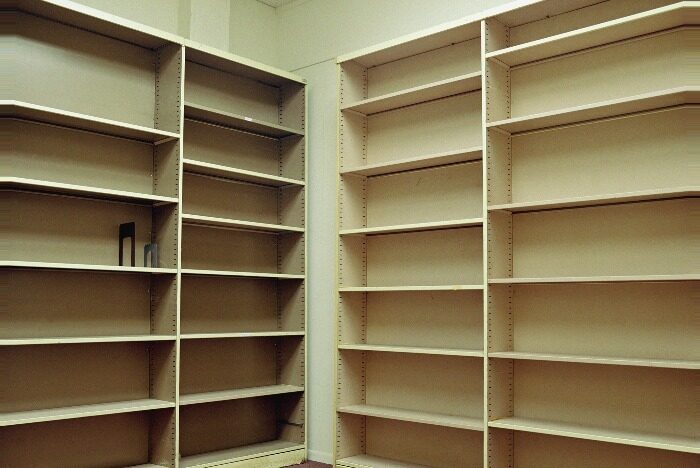
on a june day in 2018, I watched a construction loader pour thousands of books into a big green dumpster. It had appeared overnight, parked behind the library at the university where I taught English. I heard the books before I saw them; the terrible crashing sound reached me in my un-air-conditioned basement office, interrupting my own work on the manuscript of my first book, by then nearly finished. The volumes in the dumpster were being “deaccessioned,” as the practice is known in information science. The library was being renovated. Large open lounge areas would be created. And so the shelves were being cleared to make space—not for more books but for space itself.
A few months before the dumpster arrived, I had been drawn into a bitter dispute over the imperiled books. It had started with a spreadsheet from library staff naming several thousand titles that were to be eliminated from the collection due to low checkout rates. My colleagues and I were given a few weeks to identify any books we thought worth keeping. This resulted, at first, in a burst of energy. We added comments. We wrote impassioned defenses directed at the librarians doing the culling. We shared the list with our students, who checked out titles that were slated for removal—a last-ditch attempt to boost their circulation. And we agreed to take some of the rejected books ourselves, to house them in our offices or classrooms or shared campus spaces, since a state university’s property, even if it’s been deemed trash, cannot be transferred to private individuals.
My investment in the fight was personal as much as professional: the manuscript I was working on that June day was about a library—or half a library. The books it held once belonged to the writer Edith Wharton. Half of the volumes still exist today, but the other half is a ghost, with titles such as Louis Couperus’s novel Eline Vere, perhaps the chief source of inspiration for Wharton’s House of Mirth, reduced to mere entries in a spreadsheet. As I watched the big green dumpster fill with books, I saw another ghost library in the making.
There were times when the missing half seemed to speak louder than the books I held in my hands.
My obsession with Wharton’s library had emerged five years earlier, and somewhat by accident. As a graduate student in English, I had received a fellowship to the Mount, Wharton’s home in Lenox, Massachusetts, where I became convinced that to know and understand her as a writer, I had to understand her as a reader. Paging through nearly three thousand library books, I saw her talk back to them, disagree with them, question and antagonize and struggle with them. In one, she penciled the word succotash—the nineteenth-century equivalent of nonsense; on the fly of another, inscribed to her lover William Morton Fullerton, she composed a four-stanza poem that does not exist anywhere else in her own hand. These physical traces allowed me to see how she had read her books, but they also showed me where she had wilted under another writer’s power. Her underlinings and exclamation points and squiggles became an atlas by which I discerned both her evolution as a writer and her battles as a reader to understand texts written in six different languages.
I spent five summers working at the Mount, cataloguing and digitizing Wharton’s library and, all the while, learning from it. The stories it told were not just about Edith Wharton. They were also about what it means to try to know something—to arrive at knowing, to fumble for it with the help of books. Though Wharton became known as a writer of fiction, she was a reader of everything: her books spanned not just languages but subjects ranging from botany to ancient Rome. One of them, Francis Meynell’s The Week-EndBook, contained instructions for lawn games and a recipe for peanut-butter-and-olive sandwiches.
But I had to keep reminding myself that the volumes I saw on the shelves comprised only half of her collection. There were times when the missing half seemed to speak louder than the books I held in my hands. When Wharton died in 1937, without any children, her will bequeathed her library to the sons of two friends of hers. The first, William Royall Tyler, Jr., stored his half in a warehouse on the outskirts of London. The other half went to Colin Clark, who let the books molder for decades at his family castle in Kent until financial troubles prompted his brother to begin selling off chunks of it to various dealers in rare books. Clark’s half was painstakingly recovered and brought back to the Mount, but the other half was destroyed in 1941, during the London Blitz.
As I researched how the library came to be and all the many ways that Wharton used it, questions about the other half lingered. In her correspondence, she would thank a friend for the gift of a volume I could not pull off any shelf. She kept long lists of publications to be shuttled between her various homes in Massachusetts, Provence, and the Parisian suburbs, and I pored over those mini inventories, glimpsing a library I would never get to see. For even if I could reconstruct the ghost half using those documents, I couldn’t access Wharton’s engagement with it: all those penciled questions, comments, and squiggly lines—the whole record of her interactions, which had lit up the pages of her remaining books for me—would still be lost.
it was those haunting gaps in Wharton’s library that led me back to the work of the French philosopher Jacques Derrida. I had first learned about Derrida’s notoriously difficult literary theories as an undergraduate and had been pretending to understand them ever since. In Of Grammatology(1967), Derrida concentrates on the idea of the text
(a collection of ideas expressed as chains of words, or “signifiers,” as the structuralists would call them) as opposed to the book (the physical apparatus that houses the text). Both are instantiations of the process that we call writing, but the book is material, while the text is merely conceptual. The book can be destroyed; it can be burned, torn apart, or loaded into a dumpster and carted off to a landfill. But the text cannot be destroyed in the same way; it persists through interpretation and reinterpretation, always producing new meanings. By studying Wharton’s physical books, I could see from the annotations how she interpreted those texts, incorporating them into her own writing. The writer writes, according to Derrida, in order to discover what they think, including what they think about what they have read. That same writer then tries to convey those ideas to a new reader, who reads to discover what they think about what the writer thinks. But both writer and reader are playing (another favorite word of Derrida’s). Both are engaged in a game that has no end, and the text is the field or pitch or court on which it is played. Derrida calls that game deconstruction.
Without the medium, the connection between speaker and listener is broken, and the line goes dead.
But though he is best known for it, Derrida didn’t invent the process. Deconstruction is not something that one does to a text; it’s something the text does to itself. It’s an inherent feature of highly volatile processes, and one that turns physical books into objects of fantasy. Books exist to impose dreams of stability and order on the processes of reading and writing that are attached to them. The author might be living or dead. In either case, the book contains the event that is or was the text, to keep it alive and make it cohere. Or, to put it another way, the text is the ghost, while the book is the medium through which the ghost speaks. Without the medium, the connection between speaker and listener is broken, and the line goes dead.
This is why, Derrida says, there is no history without language. We humans communicate knowledge about the past through language—through conversation, through storytelling, through education, and, yes, most of all through writing, which creates a semi-coherent, semi-anchored record of that language. We present that record in the form of a book, something that can be turned to and consulted over and over again. And then, finally, we store that book in a place where we can get at it: a library. For someone like Wharton, that can mean a personal library, filled with the remnants of one’s own engagement with those texts. But since few of us can afford to build a three-thousand-volume personal library, there are also shared libraries, the public ones in our towns and schools.
That’s how a library becomes a final and crucial step on a chain of accessibility that permits contact with the text. There are, of course, other ways to gain access to the text: bookstores and classrooms and PDF files that can be downloaded, legally or not, from the internet. But those other ways place barriers—often financial, sometimes technical, sometimes physical—between the reader and the text. They introduce friction. Reading a bootleg PDF isn’t the same as reading a print book. Twenty years ago, UX researchers were already noting that in online reading, large sections of a text are skipped or scanned in accordance with digital scrolling habits. The eye, for example, tends to follow an F-shaped pattern across the screen. In 2023, researchers at the University of Valencia published the results of a study showing that print reading over sustained periods can yield a six- to eightfold increase in comprehension. From these examples, and countless others like them, we know that reading digital texts does not simply replicate the experience of reading print ones. Yet we still discount the tools that deepen comprehension in favor of those that are more convenient.
a few months after I watched the big green dumpster fill up with books, I was teaching an intro to literary theory course that included excerpts from Derrida’s Of Grammatology. At the time, I had three copies of the book in my campus office. The first was a Christmas present from my dad, given to me when I was still in graduate school; I had requested it because my professors kept talking about it, and up to that point, I had read only excerpts—the same excerpts, no doubt, that I was to later share with my own students. But in my attempts to decipher Derrida’s prose, I had filled the margins with notes that encroached on the text and made it hard to read. The second was a copy I’d bought for myself to replace the scrawled-all-over one. And the third was one I borrowed from my campus library, to save it from the dumpster.
On their first encounter with Derrida’s work, my students were as baffled as I had been. Also like me, they were intrigued; one of them decided to write her final paper on Derrida, and she went to the library to access Of Grammatology in full. But it wasn’t there; the third volume, the one I’d set aside in hopes of saving it from the dumpster, was seemingly the library’s sole copy. I gave the student my spare. But private lending is a recourse, not an answer, to the problem of access. Books in shared libraries can be moved around in accordance with borrowers’ needs, so their movement reflects the circulation of ideas that is an important facet of Derrida’s theories about the text. Books that are privately owned serve more humble and more limited objectives, and a handful of readers at most.
Our devices keep us texting, posting, and liking our lives away.
The decline of books—of their value, ubiquity, or availability—is the decline of the effort to push ideas into circulation and make knowledge matter. I left the university where I taught Derrida in 2020 and now teach at a different institute, where I am constantly under pressure to ditch the technology of the book—to give up on it. When I began my new job, I was assigned to an office that had no bookshelves. The building was new, LEED-certified, and the architects who designed it, I was told, assumed that professors no longer need or use books. I had just moved across the country with almost three thousand books, and I couldn’t fit all of them into my apartment. So I did what I had to do: I used my own money to purchase crappy particleboard bookcases, and I installed them myself. I can’t think without my books, but more importantly, I wouldn’t want to try. This is something I aim to convey to the students who visit me in my office, the ones who ask Have you really read all those books? The answer is no, I haven’t, but that’s not the point. Books are fantasies. They’re there to remind me of my own desire for more knowledge.
Most of the undergraduates in my writing classes don’t read very well. They F-pattern scroll through a Hawthorne novel or a Wharton short story. I don’t blame them, though; circumstances have conspired against them. It is much harder to read today than it was a generation ago, thanks to the omnipresence of digital distractions, and it keeps getting harder. Our devices keep us texting, posting, and liking our lives away. It looks like we’re reading, but in reality, literacy rates are in free fall. One of the biggest factors behind this trend may well be the turn away from books. At my new university, we are encouraged to adopt open educational resources (OERs), meaning open-license texts that are usually digitally accessible, in a move that is supposed to save students money. The principle here is a worthy one, and yet it simultaneously sends a message that diminishes their learning. It teaches students to discount the tools of their education and, likewise, the products of it: what they write and think in response to what they have read. What value does that work hold if books themselves have been judged as valueless?
In my classes, I try to create the kind of intellectual conditions that will allow my students to read better, meaning both more actively and more closely. That includes modeling attention to the text in class, showing them what it says on a literal level and how it works, so that they can then engage in the work of interpretation for themselves. Many of my students, including the ones who want to be writers, arrive at college having read few print books in their entirety. Sometimes they haven’t read any. But I try to train them for the futures they desire instead of maligning a past they’ve had little control over. And I invite them to stop in and see me during my office hours, where they can also see a few hundred of the books that have made me the writer I’m still becoming.
a few years ago, I attended the retirement party of an old colleague at my former university. With time to kill before the event, I made my way to the library. The renovations that had begun when I left were now complete. In place of the building I once knew was a gleaming glass-walled enclosure. The reading room, once lined with shelves, had been exsanguinated. The books were all gone, and so were the textures and colors they had once lent to the space, leaving only cold, cadaverous white.
The new library has four floors. Two of them feature books. This makes it look a lot like the library at my current university, which is so insecure about its relationship with physical books that it calls itself an “information commons.” The word commons summons a political ideal yet doesn’t disguise the fact that private space is expensive. And information offers a more neutral idea about knowledge: knowledge is something you carry with you; information is something you retrieve only if you need it.
The speed of the digital world connives to make us feel ashamed of certain sorts of slowly won knowledge. But to persist in caring about books, and to do so in the face of those who tell us not to, is to fight for a world that takes knowledge seriously. That fight will have to happen on many fronts; preserving the library alone will not rescue reading. But it is a good place to begin. After all, it is easier to preserve than it is to create. Wharton spent a lifetime building her personal library, and it took mere minutes for violence to destroy half of it.
When I revisited my former university’s library, I went looking for Of Grammatology. I spotted it on the third floor, among other books packed into a transparent cube that looms over the former reading room. It looked like the same 1976 hardback edition that I had fought to save, checked out during the deaccessioning, and then passed along to my student. Had she donated it before graduating? Or had the library changed its mind about Derrida? It was a mystery. But I hoped, given my experiences with ghost libraries, that someone would come and borrow it before too long—or before too late.
Sheila Liming is an associate professor at Champlain College in Burlington, Vermont. She is the author of several books, including Hanging Out (2023), and her essays have appeared elsewhere in venues like The Atlantic and The New York Review of Books.
Support Our Commitment to Print
Subscribe to The Yale Review. Receive four print issues a year—essays, fiction, poetry, and criticism.